TH Words for Kids: Easy Lists for Both TH Sounds
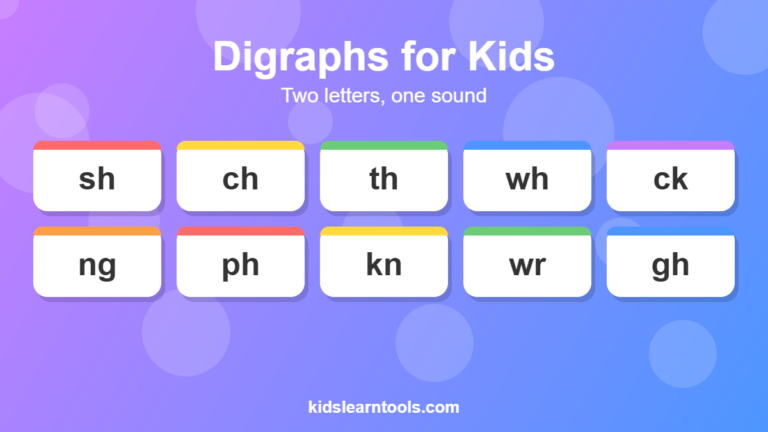
TH words are words with the letters T and H side by side, like this, thin, bath and mother. Together, T and H make one new sound, so TH is a consonant digraph. The TH digraph has two sounds: the voiced TH in this, which buzzes in the throat, and the unvoiced TH in thin, which is only air.
In this guide, you’ll find easy TH words for kids sorted by sound and by position (beginning, middle and end), plus a mouth diagram, a quick voiced-or-unvoiced flowchart, practice sentences, games and teaching tips from a classroom teacher.
What Are TH Words?
TH words are any words that use the th spelling pattern. The TH can come at the beginning of a word (three), in the middle (mother) or at the end (bath).
Kids usually meet TH words right after they learn to read CVC words like cat, sit and hop. TH is taught together with the other first digraphs, SH, CH and WH. Once a child knows TH, they can read some of the most common words in English, such as the, this, that and they.
Is TH a Digraph or a Blend?
Many parents search for “TH blends,” but TH is a digraph, not a blend. In a blend like st or bl, you can still hear both letters. In a digraph, the two letters make one new sound. You cannot hear a T or an H in the word thin.
Why Are TH Words Hard for Kids?
The TH sound is one of the later speech sounds kids learn to say clearly. There are three main reasons:
- The tongue tip has to go between the teeth, which feels strange at first.
- One spelling makes two different sounds.
- Kids often swap TH for an easier sound, like saying “fink” for think or “dis” for this.
This is a normal part of speech development. With short, daily practice, most kids get there.
Voiced vs Unvoiced TH Words: What’s the Difference?
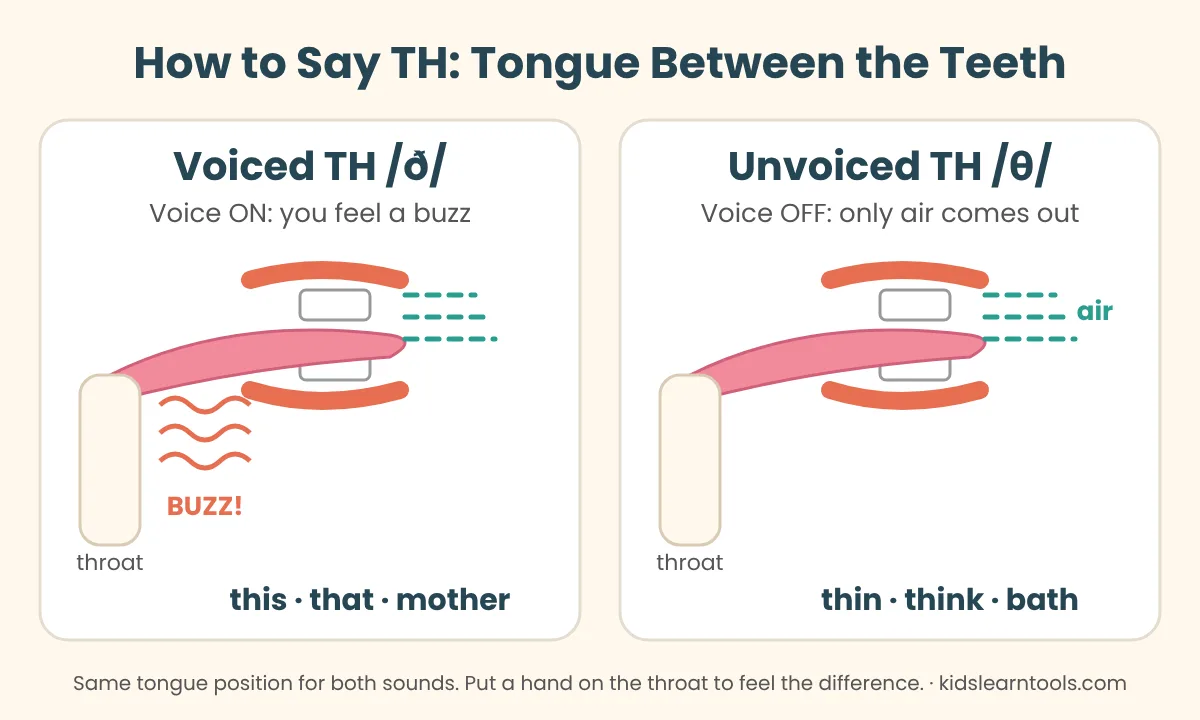
Both TH sounds use the same tongue placement. The tongue tip rests gently between the top and bottom teeth, and air flows out over the tongue. The only difference is whether the vocal cords are “on” or “off.”
| Voiced TH /ð/ | Unvoiced TH /θ/ | |
|---|---|---|
| What you hear | A buzzy sound (voice ON) | A quiet, windy sound (voice OFF) |
| Example words | this, that, mother, with | thin, think, bath, three |
| Throat test | You feel a buzz | You feel no buzz, only air |
| Kid-friendly name | “Buzzy TH” | “Windy TH” |
Try the throat test: Ask your child to put a hand on their throat and say “thhhh-is.” They will feel a buzz from the vocal cords. Then say “thhhh-in.” There’s no buzz, just air blowing out. This simple test helps kids hear and feel the difference between the two sounds.
When Does TH Make Each Sound?
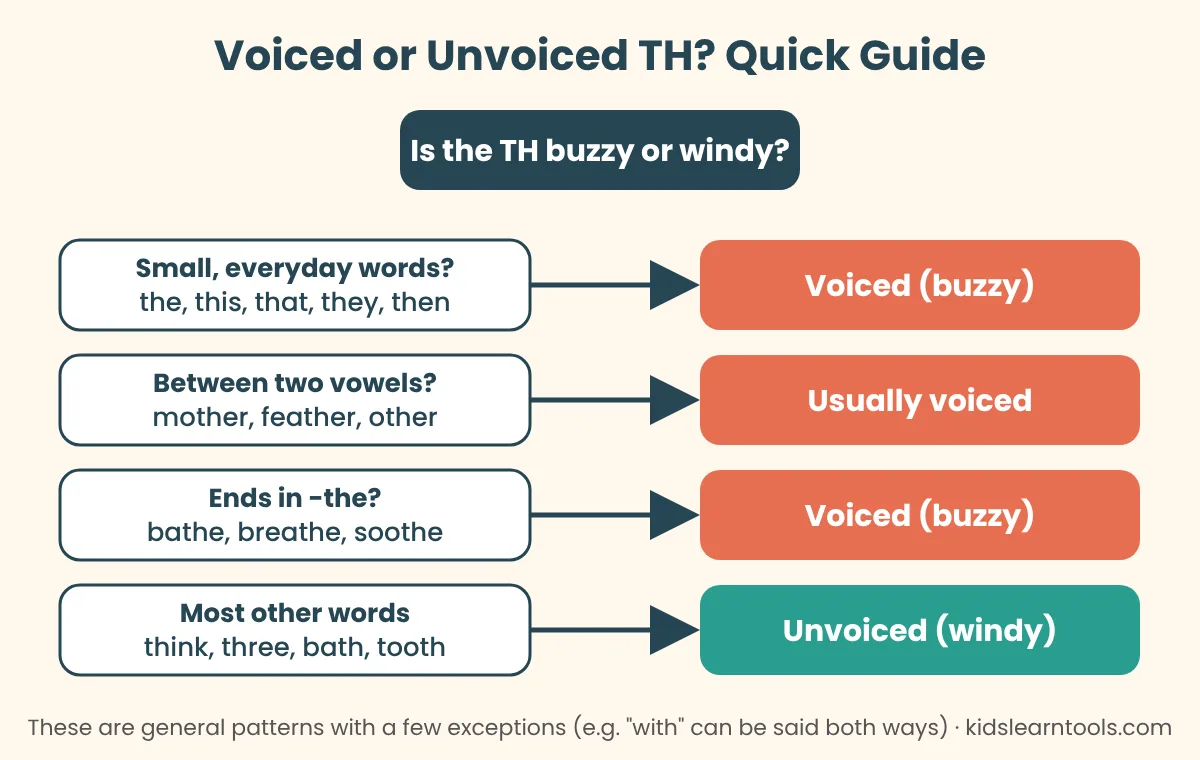
There is no perfect rule, but these patterns work for most TH words:
- Small, everyday words like the, this, that, they, them, then use the voiced TH.
- TH between two vowels, as in mother, feather, other, is usually voiced.
- Words ending in -the, like bathe, breathe, soothe, use the voiced TH.
- Most other words, including nouns and action words like think, three, thumb, bath, tooth, use the unvoiced TH.
A fun word pair for older kids is breath (unvoiced) and breathe (voiced). The extra E changes the sound.
Voiced TH Words List
Voiced TH words make the buzzy /ð/ sound. Many of them are also high-frequency sight words, so kids will see them on almost every page of a book.
Voiced TH: Beginning Sound
| the | this | that | these |
| those | them | they | then |
| there | their | than | though |
| thus | they’re | themselves | therefore |
Voiced TH: Middle Sound
| mother | father | brother | other |
| feather | weather | together | leather |
| either | rather | bother | another |
| grandmother | grandfather | northern | southern |
Voiced TH: Ending Sound
| with | smooth | breathe | bathe |
| soothe | clothe | teethe | loathe |
Unvoiced TH Words List
Unvoiced TH words make the quiet /θ/ sound. Only air comes out, with no buzz in the throat.
Unvoiced TH: Beginning Sound
| thin | think | thank | thick |
| thumb | thing | three | throw |
| thirty | thirsty | thunder | Thursday |
| thorn | thread | throat | thought |
| third | theme | thief | throne |
Unvoiced TH: Middle Sound
| birthday | nothing | bathtub | toothbrush |
| author | python | athlete | something |
| bathroom | healthy | everything | toothpaste |
Unvoiced TH: Ending Sound
| bath | math | path | moth |
| teeth | tooth | mouth | both |
| north | south | earth | month |
| cloth | fifth | sixth | tenth |
| health | breath | truth | length |
TH Words by Position: Beginning, Middle and End
Speech therapists and teachers often practice TH words by position, because a child may say TH well at the start of a word but not at the end. Use this chart to check all three positions.
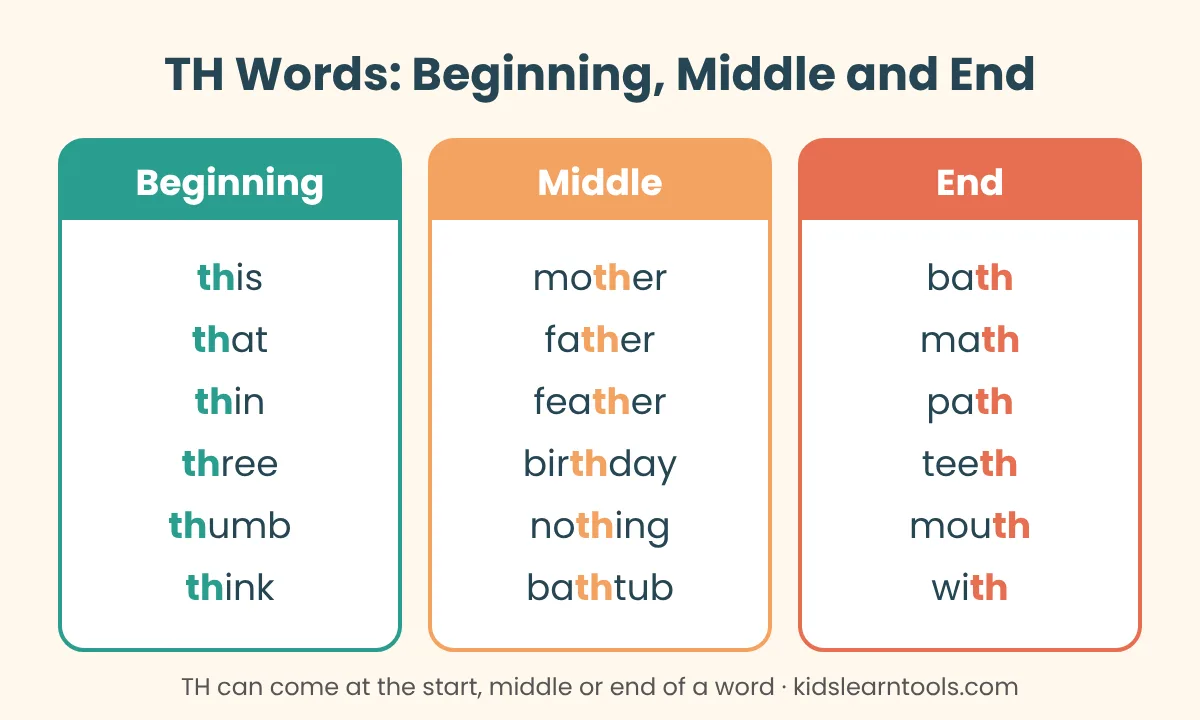
Body game: Say a word like mother or bath. Kids touch their head if the TH is at the beginning, their tummy if it’s in the middle, and their toes if it’s at the end.
Easy TH Words for Beginning Readers
For kids just starting out, choose short TH words that follow simple phonics patterns. They connect nicely with short A words and other short vowel words your child already knows.
| Short Vowel | Easy TH Words |
|---|---|
| Short a | that, than, math, bath, path |
| Short e | then, them, Beth |
| Short i | this, thin, with |
| Short o | moth, cloth |
| Short u | thud, thump, thus |
Start with this, that, thin, math, bath and moth. They are short, easy to sound out and easy to picture.
TH Words for Kindergarten (Including TH Sight Words)
Kindergarten kids should first learn the TH sight words they see in almost every book: the, this, that, they, them, then, there and with. Read them every day until kids know them on sight.
Next, add a few TH words for kindergarten that kids can sound out, like thin, math, bath, path, moth, three and thank.
| TH Sight Words | Easy TH Words to Sound Out |
|---|---|
| the, this, that, they | thin, math, bath |
| them, then, there, with | path, moth, three, thank |
If your child is still learning letter names and sounds, pair this list with our letter recognition activities and the letter sounds phonics video.
Hard TH Words for Older Kids
Once kids know the basics, challenge them with longer, multi-syllable words. These are good for first and second graders who are ready for more.
| thermometer | theater | thousand |
| throughout | thoughtful | Thanksgiving |
| arithmetic | marathon | enthusiastic |
| mathematics | sympathy | weatherman |
TH Phrases and Sentences for Kids
Reading TH words in short phrases and sentences helps kids move from sounding out single words to real reading.
Short TH Phrases
- this thing
- three thin moths
- thank you, mother
- a bath with bubbles
- the fifth birthday
Voiced TH Sentences
- This is my mother.
- They went there together.
- That feather is soft and smooth.
- My brother plays with the ball.
Unvoiced TH Sentences
- I think I lost a tooth.
- Three thin moths flew down the path.
- Thank you for the bath toy!
- We do math on Thursday.
Mixed challenge: “This thick book is the fifth one I read this month.” Ask your child to find every TH word and say whether it is buzzy or windy.
How to Teach TH Words Step by Step
Use these six steps at home or in class. Each step takes only five to ten minutes.
Step 1: Show the Tongue Placement
Sit in front of a small mirror with your child. Show how the tongue tip peeks out between the teeth. Make it silly: “Let’s stick our tongue out a tiny bit, like a sleepy snake!”
Step 2: Teach One Sound at a Time
Start with the unvoiced TH (thin, bath) because kids can hold the sound longer and practice blowing air. Add the voiced TH (this, mother) after a few days.
Step 3: Use the Throat Test
Hands on the throat. Buzz or no buzz? This turns careful listening into a game.
Step 4: Read Short Word Lists
Read five to eight words a day instead of one long list. Short, daily practice works better than one long session each week.
Step 5: Move to Phrases, Sentences and Books
Once your child can read the words alone, use the sentences above. Then go on a TH hunt in picture books and story time.
Step 6: Write and Trace TH Words
Writing helps spelling stick. Use our free letter tracing worksheets tool to make a tracing sheet with words like thin, bath and three. For more handwriting help, read our guide on how to teach a child to write letters.
Fun TH Word Games and Activities
- Buzzy or Windy Sort: Write TH words on cards. Kids sort them into two piles: voiced (buzzy) and unvoiced (windy).
- TH Treasure Hunt: Hide TH word cards around the room. Each time kids find one, they read it aloud.
- Tongue Mirror Game: Kids say a word into a mirror and check that their tongue tip is peeking out.
- Feather Blow: Hold a small feather or a piece of tissue in front of the mouth. When kids say an unvoiced TH word correctly, the air makes it move. Blowing bubbles before practice is a great warm-up too.
- TH Bingo: Make bingo cards with TH words. Call out a word, and kids cover it.
- Thumbs Up for TH: Read a mix of words. Kids give a thumbs up only when they hear a TH word.
- TH Words for Thursday: Make Thursday your “TH Day.” Kids bring one thing that starts with TH, like a thumb puppet, three toys or a thread, and say its name.
- TH Story Time: Use our writing prompt generator for kids and challenge older kids to write a short story using five TH words.
A 5-Day TH Practice Plan
Busy parents and teachers often ask how much practice is enough. This simple weekly plan takes about ten minutes a day and covers listening, speaking, reading and writing.
| Day | Focus | What to Do |
|---|---|---|
| Monday | Listening | Say pairs like fin/thin and day/they. Kids point to the TH word. |
| Tuesday | Tongue placement | Mirror practice and the throat test with five unvoiced words. |
| Wednesday | Voiced sound | Read the small sight words: the, this, that, they, them. |
| Thursday | Phrases and sentences | Read three sentences together, then play TH Bingo. |
| Friday | Writing | Trace and write six words, then use one in a sentence. |
Keep a small chart on the fridge and add a sticker after each session. Kids love seeing their progress, and a quick review at the end of the week shows which sound still needs work.
Practicing the TH Sound at Home Like a Speech Therapist
Speech therapists use a few clever tricks that parents can borrow at home. You don’t need special tools, just a little time each day.
- Start with the sound alone. Before using full words, practice a long “thhhh” like a quiet wind. Then add a vowel: “thaaa,” “theee,” “thooo.”
- Use carrier phrases. Put each word inside the same short phrase, like “I see a ___” or “I want the ___.” Repeating the phrase helps kids focus on the target sound.
- Go by syllables. Practice one-syllable words first (thin, bath), then two-syllable words (thunder, birthday), then longer words (thermometer).
- Praise the effort. Say “Great tongue!” even when the sound is not perfect yet. Confidence builds faster than correction.
- Keep sessions short. Five focused minutes after breakfast and five before bedtime work better than a 30-minute lesson.
Minimal pairs are another powerful tool. These are two words that differ by only one sound, like fought/thought, free/three, sink/think, den/then and dare/there. Say one word and ask your child which one they heard. This trains the ear before the mouth.
From My Classroom
In my eight years of teaching, many of my students who needed extra support struggled with TH because they could not feel the difference between the two sounds. Word lists alone did not help them. What worked was making the sound physical. Every student kept a small hand mirror on the desk, and we did the throat test before each reading. I also paired a confident reader with a child who was still learning, and they took turns being the “TH checker.” Week by week, students who had been saying “fink” and “dis” began reading think and this correctly, and they were proud to help each other.
My tip for parents: never say “That’s wrong.” Say “Let me see your tongue!” It keeps practice light, fun and stress-free.
Fun Facts About the TH Sound
Older kids love a little word history. Share these fun facts to make practice more interesting:
- “The” is the most common word in English. That means your child will read the voiced TH sound more often than almost any other sound.
- TH once had its own letters. Long ago, Old English used special letters called thorn (þ) and eth (ð) for this sound. Later, printers replaced them with the two letters T and H.
- Many languages don’t have the TH sound. That’s why kids learning English as a second language often find it tricky. They may say “s,” “t,” “d” or “z” instead.
- Your tongue is a key player. TH is one of the few English sounds where the tongue tip comes out past the teeth, which is why a mirror is such a helpful tool.
Common TH Mistakes and Quick Fixes
| Mistake | Example | Quick Fix |
|---|---|---|
| Saying F for unvoiced TH | “fink” for think | Tongue out first, then blow air. Check in a mirror. |
| Saying D for voiced TH | “dis” for this | Tongue between the teeth, then turn the buzz on. |
| Saying V for voiced TH | “muvver” for mother | Make sure the top teeth are not resting on the lip. |
| Reading T and H separately | “t-h-in” for thin | Teach TH as “two letters, one sound.” |
If your child still has trouble with TH after age 8, or has trouble with many speech sounds, talk to their teacher or a speech-language pathologist. ASHA’s family guide to speech sound disorders explains what is typical and when to get help. For more ideas on teaching digraphs and decoding, Reading Rockets has a helpful phonics and decoding section for parents and teachers.
Frequently Asked Questions About TH Words
What are 10 TH words for kids?
Ten easy TH words for kids are this, that, the, they, mother, thin, think, three, bath and tooth. They include both voiced and unvoiced TH sounds.
Is TH a blend or a digraph?
TH is a digraph, not a blend. In a blend like st, you hear both letters. In a digraph, two letters make one new sound, so you cannot hear a T or an H in thin.
What are the two TH sounds?
The two TH sounds are the voiced TH /ð/, as in this and mother, where the voice buzzes, and the unvoiced TH /θ/, as in thin and bath, which is only air. Both use the same tongue placement.
At what age should a child say TH correctly?
TH is one of the later sounds to develop. Many kids don’t say it clearly until around age 7 or 8, so it’s normal for younger kids to say “f” or “d” instead. If you are worried, talk to a speech-language pathologist.
What grade learns TH words?
Most kids learn to read TH words in kindergarten or first grade, right after CVC words. TH is usually taught along with the SH and CH digraphs.
What words end in TH?
Common words that end in TH are bath, math, path, moth, teeth, tooth, mouth, both, north, south, earth, month and with.
Final Thoughts
TH words are a big step in learning to read, because so many everyday words like the, this and they use them. Teach one sound at a time, use a mirror and the throat test, and practice a few words every day. When your child is ready, keep building skills with our CVC words list and the free name tracing worksheet maker.