Place Value Chart for Kids: Free Printable Charts & Easy Guide
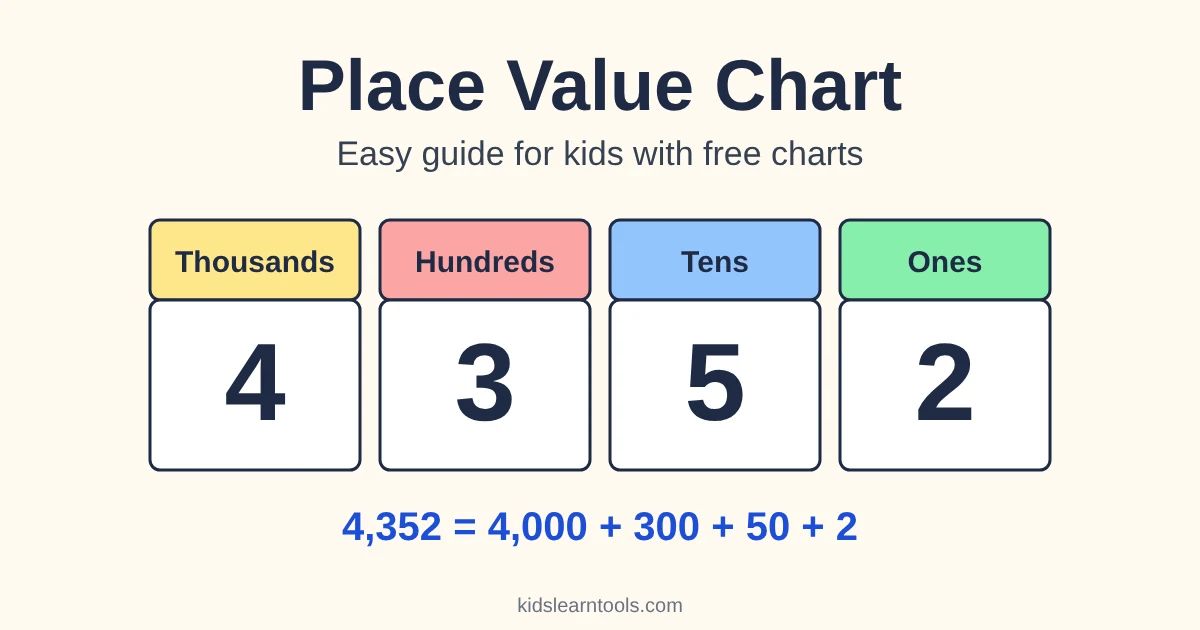
A place value chart is a simple table that shows what each digit in a number is worth. Each column has a name, such as ones, tens, hundreds and thousands, and each column is worth 10 times more than the column to its right. When a child writes 352 in a place value chart, they can see right away that the 3 means 300, the 5 means 50 and the 2 means just 2.
In this guide, you’ll find easy place value charts for kids, from tens and ones all the way up to millions and decimals. Each chart comes with a picture, a short example, and the same tips I used with my own students in eight years of classroom teaching. You’ll also get a times-ten graph, a base ten blocks diagram, games, common mistakes and practice questions with answers.
What Is a Place Value Chart?
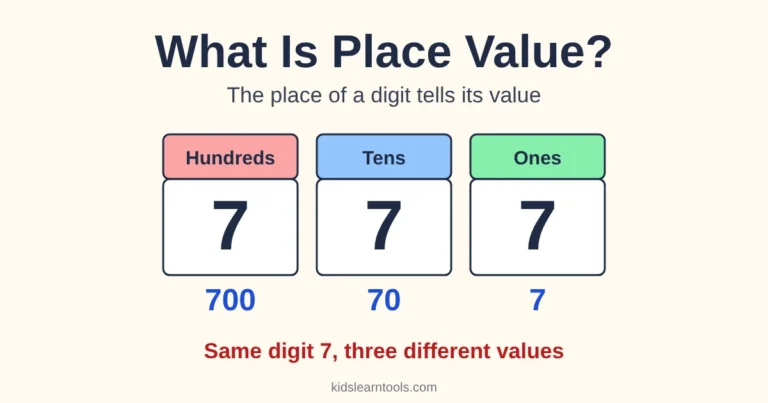
A place value chart is a grid that helps kids read, write and understand numbers. Our number system is a base ten system. That means we only use ten digits (0 to 9), and the place of a digit tells us its value. The digit 7 is worth 7 in the ones place, 70 in the tens place and 700 in the hundreds place.
The chart turns this big idea into something kids can see. Every digit gets its own column, so a child never has to guess what a digit means. That is why teachers use a place value chart from kindergarten all the way to 5th grade. New to the idea? Start with our simple guide on what place value means, with examples and teaching tips.
How It Works
- Read from right to left to name the places: ones, tens, hundreds, thousands and so on.
- Put one digit in each column. A column can hold only one digit from 0 to 9.
- Multiply the digit by its column’s value to find what it is worth. For example, 4 in the hundreds column is 4 × 100 = 400.
- Use zero as a placeholder. In 405, the 0 shows there are no tens, and it keeps the 4 in the hundreds place.
Once a child understands these four rules, they can read any whole number, no matter how big it is.
Place Value Chart for Kids: Ones, Tens and Hundreds
Most children meet place value with just two or three columns. In kindergarten, they learn tens and ones (numbers up to 99). In 1st and 2nd grade, they add the hundreds column. Here is a simple three-column chart for the number 352.
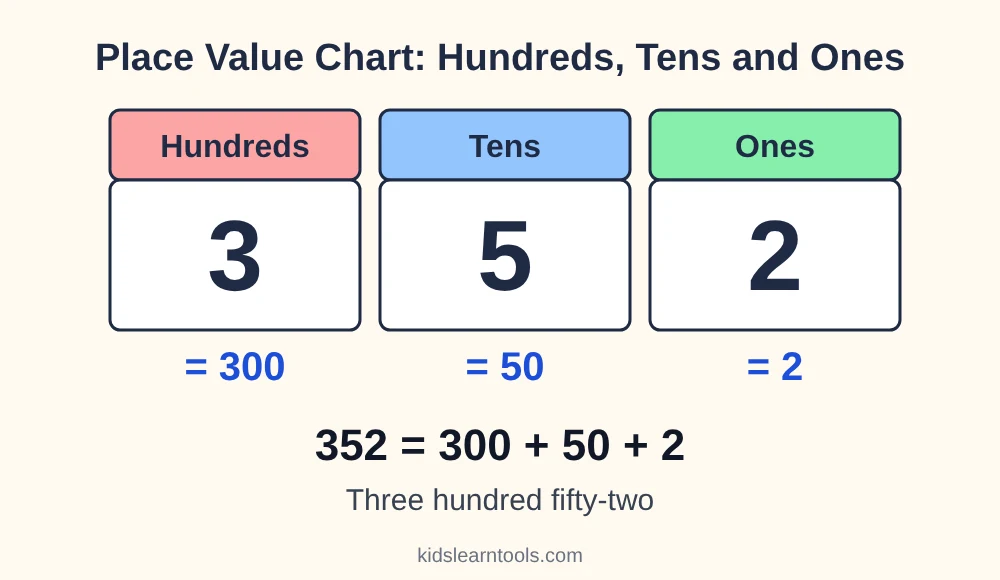
| Place | Digit in 352 | Value | How to Say It |
|---|---|---|---|
| Hundreds | 3 | 300 | 3 hundreds |
| Tens | 5 | 50 | 5 tens |
| Ones | 2 | 2 | 2 ones |
When kids add the values together (300 + 50 + 2), they get back to 352. This is called writing the number in expanded form, and it is one of the best ways to check that a child really understands each place.
Tens and Ones Chart for Kindergarten
For young kids, start with only two columns. Use real objects first: bundle 10 straws with a rubber band to make one ten, and keep single straws as ones. For the number 34, a child makes 3 bundles and 4 single straws, then writes 3 in the tens column and 4 in the ones column. Our free hundreds chart maker is also a great partner here, because each row on a hundreds chart is one new ten.
Why Each Place Is Worth 10 Times More
This is the heart of place value. Every time you move one place to the left, the value gets 10 times bigger. Every time you move one place to the right, it gets 10 times smaller. The graph below shows how fast the values grow.
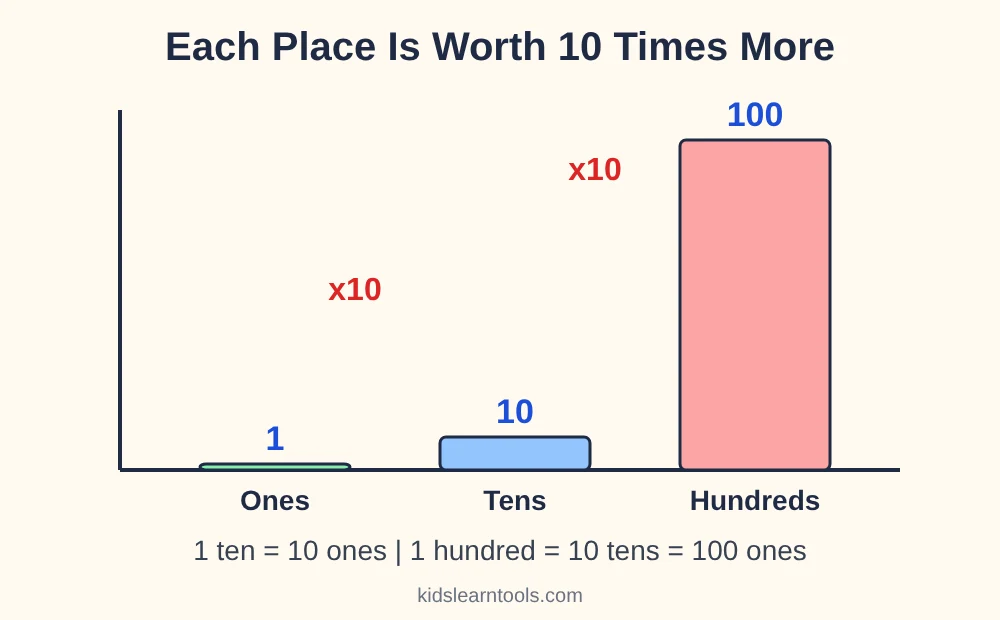
- 10 ones make 1 ten.
- 10 tens make 1 hundred (and 1 hundred is also 100 ones).
- 10 hundreds make 1 thousand.
- 10 thousands make 1 ten thousand, and the pattern keeps going forever.
This times-ten pattern is why we can write huge numbers with only ten digits. It also explains why regrouping (carrying and borrowing) works in addition and subtraction.
Place Value Chart to Thousands and Millions
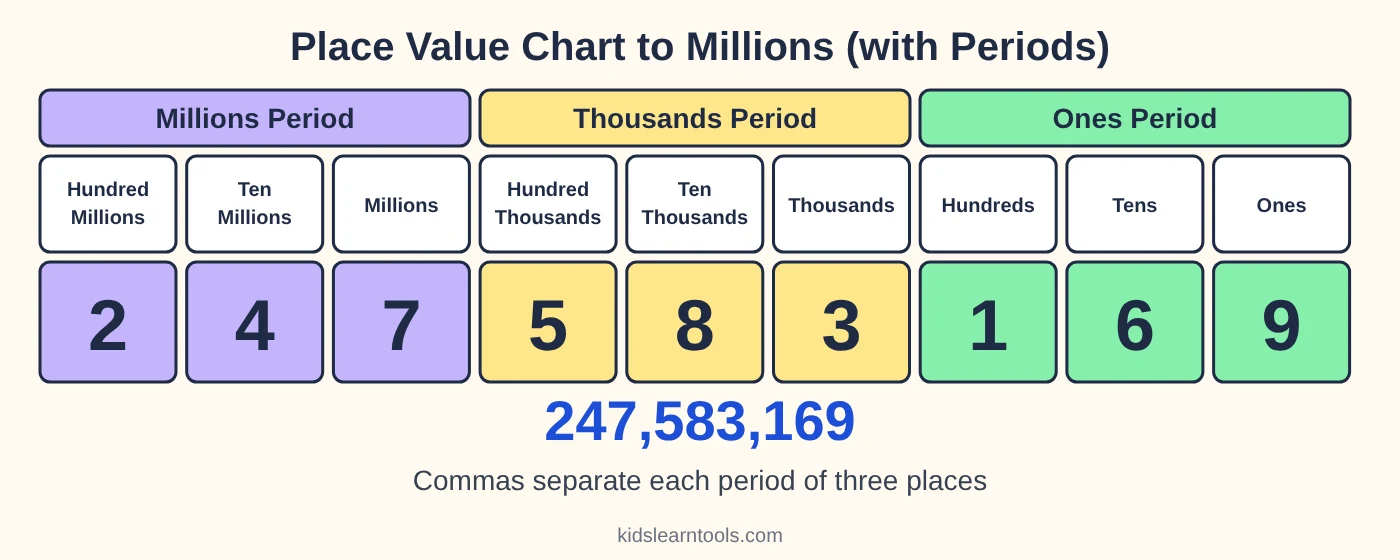
By 3rd and 4th grade, kids work with bigger numbers. A larger place value chart keeps them organized. The chart below shows 247,583,169 split into nine places.
| Place | Value of One Unit | Written as a Number |
|---|---|---|
| Ones | one | 1 |
| Tens | ten | 10 |
| Hundreds | one hundred | 100 |
| Thousands | one thousand | 1,000 |
| Ten Thousands | ten thousand | 10,000 |
| Hundred Thousands | one hundred thousand | 100,000 |
| Millions | one million | 1,000,000 |
| Ten Millions | ten million | 10,000,000 |
| Hundred Millions | one hundred million | 100,000,000 |
What Are Periods in Place Value?
In a big place value chart, the places are grouped in threes. Each group is called a period. The first three places (hundreds, tens, ones) make the ones period. The next three make the thousands period, and the next three make the millions period.
- Commas separate the periods, so 247583169 is written as 247,583,169.
- Read one period at a time, then say the period name: “two hundred forty-seven million, five hundred eighty-three thousand, one hundred sixty-nine.”
- Do not say the word “ones” at the end. We just stop after the last period.
Indian vs International Place Value Chart
Kids in the US, UK and most countries use the international place value chart, which groups digits in threes. In India and Pakistan, many schools also teach the Indian place value chart, which uses lakhs and crores. After the first three places, it groups digits in twos.
| Number | International System | Indian System |
|---|---|---|
| 1,00,000 / 100,000 | One hundred thousand | One lakh |
| 10,00,000 / 1,000,000 | One million | Ten lakh |
| 1,00,00,000 / 10,000,000 | Ten million | One crore |
Both systems use the same place values. Only the comma spots and the names change, so it helps to show children both if they will see both at school.
Decimal Place Value Chart
A decimal place value chart adds places to the right of the decimal point. These places show parts of one whole. The same times-ten rule still works: each place to the right is 10 times smaller.
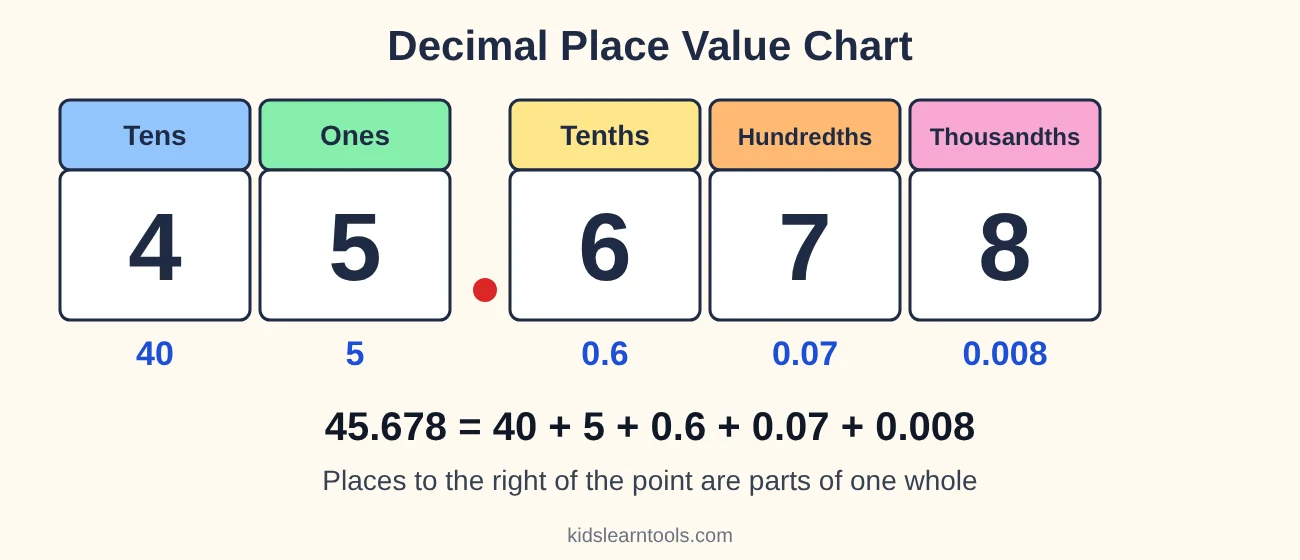
Tenths, Hundredths and Thousandths
| Place | Fraction | Decimal | Example in 45.678 |
|---|---|---|---|
| Tenths | 1/10 | 0.1 | 6 tenths = 0.6 |
| Hundredths | 1/100 | 0.01 | 7 hundredths = 0.07 |
| Thousandths | 1/1,000 | 0.001 | 8 thousandths = 0.008 |
A great tip for kids: the place names to the right of the point have a “th” at the end. Tens is a whole-number place, but tenths is a decimal place. Money is a perfect real-life example, because $4.25 means 4 dollars, 2 dimes (tenths of a dollar) and 5 pennies (hundredths).
Comparing Decimals with a Chart
Children often think 0.45 is bigger than 0.5 because 45 is bigger than 5. A place value chart clears this up fast. Line up the decimal points, then compare from left to right:
- 0.5 has 5 tenths.
- 0.45 has only 4 tenths.
- Since 5 tenths is more than 4 tenths, 0.5 is bigger. You can add a zero (0.50) to make the comparison even easier to see.
How to Use a Place Value Chart Step by Step
Here is a simple routine you can follow with any number. I suggest saying each step out loud with your child the first few times.
- Step 1 – Read the number. Say it aloud, for example 6,208.
- Step 2 – Start at the ones. Write the last digit (8) in the ones column.
- Step 3 – Move left one place at a time. Put 0 in tens, 2 in hundreds and 6 in thousands.
- Step 4 – Find each value. 6,000 + 200 + 0 + 8.
- Step 5 – Check with expanded form. Add the values back together to get 6,208.
- Step 6 – Ask a question. “What is the value of the 2?” (200) or “Which digit is in the tens place?” (0).
From My Classroom: Colour the Columns, Not the Digits
When I first used a plain black-and-white place value chart, several of my slower learners kept writing 306 as 3 | 6 | 0. They knew the digits but not where each one belonged. What helped most was giving every column its own colour, the same colour every day: blue for hundreds, green for tens and orange for ones. After a week, children would say “the 6 goes in orange” before they said “ones”, and that was enough to stop the mix-ups.
- Keep the colours the same on the chart, the blocks and the worksheet.
- Let kids build the number with real blocks before they write it.
- Always include one number with a zero, so the empty tens or ones column is talked about, not skipped.
Place Value vs Face Value
These two terms are easy to mix up, so it is worth teaching them side by side.
- Face value is the digit itself. In 5,632, the face value of 6 is just 6.
- Place value is what the digit is worth in its spot. In 5,632, the place value of 6 is 600.
- Zero is special: its face value and place value are always 0, but it still holds a place.
Expanded Form, Standard Form and Word Form
A place value chart makes it easy to switch between the three ways we write numbers.
| Form | What It Means | Example (3,415) |
|---|---|---|
| Standard form | The usual way we write numbers | 3,415 |
| Expanded form | The value of each digit added together | 3,000 + 400 + 10 + 5 |
| Word form | The number written in words | three thousand, four hundred fifteen |
Older kids can also try expanded notation, which shows the multiplication: (3 × 1,000) + (4 × 100) + (1 × 10) + (5 × 1).
Place Value with Base Ten Blocks
Before kids work with numbers on paper, it helps to let them hold the numbers in their hands. Base ten blocks are small cubes, rods and flats that match the columns of a place value chart.
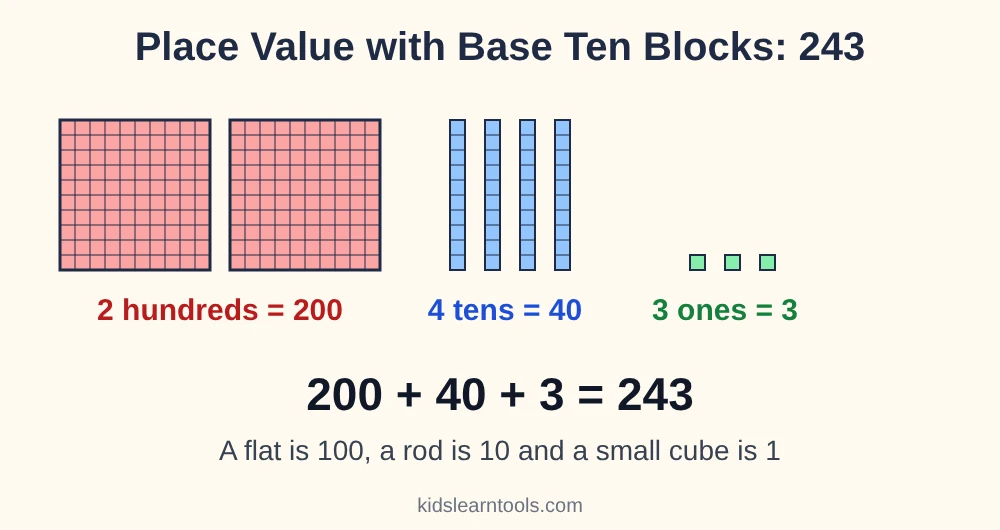
- Unit cube = 1 (ones)
- Rod = 10 cubes joined together (tens)
- Flat = 10 rods, or 100 cubes (hundreds)
- Big cube = 10 flats, or 1,000 cubes (thousands)
Ask your child to build a number with blocks, then write it in the chart. If you don’t have blocks, draw them: a square for a hundred, a line for a ten and a dot for a one. Studies on early math, such as the guidance from the National Council of Teachers of Mathematics, show that hands-on models like these help children build a strong number sense.
Place Value Chart by Grade
Every child learns at their own pace, but this table shows what is usually covered in each US grade, based on the Common Core math standards.
| Grade | Places Covered | Key Skill |
|---|---|---|
| Kindergarten | Tens and ones (11–19) | See teen numbers as ten ones plus some more ones |
| 1st Grade | Tens and ones (to 120) | Count, read and write numbers; compare two-digit numbers |
| 2nd Grade | Hundreds, tens, ones (to 1,000) | Expanded form, skip count by 5s, 10s and 100s |
| 3rd Grade | To thousands | Round to the nearest 10 or 100 |
| 4th Grade | To millions | Read, write and compare multi-digit numbers |
| 5th Grade | Millions to thousandths | Decimal place value, powers of 10 |
Fun Place Value Activities and Games
Kids remember place value best when they play with it. Here are some of my favorite classroom games that also work well at home.
- Roll and build: Roll a die three times. Place each number in the chart to make the biggest (or smallest) number you can.
- Place value war: Each player flips three playing cards (aces = 1, face cards removed) and builds a number. The biggest number wins the cards.
- Human place value chart: Give each child a digit card. Ask them to stand in order to make a number, then swap two kids and read the new number.
- Money match: Use pennies, dimes and dollar bills as ones, tens and hundreds.
- Mystery number: “I have 4 hundreds, 0 tens and 7 ones. What am I?” (407)
- Worksheet practice: Use our free math worksheet generator to make quick practice pages.
Younger kids who are still learning to count can warm up with our counting song for kids before moving on to tens and ones.
Keep building number sense:
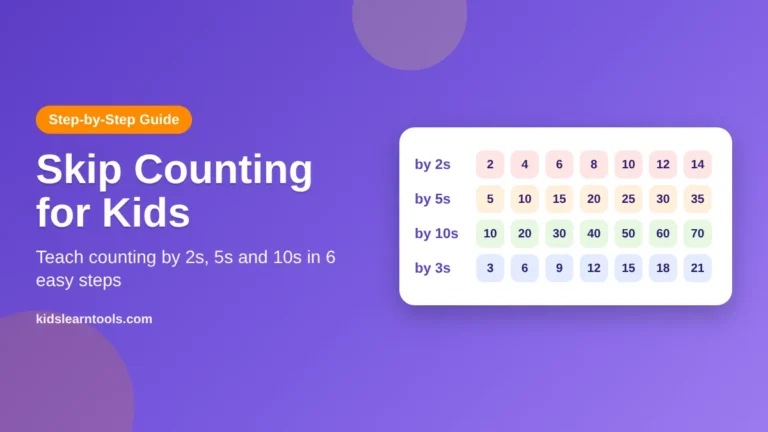
- Practise counting in tens with our skip counting guide for kids, the fastest way to make the tens column feel natural.
- Try these hundreds chart activities to see how each row on a hundreds chart is one more ten.
- Learn how numbers split into parts with number bonds to 5, 10 and 20, a natural step before expanded form.
- Make your own custom chart with the free Hundreds Chart Maker.
Common Place Value Mistakes and Quick Fixes
- Forgetting the zero. A child writes “four hundred five” as 45. Fix: write it in a chart first, so the empty tens column needs a 0.
- Reading digits, not values. A child says the 3 in 380 is worth 3. Fix: always ask, “3 what? 3 ones, 3 tens or 3 hundreds?”
- Mixing up tens and tenths. Fix: point out the “th” sound and the decimal point every time.
- Thinking longer decimals are bigger. Fix: line up the decimal points and compare place by place.
- Putting commas in the wrong place. Fix: count three places from the right for each period.
Free Printable Place Value Charts
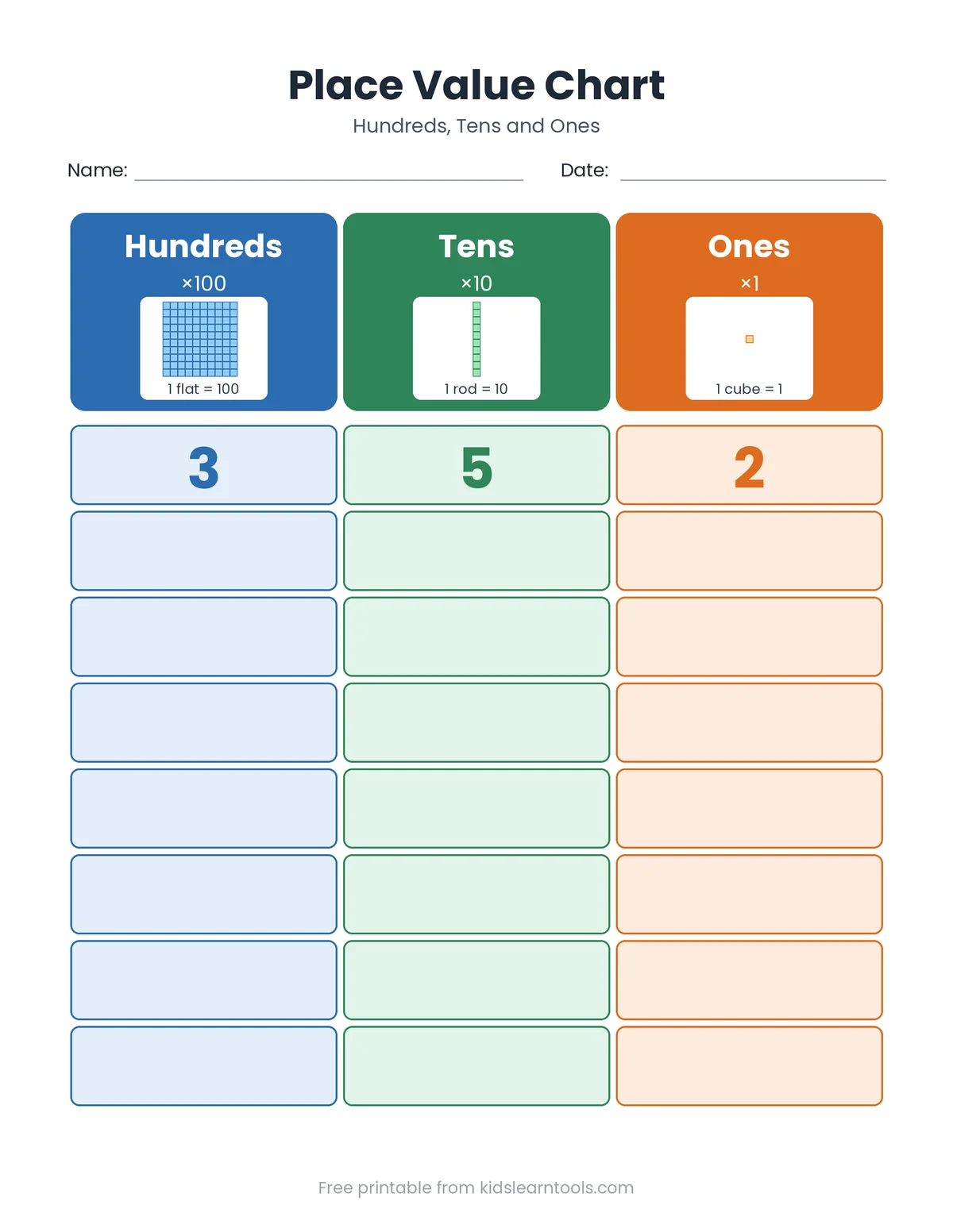
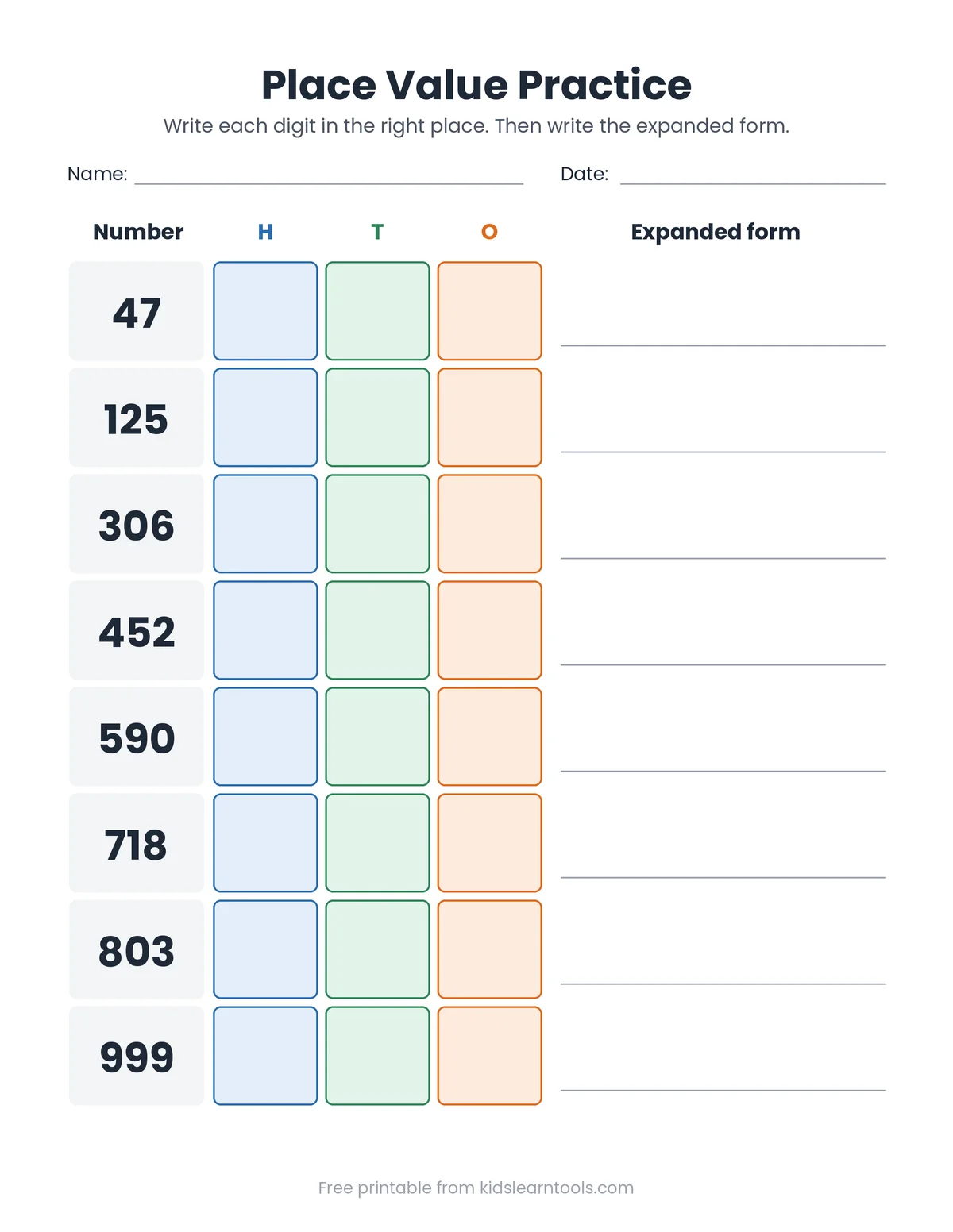
Download a free printable place value chart (PDF, 4 pages) for hundreds, tens and ones. The pack includes a chart with a worked example, a blank chart, a practice worksheet and an answer key. It prints on US Letter paper and also fits A4 if you choose “Fit to page”.
| Page | What it is | Best for |
|---|---|---|
| Page 1 | Hundreds, tens and ones chart with one example row | First lesson: show how 352 fits in the chart |
| Page 2 | Blank place value chart (8 rows) | Daily practice, dry-erase sleeve, dice games |
| Page 3 | Practice worksheet: 8 numbers + expanded form | Kindergarten to 2nd grade independent work |
| Page 4 | Answer key | Parents and teachers checking work quickly |
How to Use the Printable Place Value Chart
- Say the number first. Your child reads the number aloud, for example “four hundred fifty-two”.
- Start from the right. Write the last digit in Ones, the middle digit in Tens and the first digit in Hundreds.
- Check the picture. Each column header shows a flat (100), a rod (10) or a cube (1), so kids can see the size of each place.
- Write the expanded form. 452 becomes 400 + 50 + 2. This is the bridge to adding and subtracting with regrouping.
- Use zero on purpose. Numbers like 306, 590 and 803 are on the worksheet to practise zero as a placeholder.
You can also save any other chart image on this page (right-click, or press and hold on a phone) and print it. For longer use, slide the sheet into a plastic sleeve and let your child write with a dry-erase marker. Here is which chart to use:
- Hundreds, tens and ones chart: best for kindergarten to 2nd grade.
- Chart to millions: great for 3rd and 4th grade big-number practice.
- Decimal place value chart: perfect for 4th and 5th grade decimals and money.
- Base ten blocks picture: helpful for visual learners and kids who need a model.
Want more free printables? Browse all of our free learning tools for kids, including a printable 1 to 100 hundreds chart.
Place Value Practice Questions with Answers
Try these with your child. Use a place value chart for each one, then check the answers below.
- What is the value of 8 in 4,872?
- Write 6,000 + 500 + 9 in standard form.
- Which digit is in the hundreds place in 31,642?
- Write 2.36 in expanded form.
- Which is bigger, 0.7 or 0.65?
- How many tens are in 300?
Answers:
- 800
- 6,509 (there are no tens, so the tens place is 0)
- 6
- 2 + 0.3 + 0.06
- 0.7, because 7 tenths is more than 6 tenths
- 30 tens
Frequently Asked Questions
What is a place value chart?
A place value chart is a table with columns such as ones, tens, hundreds and thousands. Each digit of a number goes in its own column, so kids can see what that digit is worth.
What are the place values in order?
From right to left, the whole-number place values are ones, tens, hundreds, thousands, ten thousands, hundred thousands, millions and so on. To the right of the decimal point, they are tenths, hundredths and thousandths.
How do you explain place value to a child?
Start with real objects. Bundle 10 straws to make a ten and keep single straws as ones. Then show the same number in a place value chart. Keep saying, “The place tells us the value.”
What does a place value chart look like?
It looks like a row of labeled boxes. The labels (ones, tens, hundreds) sit at the top, and one digit goes in each box below. Bigger charts group the boxes into periods of three, separated by commas.
What is the difference between place value and face value?
Face value is the digit itself. Place value is what the digit is worth in its position. In 752, the face value of 5 is 5 and its place value is 50.
What grade learns place value?
Kids start with tens and ones in kindergarten and 1st grade, move to hundreds in 2nd grade, reach millions in 4th grade, and learn decimal place value in 5th grade.
Final Thoughts
A place value chart is one of the most useful tools in early math. It turns an abstract idea into something kids can see, touch and talk about. Start small with tens and ones, use real objects and base ten blocks, and move to thousands, millions and decimals only when your child is ready. Print a chart from this page, keep it on the fridge or the homework table, and practice for just five minutes a day. You will be amazed at how quickly the numbers start to make sense.