Skip Counting for Kids: What It Is and How to Teach It (Step-by-Step)
Skip counting is counting forward or backward by a number other than 1, such as 2, 4, 6, 8 or 5, 10, 15, 20. It is a form of repeated addition, and it is the bridge between simple counting and multiplication. Most kids learn to skip count by 10s in kindergarten and by 2s, 5s and 100s by grade 2. This guide explains what skip counting is, why it matters, and a simple six-step way to teach it at home or in class.
What Is Skip Counting in Math?
In math, skip counting means adding the same number again and again and saying only the totals. When you count by 5s, you are adding 5 each time: 5, 10, 15, 20. The numbers you say are called multiples of 5.
Skip counting can:
- Start at zero or any number. Counting by 3s from 4 gives 4, 7, 10, 13.
- Go forward or backward. Counting back by 10 from 100 gives 100, 90, 80, 70.
- Use any step size. 2s, 3s, 4s, 5s, 10s and 100s are the most common.
Skip Counting Chart (2s to 10s)
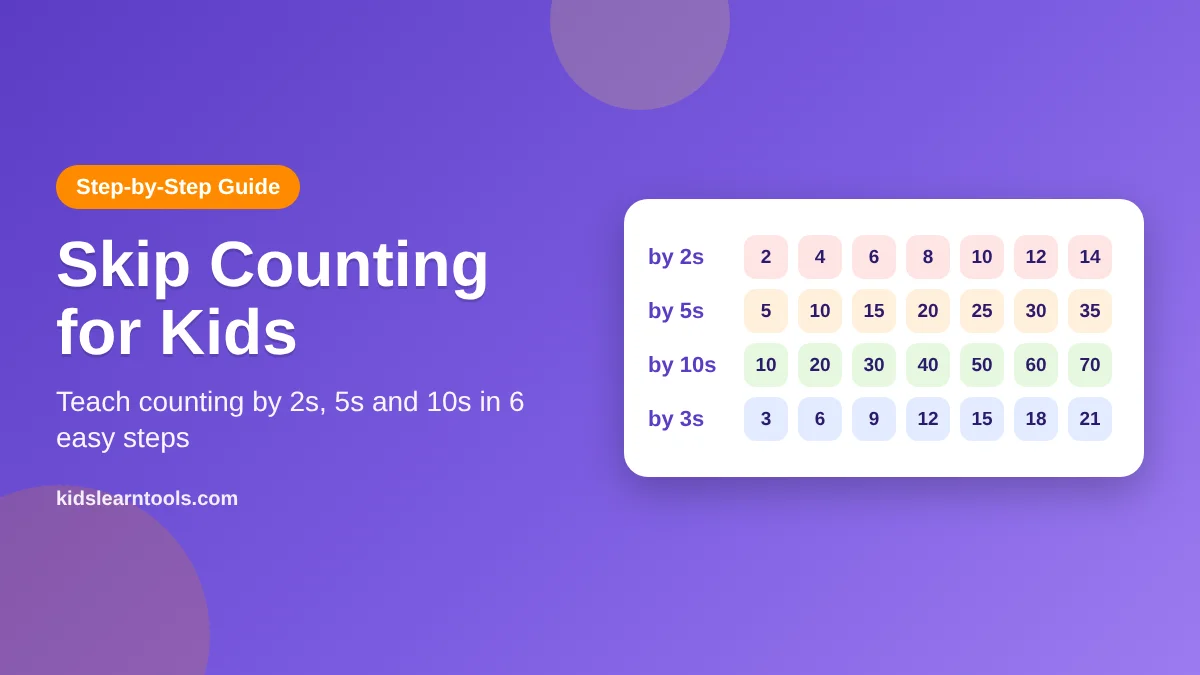
Use this skip counting chart as a quick reference. Each row shows the first ten multiples of one number.
| Count by | 1st | 2nd | 3rd | 4th | 5th | 6th | 7th | 8th | 9th | 10th |
|---|---|---|---|---|---|---|---|---|---|---|
| 2s | 2 | 4 | 6 | 8 | 10 | 12 | 14 | 16 | 18 | 20 |
| 3s | 3 | 6 | 9 | 12 | 15 | 18 | 21 | 24 | 27 | 30 |
| 4s | 4 | 8 | 12 | 16 | 20 | 24 | 28 | 32 | 36 | 40 |
| 5s | 5 | 10 | 15 | 20 | 25 | 30 | 35 | 40 | 45 | 50 |
| 6s | 6 | 12 | 18 | 24 | 30 | 36 | 42 | 48 | 54 | 60 |
| 7s | 7 | 14 | 21 | 28 | 35 | 42 | 49 | 56 | 63 | 70 |
| 8s | 8 | 16 | 24 | 32 | 40 | 48 | 56 | 64 | 72 | 80 |
| 9s | 9 | 18 | 27 | 36 | 45 | 54 | 63 | 72 | 81 | 90 |
| 10s | 10 | 20 | 30 | 40 | 50 | 60 | 70 | 80 | 90 | 100 |
Why Is Skip Counting Important?
- It is the base of multiplication. Counting 5, 10, 15 gives the answers to 5 × 1, 5 × 2 and 5 × 3. Kids who skip count well learn times tables faster.
- It makes counting faster. Counting 40 objects in groups of 10 takes 4 steps instead of 40.
- It builds number sense. Kids see that numbers grow in steady patterns.
- It is used every day. Telling time by 5-minute steps, counting nickels and dimes, and sharing things into equal groups all use skip counting.
- It prepares kids for division. Counting back in equal steps is the first idea of sharing and dividing.
When Do Kids Learn Skip Counting?
| Age / Grade | What kids learn | Common Core standard |
|---|---|---|
| 4–6 years (Pre-K–K) | Rote skip counting by 10s through songs and chants | K.CC.1: count to 100 by ones and by tens |
| 6–7 years (Grade 1) | Skip counting by 2s, 5s and 10s with objects; 10 more and 10 less | 1.NBT.5: mentally find 10 more or 10 less |
| 7–8 years (Grade 2) | Skip counting by 5s, 10s and 100s within 1000 | 2.NBT.2: skip-count by 5s, 10s and 100s |
| 8–9 years (Grade 3) | Skip counting by 3s, 4s, 6s to learn times tables | 3.OA.7: multiply and divide within 100 |
These grade levels follow the Common Core math standards. Before starting, a child should count to at least 50 by ones and recognize the numbers on a hundreds chart.
How to Teach Skip Counting in 6 Steps
The best order follows the concrete → pictorial → abstract approach: first real objects, then pictures and charts, then numbers only.
Step 1: Start With Real Objects (Equal Groups)
Give your child buttons, blocks or pasta. Ask them to make equal groups of 2 on small plates, then count the plates together: “2, 4, 6, 8.” Touching each group shows that one number stands for a whole group, not one item.
Step 2: Count by 10s First
Counting by 10s has the easiest pattern because only the tens digit changes: 10, 20, 30, 40. Use two hands of fingers, bundles of 10 straws or ten-frames. When your child can count to 100 by 10s, move on.
Step 3: Move to 5s, Then 2s
Counting by 5s always ends in 5 or 0, so kids can hear the pattern. Use one hand (5 fingers) or nickels. Next, teach 2s with pairs of socks, shoes or eyes. Spend a few days on each pattern before mixing them.
Step 4: Show the Pattern on a Hundreds Chart and Number Line
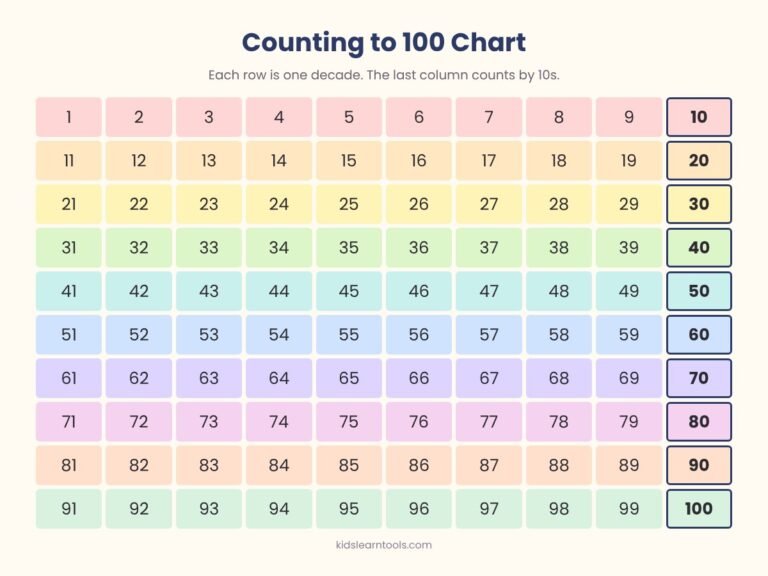
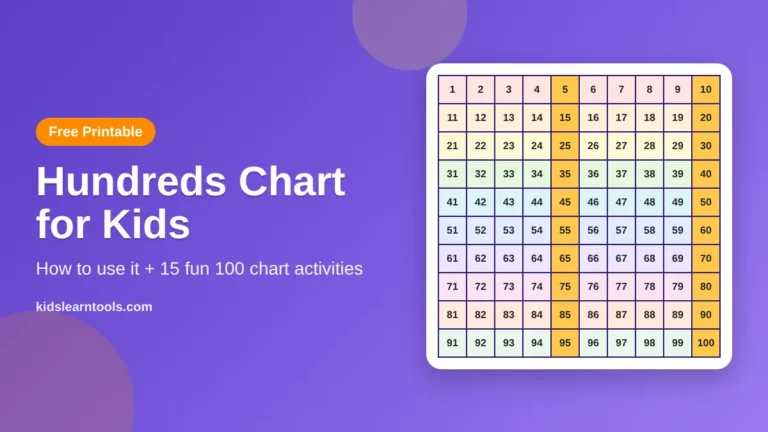
Print a hundreds chart and color every number your child says. Counting by 10s colors one column, 5s colors two columns and 2s makes stripes. Then draw a number line and show each count as an equal jump. Both pictures help kids check their own answers. For more chart ideas, see our hundreds chart activities.
Step 5: Add Songs, Rhythm and Movement
Kids remember rhythm better than lists. Try these:
- Whisper and shout: Whisper the numbers in between and say the skip-count numbers loudly (1, 2, 3, 4…).
- Hopscotch counting: Jump on every 5th square and call out the number.
- Ball toss: Toss a ball around a circle; each child says the next number in the pattern.
- Skip counting songs: Sing the numbers to a tune your child already knows, a few minutes each day.
Step 6: Practice With Worksheets, Word Problems and Multiplication
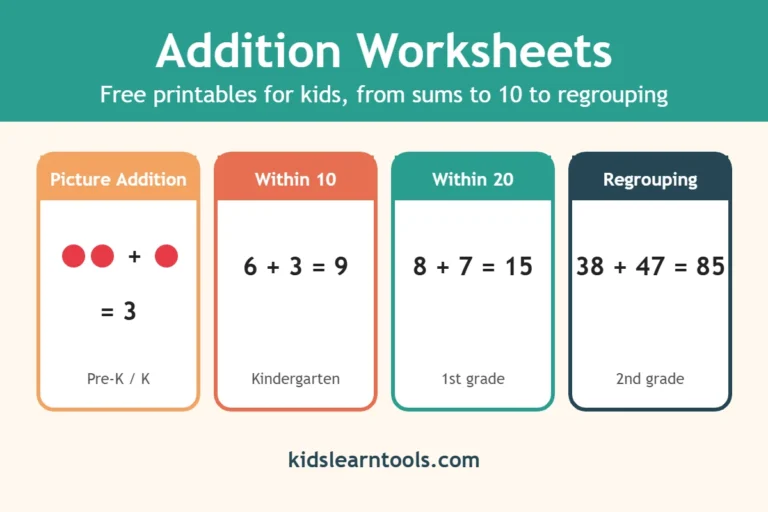
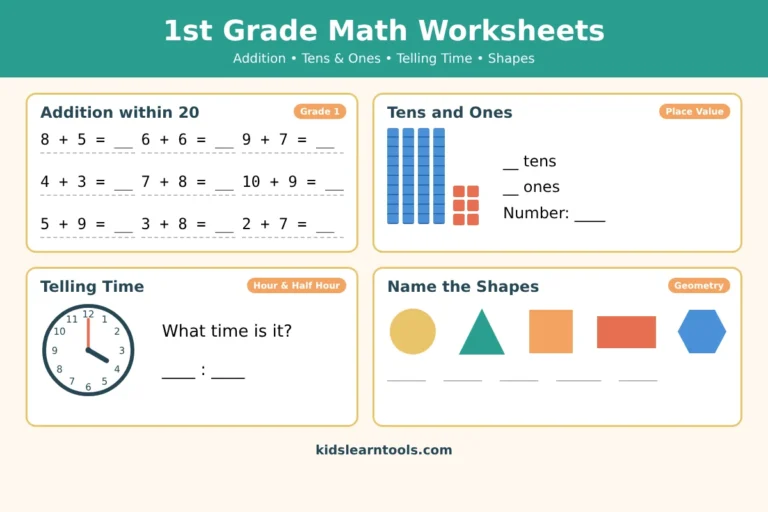
When the patterns feel easy, move to paper. Fill-in-the-blank number sequences (5, 10, __, 20), skip counting backwards, and short word problems connect the skill to real math. Then show how skip counting builds times tables: 4 groups of 3 is 3, 6, 9, 12, so 4 × 3 = 12. Our free Math Worksheet Generator can make fresh skip counting worksheets and multiplication practice whenever you need them. Our kindergarten math worksheets pack is a good starting point for younger kids.
Skip Counting Examples
Example 1: Skip count by 5
Start at 0 and add 5 each time: 5, 10, 15, 20, 25, 30.
Example 2: Skip count by 3, starting at 4
Not every pattern starts at zero. Start at 4 and add 3: 4, 7, 10, 13, 16, 19.
Example 3: Skip count by 100
Add 100 each time: 100, 200, 300, 400, 500. Only the hundreds digit changes.
Example 4: Skip count backwards by 10
Start at 95 and take away 10 each time: 95, 85, 75, 65, 55.
Example 5: Word problem
Mia has 6 pairs of socks. How many socks does she have? Skip count by 2 six times: 2, 4, 6, 8, 10, 12. Answer: 12 socks.
Skip Counting Activities at a Glance
| Activity | Level | Materials | Time |
|---|---|---|---|
| Equal groups on plates | Beginner | Buttons, blocks or pasta | 5 min |
| Finger counting by 5s and 10s | Beginner | Hands | 2 min |
| Hundreds chart coloring | Beginner–Intermediate | Printed chart, crayons | 10 min |
| Whisper and shout | Intermediate | None | 3 min |
| Number line jumps | Intermediate | Paper number line | 5 min |
| Skip counting maze (follow 2, 4, 6…) | Intermediate | Printed maze | 10 min |
| Fill-in-the-blank sequences | Advanced | Worksheet | 10 min |
| Word problems and times tables | Advanced | Worksheet | 10 min |
For a fun twist, print a maze from our Printable Maze Generator and write skip-count numbers along the correct path.
Common Skip Counting Mistakes and How to Fix Them
- Chanting without understanding. Some kids say “5, 10, 15” like a song but cannot explain it. Fix: return to real objects for a minute.
- Always starting at zero. Kids get stuck when a pattern starts at 4 or 7. Fix: practice starting from different numbers on the hundreds chart.
- Losing track after 50. Fix: keep the hundreds chart or number line in view until the pattern feels natural.
- Mixing patterns. Kids may switch from 5s to 10s by mistake. Fix: practice one pattern a day at first.
- Skipping backward counting. Fix: count back by 10s and 5s once kids can count forward, as it prepares them for subtraction and division.
From My Classroom
In my eight years of teaching, I found that children who struggled with math often memorized skip counting as a chant without seeing what it meant. With these children, I always began with real objects and grouped them into small peer groups, where each child counted one pile aloud. Coloring the pattern on a hundreds chart came next, and only then did we move to worksheets. That slow, hands-on order gave struggling children the confidence to join in, and many of them later picked up their times tables faster than expected.
Practice Questions (With Answers)
- Count by 2s: 14, 16, __, 20. (18)
- Count by 5s: 35, 40, __, 50. (45)
- Count back by 10s: 80, 70, __, 50. (60)
- Count by 3s from 1: 1, 4, 7, __. (10)
- How many fingers are on 7 hands? (35)
Skip Counting on a Number Line
A number line shows skip counting as equal jumps, which helps kids see that every jump is the same size. It is also the model kids will use later for multiplication and division.
- Draw a line and mark 0 to 20 (or 0 to 50 for counting by 5s).
- Start at 0 and draw a curved “hop” to the first number in the pattern.
- Write the size of each hop above it, such as +4.
- Keep hopping and say each number out loud.
- Count the hops at the end. Five hops of 4 land on 20, so 5 × 4 = 20.
Example: skip count by 4s. 0 → 4 → 8 → 12 → 16 → 20. Each hop is +4, and there are 5 hops. Once kids are confident, start at a number other than zero, such as 3 → 7 → 11 → 15.
Skip Counting Patterns Kids Can Discover
Every skip counting sequence has a hidden pattern in its ones digits. Spotting these patterns helps kids self-check their answers and makes times tables easier to remember.
| Count by | First numbers | Pattern to notice |
|---|---|---|
| 2s | 2, 4, 6, 8, 10, 12 | Ones digits repeat 2, 4, 6, 8, 0. Every number is even. |
| 5s | 5, 10, 15, 20, 25 | Ones digits take turns: 5, 0, 5, 0. |
| 10s | 10, 20, 30, 40 | The ones digit is always 0; only the tens digit grows. |
| 4s | 4, 8, 12, 16, 20 | Ones digits repeat 4, 8, 2, 6, 0. |
| 9s | 9, 18, 27, 36, 45 | The tens digit goes up by 1 while the ones digit goes down by 1. |
| 3s | 3, 6, 9, 12, 15, 18 | The digits add up to 3, 6 or 9 (1 + 2 = 3, 1 + 5 = 6, 1 + 8 = 9). |
Try coloring each pattern on a printable hundreds chart using the skip counting highlight. Counting by 9s makes a diagonal line from the top right corner down to the left.
Skip Counting With Money and Time
Real-life practice shows kids why skip counting matters. Two everyday topics use it all the time:
- Counting coins: Count nickels by 5s (5, 10, 15 cents), dimes by 10s (10, 20, 30 cents) and quarters by 25s (25, 50, 75, 100 cents). Lay real coins in a row and count them together.
- Telling time: Each number on a clock stands for 5 minutes. Kids skip count by 5s around the clock face to read the minutes: 5, 10, 15, 20 and so on up to 60.
- Everyday groups: Count wheels on cars by 4s, legs on spiders by 8s, or eggs in a carton by 2s across each row.
Easy Skip Counting Chants You Can Make Up
You don’t need a special song. Pick a tune your child already loves and fit the numbers to it, or use a simple clapping chant. Here is an original chant for counting by 5s:
“Five, ten, clap again! Fifteen, twenty, high five plenty! Twenty-five, thirty, hands up high, I can count by fives, oh my!”
Say the chant while clapping or marching. Then ask your child to make up a chant for 2s or 10s. Kids remember a pattern much better when they invent the words themselves.
A 5-Day Skip Counting Practice Plan
| Day | Focus | Activity (5–10 minutes) |
|---|---|---|
| Day 1 | Count by 10s | Make bundles of 10 straws and count the bundles to 100. |
| Day 2 | Count by 5s | Trace hands on paper and count the fingers by 5s. |
| Day 3 | Count by 2s | Line up pairs of socks or shoes and count them by 2s. |
| Day 4 | Mixed review | Color 2s, 5s and 10s on three hundreds charts and compare the patterns. |
| Day 5 | Count backwards | Count back from 100 by 10s, then from 50 by 5s, using the chart. |
Repeat the plan for a second week with 3s and 4s once your child is confident with 2s, 5s and 10s.
Once your child can skip count by 10s, a great next step is number bonds to 10 and 100. Both skills use the same “make a ten” thinking, so they support each other.
Frequently Asked Questions
What is skip counting?
Skip counting is counting by a number other than 1, such as 2, 5 or 10. Each number you say is the last one plus the same amount, so it works like repeated addition.
What should kids skip count by first?
Start with 10s, then 5s, then 2s. Counting by 10s has the simplest pattern, so it builds confidence before the harder ones.
At what age do kids learn skip counting?
Most kids start counting by 10s at age 5 to 6 (kindergarten), learn 2s and 5s by age 6 to 7 (grade 1), and count by 5s, 10s and 100s to 1,000 in grade 2.
How is skip counting related to multiplication?
Skip counting gives the answers to times tables in order. Counting 3, 6, 9, 12 gives 3 × 1, 3 × 2, 3 × 3 and 3 × 4.
Can you skip count backwards?
Yes. Skip counting backwards means taking away the same number each time, such as 50, 45, 40, 35. It helps with subtraction and division.
How long should skip counting practice take each day?
Five to ten minutes a day is enough. Short daily practice works better than one long session a week.
Final Thoughts
Teaching skip counting does not need expensive materials. Start with real objects, follow the 10s → 5s → 2s order, show the pattern on a hundreds chart and number line, and keep practice short and playful. When your child is ready, link each pattern to its times table. Explore all our free learning tools for kids for more printable practice.