1st Grade Math Worksheets: Free Printables by Skill (Addition, Place Value, Time & More)
1st grade math worksheets help kids practice the core skills of first grade: adding and subtracting within 20, counting to 120, understanding tens and ones, comparing numbers, telling time to the hour and half hour, measuring length, and naming shapes. The best way to use them is 10–15 minutes a day, one skill at a time.
Below you will find every first grade math skill in one place, which worksheet to use for each skill, a simple month-by-month plan, and free tools that make fresh printable worksheets in seconds. Whether you call it grade 1 math or class 1 maths, the skills are the same.
What Math Do Kids Learn in 1st Grade?
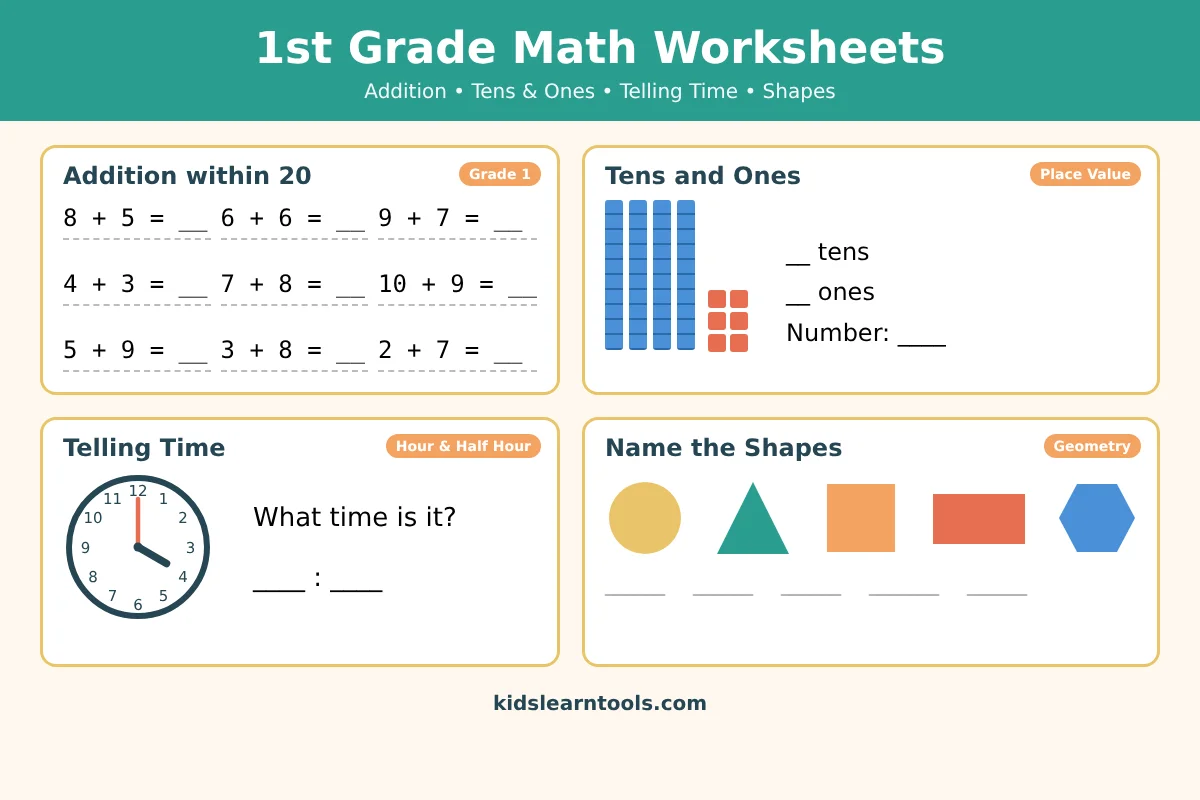
First grade math is built on four big areas. In the US these match the Common Core standards for grade 1, and most school systems (including class 1 syllabi in Pakistan and India) teach the same skills in a similar order.
| Skill area | What kids should be able to do by the end of 1st grade | Worksheet types to use |
|---|---|---|
| Addition & subtraction | Add and subtract within 20; know facts within 10 quickly; solve simple word problems; understand the equal sign | Single digit addition, subtraction within 20, fact families, missing number, word problems |
| Numbers & place value | Count, read and write numbers to 120; understand tens and ones; compare two-digit numbers using >, < and =; find 10 more and 10 less | Number chart 1–120, tens and ones, comparing numbers, ascending and descending order, ordinal numbers |
| Measurement & data | Order objects by length; tell time to the hour and half hour; read and make simple graphs | Measuring length, clock worksheets, days of the week, months of the year, bar graphs |
| Geometry | Name and draw 2D and 3D shapes; split shapes into halves and quarters | Shape sorting, drawing shapes, halves and quarters |
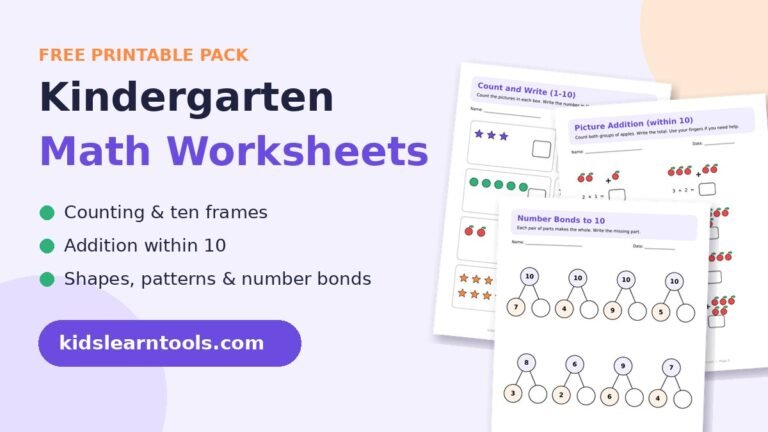
If your child is still working on kindergarten skills like counting to 20 or number recognition, start with our kindergarten math worksheets first. Moving up too early is the most common reason kids start to dislike math.
1st Grade Math Worksheets by Skill
Here is a skill-by-skill guide to 1st grade math worksheets. Each section tells you what to practice, what a good worksheet looks like, and where kids usually get stuck.
Addition Worksheets for Grade 1
Addition is the biggest topic in first grade. Kids move from counting objects to using strategies, then to knowing facts by heart.
- Start with: single digit addition (sums to 10) with pictures or a number line
- Then move to: sums to 20, doubles (6 + 6), near doubles (6 + 7) and making 10 (8 + 5 = 8 + 2 + 3)
- End of year: adding a two-digit number and a one-digit number (34 + 5), and adding tens (30 + 20)
- Common mistake: counting the first number again (for 5 + 3, saying “5, 6, 7” instead of “6, 7, 8”)
Our number bonds guide is the best warm-up before addition worksheets, because number bonds show kids how numbers break apart and join together.
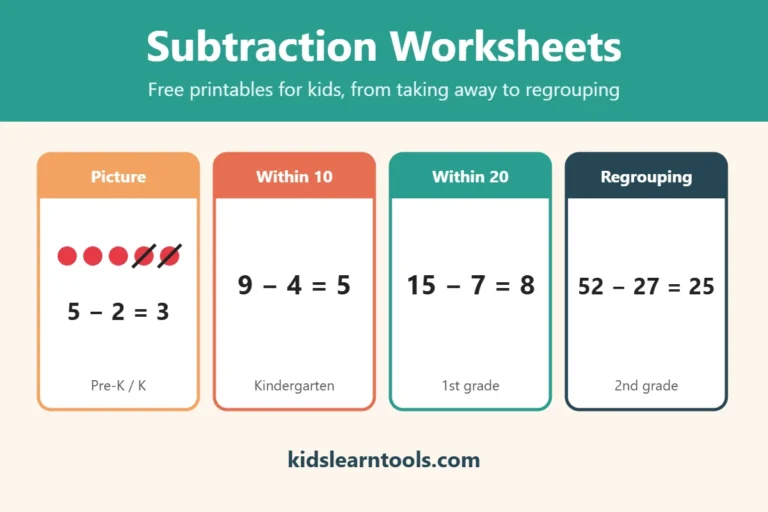
Subtraction Worksheets for Grade 1
- Start with: “take away” pictures (5 apples, cross out 2)
- Then move to: subtraction within 10 on a number line, then within 20
- Key idea: fact families – if 7 + 3 = 10, then 10 − 3 = 7 and 10 − 7 = 3
- Common mistake: always taking the smaller number from the bigger one, even when the problem is written the other way
Tens and Ones (Place Value) Worksheets
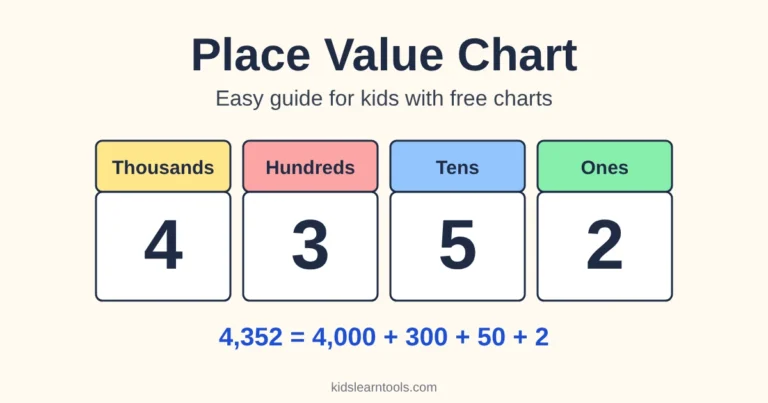
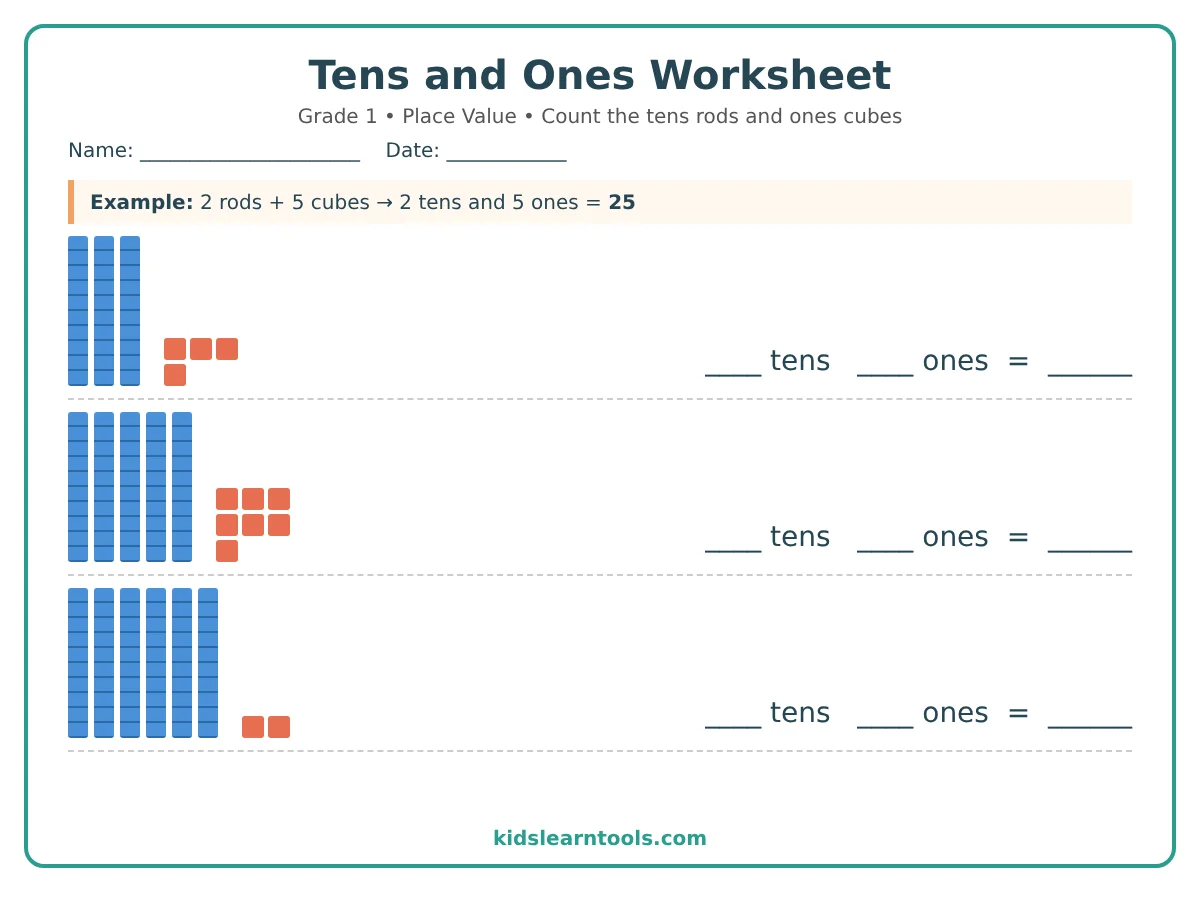
Place value is the skill that unlocks all later math. A first grader should understand that 46 means 4 tens and 6 ones, not just “a four and a six.”
- Bundling sticks or drawing tens rods and ones cubes
- Writing numbers in expanded form (46 = 40 + 6)
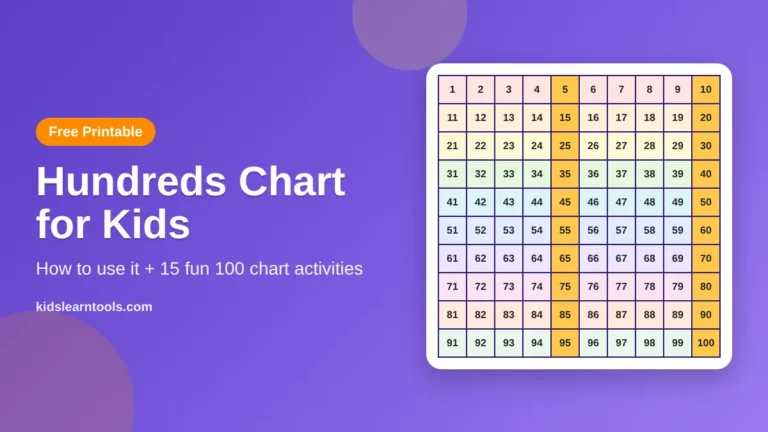
- Finding 10 more and 10 less on a hundreds chart
Our place value chart post has a printable chart and examples you can use alongside these worksheets.
Counting, Number Charts and Number Order
First graders count to 120, so a 1–100 or 1–120 number chart becomes a daily tool. Useful worksheet types include:
- Missing numbers on a 100 chart
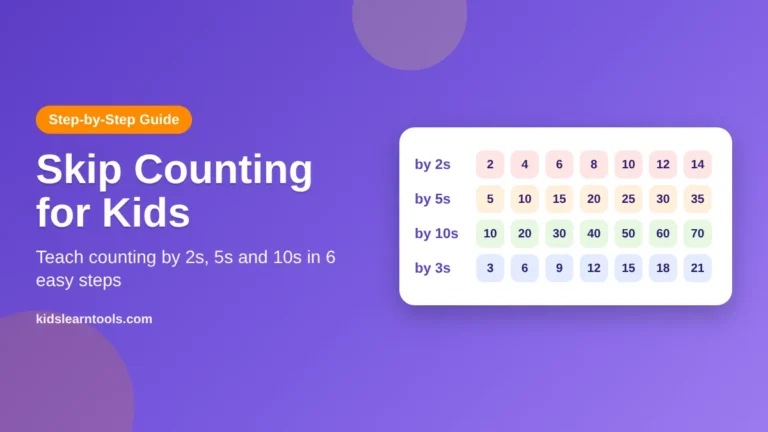
- Skip counting by 2s, 5s and 10s – see our skip counting for kids guide
- Ascending and descending order – putting 3–5 numbers from smallest to largest and back
- Comparing numbers with >, < and =
- Ordinal numbers – 1st, 2nd, 3rd, up to 10th
You can make a blank or partly filled chart with our free Hundreds Chart Maker, and find 15 game ideas in our hundreds chart activities post.
Time, Calendar and Measurement Worksheets
- Telling time: to the hour (3:00) first, then the half hour (3:30)
- Calendar: days of the week and months of the year worksheets
- Length: comparing “longer” and “shorter,” then measuring with cubes or paper clips
- Graphs: reading a simple bar graph and filling in a blank bar graph from a tally
Shapes and Fractions Worksheets
- Naming 2D shapes (circle, square, triangle, rectangle, hexagon) and 3D shapes (cube, cone, cylinder, sphere)
- Telling the difference between “defining” features (number of sides) and features that do not matter (color, size)
- Splitting circles and rectangles into halves and quarters (fourths)
Make Free 1st Grade Math Worksheets in Seconds
Printed packs run out fast. With our free Math Worksheet Generator you can make new 1st grade math worksheets for addition and subtraction every day. Choose Grade 1 and the tool uses numbers from 0 to 20, which matches the first grade target exactly. Print it or save it as a PDF, and you have a fresh practice page in under a minute.
- No sign-up and no login
- New problems every time you click, so kids cannot memorize the page
- Works on mobile and desktop
For quick on-screen practice, kids can also try our addition quiz for kids.
A Simple Month-by-Month Plan for 1st Grade Math
This plan follows the order most schools use. Use it to pick the right 1st grade math worksheets each month, and adjust it to your child – it is fine to spend an extra few weeks on any skill.
| Months | Main focus | Worksheets to use |
|---|---|---|
| Months 1–2 | Review kindergarten skills; counting to 100; addition and subtraction within 10 | Number chart, counting objects, single digit addition |
| Months 3–4 | Addition and subtraction strategies within 20; fact families | Doubles, making 10, subtraction within 20, missing number |
| Months 5–6 | Place value; tens and ones; comparing numbers | Tens and ones, > < =, ascending and descending order |
| Months 7–8 | Counting to 120; 10 more and 10 less; adding tens | Number chart 1–120, two-digit plus one-digit addition |
| Months 9–10 | Time, measurement, graphs, shapes and fractions; mixed review | Clock, bar graph, shapes, halves and quarters, mixed review |
How Many Math Worksheets Should a 1st Grader Do a Day?
One or two 1st grade math worksheets a day is enough – about 10 to 15 minutes. Short, regular practice works much better than a long weekend session. A simple daily routine looks like this:
- 2 minutes: warm-up – count aloud by 2s, 5s or 10s
- 8–10 minutes: one worksheet on the skill you are working on this week
- 2–3 minutes: check answers together and talk about one mistake
If your child is tired or upset, stop and play a math game instead. A happy 5 minutes beats a tearful 20 minutes.
From My Classroom
When I teach first grade math, I always let kids use real objects before a worksheet. Buttons, beans or small blocks on the table make “8 + 5” something they can see and touch. Once they can solve a problem with objects, the same problem on paper suddenly feels easy.
I also give every worksheet a “check your work” step. Kids circle one answer they are sure of and one they want to check again. This small habit teaches them to look back at their work – a skill that helps them far beyond first grade.
Tips to Make 1st Grade Math Worksheets More Effective
- One skill per page: mixed pages are great for review, but not for learning something new
- Read word problems aloud: many first graders can do the math but cannot read the question yet
- Use a number line or ten frame: keep one on the table until your child stops reaching for it
- Praise the strategy, not just the answer: “You used doubles – smart!” builds thinking skills
- Repeat tricky pages: doing the same type of worksheet three days in a row is normal and helpful
- Mix in games: dice, playing cards and hundreds chart games build fact fluency without paper
Is My Child Ready for 2nd Grade Math?
Your child is likely ready for 2nd grade math if they can do most of the following without help:
- Add and subtract within 20, with facts to 10 known quickly
- Count, read and write numbers to 120
- Explain that 63 is 6 tens and 3 ones
- Compare two-digit numbers using >, < and =
- Tell time to the hour and half hour
- Name basic 2D and 3D shapes and split a shape into halves
If one or two skills are still shaky, spend a few extra weeks on those 1st grade math worksheets. That small gap is much easier to close now than in 2nd grade, when kids start adding and subtracting within 1,000.
Frequently Asked Questions
What math should a 1st grader know?
By the end of first grade, kids should add and subtract within 20, know facts within 10 quickly, count to 120, understand tens and ones, compare two-digit numbers, tell time to the hour and half hour, and name basic shapes.
Are these 1st grade math worksheets free?
Yes. All worksheets and tools on Kids Learn Tools are free to print and use at home or in class. You do not need to sign up or log in.
Can I print 1st grade math worksheets as a PDF?
Yes. Open any worksheet or the Math Worksheet Generator, click print, and choose “Save as PDF” in your browser’s print window. You can then print it later or share it with your class.
How long should a 1st grader practice math each day?
About 10 to 15 minutes a day is enough for most first graders. Short daily practice builds skills faster than one long session per week.
Is 1st grade the same as class 1?
Yes, in most cases. First grade in the US and class 1 in Pakistan and India are for kids around 6 to 7 years old, and the math topics – addition, subtraction, place value, time and shapes – are very similar.
What is the hardest math skill in 1st grade?
For many kids, place value (tens and ones) and subtraction word problems are the hardest. Using real objects, a hundreds chart and lots of short practice makes both skills much easier.