
An addition quiz is a short set of adding questions that checks how quickly and correctly a child can find a sum. Use the free addition quiz below: pick a level from Pre-K to 3rd grade, try a 1-minute timed test, see instant feedback and stars, and print a quiz with an answer key.
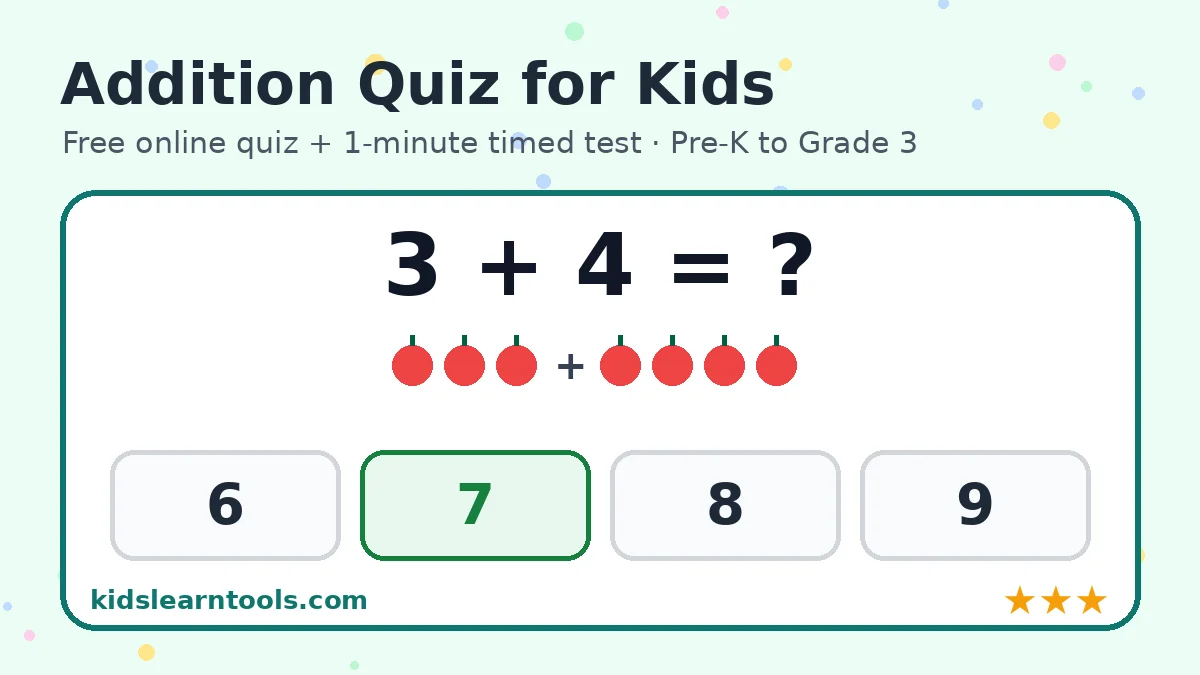
Free Addition Quiz for Kids
Choose a level and press Start. Every addition quiz is new, so kids can play again and again.
Tip: Pre-K questions show dots so kids can count them.
Every addition quiz above is made fresh each time, so your child never gets the same questions twice. It works on phones, tablets and computers, with no sign-up and no download.
How Does This Addition Quiz Work?
The tool turns addition practice into a short game. Kids answer one question at a time and get a score at the end. Here is how to use it:
- Pick a level: ten levels go from adding within 5 with pictures up to 3-digit addition for 3rd grade.
- Pick a question type: “Find the sum” (4 + 3 = ?), “Missing number” (4 + ? = 7) or a mix of both.
- Pick the length: 5, 10 or 20 questions, or the 1-minute timed test to see how many addition problems your child can solve in 60 seconds.
- Answer and learn: a correct answer turns green. A wrong answer turns red and the correct sum is shown straight away, so kids learn from every mistake.
- See the score: kids get a score, up to three stars and a short “practise again” list of the facts they missed.
- Print it: the print button makes a 20-question addition test on paper with a separate answer key page. Choose “Save as PDF” in the print window to keep it.
Which Addition Quiz Level Is Right for Your Child?
Start one level below where you think your child is. An easy first quiz builds confidence, and you can move up as soon as they score three stars. The levels follow what kids usually learn in each grade, based on the Common Core standards for operations and algebraic thinking.
| Quiz level | Grade | What kids practise | Example |
|---|---|---|---|
| Adding within 5 (with dots) | Pre-K | Counting objects to find a total | 2 + 1 = 3 |
| Adding within 10 | Kindergarten | Basic addition facts to 10 | 6 + 3 = 9 |
| Make 10 | Kindergarten | Pairs that make ten (number bonds of 10) | 7 + 3 = 10 |
| Adding within 20 | 1st grade | Addition facts to 20, counting on | 8 + 7 = 15 |
| Doubles and near doubles | 1st grade | Mental math with doubles | 6 + 7 = 13 |
| Adding three numbers | 1st grade | Grouping numbers to make it easier | 4 + 6 + 3 = 13 |
| Adding tens | 2nd grade | Place value with tens | 40 + 30 = 70 |
| 2-digit, no regrouping | 2nd grade | Adding ones and tens separately | 34 + 25 = 59 |
| 2-digit, with regrouping | 2nd grade | Carrying a ten | 38 + 47 = 85 |
| 3-digit addition | 3rd grade | Adding hundreds, tens and ones | 356 + 278 = 634 |
Addition Quiz Questions with Answers (100 Practice Problems)
Want to practise away from the screen? Here are 100 addition questions with answers, sorted by grade. Read a question out loud, give your child a few seconds, then check the answer together. These also work well as quick flash cards.
Addition Quiz for Kindergarten (Sums to 10)
| Question | Answer | Question | Answer |
|---|---|---|---|
| 1 + 2 = ? | 3 | 2 + 2 = ? | 4 |
| 3 + 1 = ? | 4 | 4 + 1 = ? | 5 |
| 2 + 3 = ? | 5 | 5 + 0 = ? | 5 |
| 3 + 3 = ? | 6 | 4 + 2 = ? | 6 |
| 5 + 2 = ? | 7 | 6 + 1 = ? | 7 |
| 4 + 4 = ? | 8 | 3 + 5 = ? | 8 |
| 6 + 2 = ? | 8 | 7 + 1 = ? | 8 |
| 5 + 4 = ? | 9 | 6 + 3 = ? | 9 |
| 7 + 2 = ? | 9 | 8 + 1 = ? | 9 |
| 5 + 5 = ? | 10 | 6 + 4 = ? | 10 |
For a kindergarten addition quiz, let kids use fingers or small toys. Counting real objects is the first step to mental math.
Addition Quiz for Grade 1 (Sums to 20)
| Question | Answer | Question | Answer |
|---|---|---|---|
| 9 + 2 = ? | 11 | 8 + 4 = ? | 12 |
| 7 + 5 = ? | 12 | 6 + 6 = ? | 12 |
| 9 + 4 = ? | 13 | 8 + 5 = ? | 13 |
| 7 + 7 = ? | 14 | 9 + 5 = ? | 14 |
| 8 + 6 = ? | 14 | 7 + 8 = ? | 15 |
| 9 + 6 = ? | 15 | 8 + 8 = ? | 16 |
| 9 + 7 = ? | 16 | 6 + 9 = ? | 15 |
| 8 + 9 = ? | 17 | 9 + 9 = ? | 18 |
| 10 + 7 = ? | 17 | 11 + 6 = ? | 17 |
| 12 + 5 = ? | 17 | 4 + 6 + 5 = ? | 15 |
This addition quiz for grade 1 also works as a quick 1st grade math test at home. Most first graders can answer these addition problems with counting on, doubles or make 10.
Addition Quiz for Grade 2 (2-Digit Addition)
| Question | Answer | Question | Answer |
|---|---|---|---|
| 20 + 30 = ? | 50 | 40 + 50 = ? | 90 |
| 12 + 13 = ? | 25 | 21 + 34 = ? | 55 |
| 32 + 45 = ? | 77 | 43 + 26 = ? | 69 |
| 51 + 38 = ? | 89 | 62 + 27 = ? | 89 |
| 17 + 15 = ? | 32 | 28 + 14 = ? | 42 |
| 36 + 25 = ? | 61 | 47 + 18 = ? | 65 |
| 29 + 29 = ? | 58 | 55 + 36 = ? | 91 |
| 48 + 37 = ? | 85 | 66 + 27 = ? | 93 |
| 39 + 44 = ? | 83 | 57 + 35 = ? | 92 |
| 68 + 24 = ? | 92 | 45 + 45 = ? | 90 |
The first eight questions in this addition quiz need no regrouping. The rest ask kids to carry a ten, which is the main 2nd grade addition skill.
Addition Quiz for Grade 3 (3-Digit Addition)
| Question | Answer | Question | Answer |
|---|---|---|---|
| 120 + 230 = ? | 350 | 305 + 402 = ? | 707 |
| 214 + 163 = ? | 377 | 341 + 258 = ? | 599 |
| 156 + 127 = ? | 283 | 238 + 145 = ? | 383 |
| 409 + 276 = ? | 685 | 367 + 218 = ? | 585 |
| 185 + 146 = ? | 331 | 274 + 159 = ? | 433 |
| 358 + 267 = ? | 625 | 476 + 385 = ? | 861 |
| 299 + 301 = ? | 600 | 520 + 280 = ? | 800 |
| 645 + 238 = ? | 883 | 712 + 189 = ? | 901 |
| 463 + 379 = ? | 842 | 588 + 256 = ? | 844 |
| 395 + 405 = ? | 800 | 250 + 250 = ? | 500 |
In a 3rd grade addition quiz, ask kids to estimate first. If 356 + 278 is “about 600”, an answer of 934 is clearly wrong. This habit builds strong math skills.
Addition Word Problems Quiz
| Word problem | Answer |
|---|---|
| Mia has 4 red balloons and 3 blue balloons. How many balloons does she have? | 7 |
| There are 6 ducks in a pond. 5 more ducks join them. How many ducks are there now? | 11 |
| Sam read 8 pages on Monday and 9 pages on Tuesday. How many pages did he read? | 17 |
| A box has 12 crayons. Another box has 7 crayons. How many crayons in all? | 19 |
| Lily has 25 stickers. Her friend gives her 14 more. How many stickers does she have now? | 39 |
| A class has 18 girls and 16 boys. How many children are in the class? | 34 |
| A farmer picks 46 apples in the morning and 38 in the afternoon. How many apples did he pick? | 84 |
| A shop sold 125 books on Friday and 140 books on Saturday. How many books did it sell? | 265 |
| A school library has 230 storybooks and 175 science books. How many books is that? | 405 |
| You save 15 cents, then 20 cents, then 10 cents. How much money did you save? | 45 cents |
Word problems help kids see where addition is used in real life. Ask your child to say the number sentence first, such as “4 + 3 = 7”, before giving the answer.
What Addition Strategies Help Kids Answer Faster?
Speed in an addition quiz does not come from rushing. It comes from knowing smart strategies, so kids can find a sum in their head instead of counting every object. Teach these one at a time:
| Strategy | How it works | Example | Best for |
|---|---|---|---|
| Counting on | Start with the bigger number and count up | 8 + 3: say “8… 9, 10, 11” | Pre-K and K |
| Make 10 | Break a number to make a ten first | 8 + 5 = 8 + 2 + 3 = 13 | K and 1st grade |
| Doubles | Learn doubles by heart | 6 + 6 = 12 | 1st grade |
| Near doubles | Use a double, then add 1 | 6 + 7 = 6 + 6 + 1 = 13 | 1st grade |
| Number line | Jump forward on a line | 25 + 10: jump from 25 to 35 | 1st and 2nd grade |
| Place value | Add tens, then ones | 34 + 25 = 50 + 9 = 59 | 2nd grade |
| Regrouping (carrying) | When ones make 10 or more, carry a ten | 38 + 47: 8 + 7 = 15, write 5, carry 1 | 2nd and 3rd grade |
If your child struggles with “make 10”, spend a few days on number bonds first. For 2-digit addition, a strong grip on place value makes regrouping much easier to understand.
Addition Facts Table: Sums from 0 to 10
This addition facts table shows every basic addition fact from 0 + 0 to 10 + 10. Find one number in the left column and the other in the top row. The box where they meet is the sum. Kids who know these facts by heart do much better in any addition test.
| + | 0 | 1 | 2 | 3 | 4 | 5 | 6 | 7 | 8 | 9 | 10 |
|---|---|---|---|---|---|---|---|---|---|---|---|
| 0 | 0 | 1 | 2 | 3 | 4 | 5 | 6 | 7 | 8 | 9 | 10 |
| 1 | 1 | 2 | 3 | 4 | 5 | 6 | 7 | 8 | 9 | 10 | 11 |
| 2 | 2 | 3 | 4 | 5 | 6 | 7 | 8 | 9 | 10 | 11 | 12 |
| 3 | 3 | 4 | 5 | 6 | 7 | 8 | 9 | 10 | 11 | 12 | 13 |
| 4 | 4 | 5 | 6 | 7 | 8 | 9 | 10 | 11 | 12 | 13 | 14 |
| 5 | 5 | 6 | 7 | 8 | 9 | 10 | 11 | 12 | 13 | 14 | 15 |
| 6 | 6 | 7 | 8 | 9 | 10 | 11 | 12 | 13 | 14 | 15 | 16 |
| 7 | 7 | 8 | 9 | 10 | 11 | 12 | 13 | 14 | 15 | 16 | 17 |
| 8 | 8 | 9 | 10 | 11 | 12 | 13 | 14 | 15 | 16 | 17 | 18 |
| 9 | 9 | 10 | 11 | 12 | 13 | 14 | 15 | 16 | 17 | 18 | 19 |
| 10 | 10 | 11 | 12 | 13 | 14 | 15 | 16 | 17 | 18 | 19 | 20 |
- Look for patterns: each row goes up by one, and the doubles run in a diagonal line.
- Turn-around facts: 3 + 5 and 5 + 3 give the same sum, so kids really only need to learn about half the table.
- Learn in small groups: master +0, +1 and +2 first, then doubles, then make 10, then the rest.
What Is a Good Score on an Addition Timed Test?
An addition timed test checks fact fluency, which means answering quickly and correctly. Use these goals for the 1-minute timed test as a friendly guide, not a strict rule. Every child learns at their own pace.
| Grade | Quiz level | Good 1-minute goal | Next step |
|---|---|---|---|
| Kindergarten | Adding within 10 | 8–12 correct | Move to make 10 |
| 1st grade | Adding within 20 | 15–20 correct | Try doubles and three numbers |
| 2nd grade | 2-digit, no regrouping | 10–15 correct | Move to regrouping |
| 3rd grade | 3-digit addition | 6–10 correct | Try word problems |
The best goal is beating your own score. Write today’s result on a sticky note and try to add one or two more correct answers next week.
Common Addition Mistakes and How to Fix Them
| Mistake | Example | Quick fix |
|---|---|---|
| Counting the first number again | 5 + 3: counts “5, 6, 7” and says 7 | Say the first number, then count on: “5… 6, 7, 8” |
| Forgetting to carry | 38 + 47 = 75 | Circle the ones first; if they make 10 or more, write the 1 above the tens |
| Lining up digits wrongly | 45 + 3 written as 45 + 30 | Use squared paper or a place value chart |
| Guessing when rushed | Random answers on a timed test | Go back to untimed practice for a few days |
| Mixing up + and − | 7 − 2 answered as 9 | Say the sign out loud before answering |
Most mistakes in an addition quiz are small habits, not a lack of ability. Fix one habit at a time and the score will follow.
From My Classroom
In my eight years of teaching, addition was where many of my slow learners first lost their confidence in math. They could count objects, but timed addition tests made them freeze.
What helped most was taking the pressure off. We began with addition quizzes of only five questions, all at a level they could already do, and I praised effort before speed. Once they felt safe, I taught one strategy at a time, starting with counting on and then making ten.
I often paired a confident child with one who was still learning, and both of them improved as they explained their thinking to each other. Only when a child could answer comfortably did we try a timed test, and even then the goal was to beat their own score, never a classmate’s. That is why this addition quiz shows the right answer straight away and lets kids practise the facts they missed.
How Can You Make Addition Practice Fun?
- Dice addition: roll two dice and add the numbers. The first to reach 50 wins.
- Card game: flip two playing cards (ace = 1, picture cards = 10) and race to say the sum.
- Shopping game: give items prices up to 20 cents and let kids add up the bill.
- Star chart: collect the stars from each quiz and give a small reward at 20 stars.
- Swap roles: let your child quiz you and catch your “mistakes”.
- Hundreds chart jumps: use a hundreds chart to add tens by jumping down a row.
What Should Kids Practise After an Addition Quiz?
| Score | What it means | Next step |
|---|---|---|
| 90–100% (3 stars) | Facts at this level are strong | Move up one level or try the 1-minute timed test |
| 70–89% (2 stars) | Almost there | Practise the missed facts, then take a new addition quiz |
| 40–69% (1 star) | Still learning | Use objects, fingers or a number line and stay at this level |
| Below 40% | Level is too hard right now | Move down one level and build confidence first |
Keep building math skills with these free guides and tools:
- Math quiz for kids with subtraction, comparing, multiplication and division
- Number bonds to make “make 10” addition easy
- Skip counting for adding tens and getting ready for multiplication
- Place value for 2-digit and 3-digit addition
- The free math worksheet generator for longer addition practice on paper
Frequently Asked Questions
Is this addition quiz free?
Yes. The addition quiz is completely free, with no sign-up, no app and no download. Kids can play online and you can print a quiz with an answer key.
What age is this addition quiz for?
It suits kids from about 3 to 9 years old, from Pre-K to 3rd grade. Pre-K kids add within 5 using dots, and 3rd graders practise 3-digit addition.
How does the 1-minute addition timed test work?
Choose “1-minute timed test” and press Start. Your child answers as many addition questions as possible in 60 seconds. The result shows how many were correct, so they can try to beat it next time.
Can I print the addition quiz with answers?
Yes. Press “Print Quiz + Answer Key” to get 20 addition questions on one page and the answers on a second page. Choose “Save as PDF” to keep a copy.
What addition facts should a 1st grader know?
By the end of 1st grade, most kids can add within 20 and know the facts within 10 quickly. Practising doubles and make 10 helps them get there.
How can I help my child get faster at addition?
Practise for a few minutes most days, teach one strategy at a time such as counting on or make 10, and use short quizzes instead of long tests. Speed comes from understanding, not rushing.
Start with a quick 5-question addition quiz today. A few happy minutes of practice each day turns adding into a skill your child can be proud of.