
Print a free hundreds chart in seconds. Pick a 1 to 100, 0 to 99 or 1 to 120 chart, then choose a full chart, a blank hundreds chart, a missing numbers chart or a skip counting chart. Every hundreds chart printable on this page fits on one sheet of paper and comes with an answer key.
Play mode: tap any square to color it (orange, purple, green, then clear). Great for “find the number” and pattern games.
What Is a Hundreds Chart?
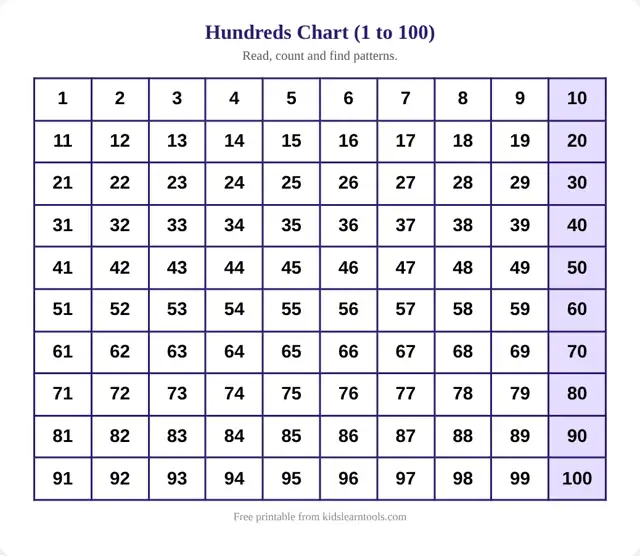
A hundreds chart is a 10 by 10 grid that shows the numbers 1 to 100 in order, with 10 numbers in each row. Kids use it to count, see number patterns, add and subtract, and learn place value. Moving one square to the right adds 1, and moving one row down adds 10.
Teachers use this grid from preschool to second grade. In the US Common Core standards, kindergarten kids learn to count to 100 by ones and by tens (K.CC.A.1), and first graders learn to count to 120 (1.NBT.A.1). A printable hundreds chart supports both goals at home and in the classroom.
How to Use This Hundreds Chart Generator
- Choose the chart size. Use 1 to 100 for most kids, 0 to 99 to show that every row starts with the same tens digit, or 1 to 120 for first grade.
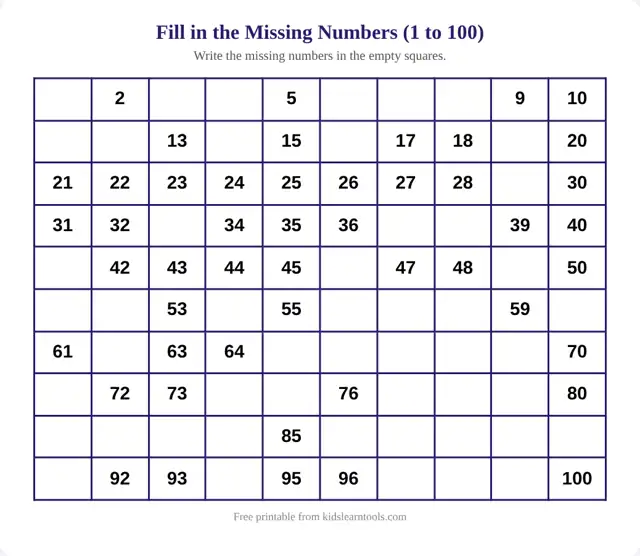
- Choose the chart type. Full, blank, missing numbers (easy, medium or hard) or skip counting.
- Pick a number to highlight. Color the multiples of 2, 3, 4, 5 or 10 to show skip counting patterns.
- Pick a print style. Color looks bright on screen. Black and white saves printer ink and still marks the multiples.
- Click “New Chart” to get a new set of missing numbers. Every click makes a different worksheet.
- Click “Print Chart” to print, or choose “Save as PDF” in the print window to keep a hundreds chart printable PDF.
- Click “Print Answer Key” to print the full chart for checking.
Tip: On a phone, tablet or interactive whiteboard, tap any square to color it. Tap again to change the color. This turns the grid into a quick number game without printing anything.
Which Hundreds Chart Should I Print?
Each chart type builds a different skill. Use this table to pick the right chart for your child or class.
| Chart type | What kids do | Best for | Typical age |
|---|---|---|---|
| Full chart (1 to 100) | Read, point and count | Counting to 100, number names, finding patterns | 4 to 6 years (Pre-K and K) |
| Blank hundreds chart | Write every number from 1 to 100 | Number writing and sequence | 5 to 7 years (K and Grade 1) |
| Missing numbers (easy) | Fill in about 1 in 4 numbers | Number order and counting on | 5 to 6 years |
| Missing numbers (medium / hard) | Fill in half or three quarters of the chart | Place value, before and after, +1 / +10 | 6 to 8 years (Grades 1 and 2) |
| Skip counting chart | Fill in or say the multiples | Counting by 2s, 5s and 10s, early times tables | 6 to 8 years |
| 120 chart | Count and write past 100 | First grade counting goal (1.NBT.A.1) | 6 to 7 years |
Hundreds Chart Patterns Every Kid Should Know
The hundreds chart is powerful because the patterns are easy to see. Once kids learn these four moves, they can add and subtract with the chart instead of counting on their fingers.
| Move on the chart | What happens to the number | Example |
|---|---|---|
| One square right → | Add 1 | 34 → 35 |
| One square left ← | Subtract 1 | 34 → 33 |
| One row down ↓ | Add 10 | 34 → 44 |
| One row up ↑ | Subtract 10 | 34 → 24 |
Other patterns kids can spot:
- Every number in a column ends with the same digit (3, 13, 23, 33…).
- Every number in a row of the 0 to 99 chart starts with the same tens digit (40, 41, 42…).
- Multiples of 10 always sit in the last column of the 1 to 100 chart.
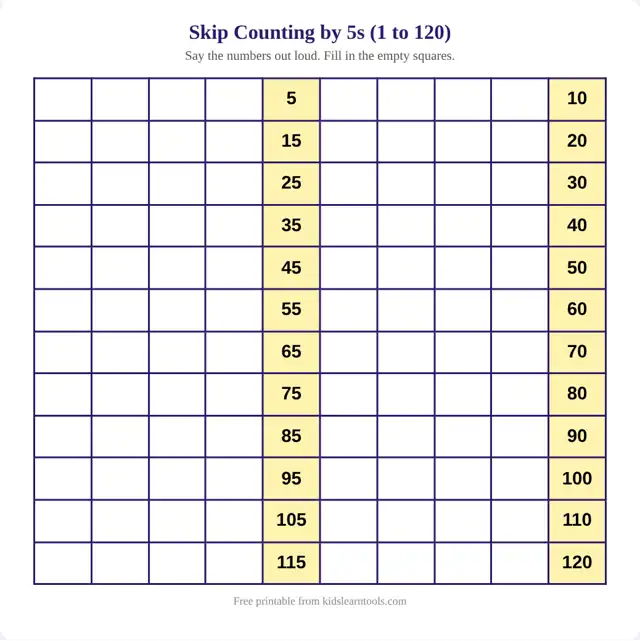
- Multiples of 5 make two straight columns. Multiples of 2 make five straight columns.
- Multiples of 9 make a diagonal line going down and to the left (9, 18, 27, 36…).
- Multiples of 11 make a diagonal line going down and to the right (11, 22, 33, 44…).
How a Hundreds Chart Teaches Place Value
Place value means that the position of a digit tells its value. In 47, the 4 means 4 tens (40) and the 7 means 7 ones. The hundreds chart shows this clearly: the row tells you the tens and the column tells you the ones.
| Number | Row on the chart (tens) | Column on the chart (ones) | Tens + ones |
|---|---|---|---|
| 23 | 3rd row | 3rd column | 20 + 3 |
| 47 | 5th row | 7th column | 40 + 7 |
| 60 | 6th row | last column | 60 + 0 |
| 85 | 9th row | 5th column | 80 + 5 |
Ask your child to find 47, then ask “How many jumps down did you make? How many squares across?” This simple question connects the chart to tens and ones. For more practice, the 0 to 99 chart works even better because each row starts with a new tens digit (0, 10, 20, 30…).
How to Add and Subtract on a Hundreds Chart
The chart works like a number map. Kids can solve two-digit sums by making jumps of ten and jumps of one. Here are worked examples you can copy onto the board.
| Problem | Start at | Tens jumps | Ones jumps | Answer |
|---|---|---|---|---|
| 35 + 20 | 35 | 2 rows down (45, 55) | none | 55 |
| 46 + 23 | 46 | 2 rows down (56, 66) | 3 squares right (67, 68, 69) | 69 |
| 72 – 30 | 72 | 3 rows up (62, 52, 42) | none | 42 |
| 58 – 14 | 58 | 1 row up (48) | 4 squares left (47, 46, 45, 44) | 44 |
Start with problems that add or take away only tens. When kids are confident, add ones as well. Later, kids can try problems that cross a row, such as 38 + 5, where they move to the next row after 40.
8 Fun Hundreds Chart Activities for Kids
1. Count and Point
Say each number out loud while pointing to it. Start with 1 to 20, then add one row each day until your child can count to 100 without help.
2. Fill In the Missing Numbers
Print the easy missing numbers chart first. When it feels simple, move to medium and hard. This shows if a child really knows the number order, not just the counting song.
3. Skip Counting by 2s, 5s and 10s
Choose the skip counting chart and pick 10s first, then 5s, then 2s. Kids color or write each multiple. This is the first step toward multiplication.
4. Mystery Number
Give clues like “My number is 10 more than 32 and 1 less than 43.” Kids use the chart to find 42. You can play this with the tap-to-color play mode on screen.
5. Add and Subtract With Jumps
To solve 46 + 23, start at 46, jump down 2 rows to 66 and right 3 squares to 69. Kids see addition instead of only memorizing it.
6. Hidden Picture Coloring
Call out numbers for kids to color on a blank or full chart. When they finish, a shape or letter appears. This works well as a fun Friday math activity.
7. Number Puzzle
Print a full chart, cut it into 5 or 6 pieces along the lines, and ask kids to put it back together. They must look at the numbers, not the shape of the pieces.
8. Odd and Even Hunt
Highlight multiples of 2 to show even numbers. Every number that is not colored is odd. Ask kids what pattern they see in the columns.
Hundreds Chart Printable Ideas by Grade
Kids grow quickly between preschool and second grade. Use this guide to match the chart to what your child is learning right now.
| Grade | Main skill | Chart to print | Quick activity |
|---|---|---|---|
| Pre-K | Count to 20 or 30 | Full 1 to 100 chart | Point and count the first two rows each day |
| Kindergarten | Count to 100 by 1s and 10s | Full chart with 10s highlighted | Count the last column: 10, 20, 30… |
| Grade 1 | Count to 120, +10 and -10 | 1 to 120 chart, missing numbers (easy) | Find 10 more and 10 less than a number |
| Grade 2 | Add and subtract within 100, skip counting | Missing numbers (hard), skip counting chart | Solve two-digit sums with jumps |
Common Hundreds Chart Mistakes (and Easy Fixes)
- Reading down instead of across. Some kids read the columns first. Fix: put a finger under the first row and slide right, like reading a book.
- Mixing up the teens. Kids often swap 13 and 31. Fix: say “thirteen is one ten and three ones” and find both numbers on the chart.
- Getting lost at the end of a row. After 30, some kids go back to the start of the same row. Fix: show that 31 is always one row down, at the left side.
- Counting the starting square in jumps. When adding 3, kids count the square they are on. Fix: say “jump first, then count.”
- Writing numbers backward. Kids may write 21 as 12. Fix: use the full chart as a model next to a blank hundreds chart.
5 Benefits of Using a Chart of 1 to 100
A simple grid of numbers does a lot of work for kids. Here is why teachers keep one on the wall all year.
- It makes numbers visual. Kids can see that 50 is halfway and that 99 is just before 100. Numbers stop being words and become places they can point to.
- It builds number sense. Kids learn which numbers are close, which are far apart and which are bigger. This helps with estimating and checking answers later.
- It supports mental math. After many jumps on paper, kids start to picture the grid in their heads and add 10 without counting.
- It prepares kids for multiplication. Coloring the multiples of 2, 5 and 10 shows the times tables as patterns long before kids memorize them.
- It works for every level. The same grid helps a 4 year old count and an 8 year old subtract two-digit numbers, so one printable can last for years.
Easy Number Games to Play at Home
You do not need special supplies to make math fun. A printed chart, a few coins and a die are enough for these quick games.
- Race to 100: Each player rolls a die and moves a coin forward that many squares. The first player to reach 100 wins. For a harder version, roll two dice and add them.
- Ten more, ten less: Call out a number. Your child places a coin on it, then says the number above and below it.
- Cover up: Hide 5 numbers with small sticky notes. Your child guesses each hidden number, then lifts the note to check.
- Snake path: Start at 1 and only move right or down. Kids say every number on the path. Ask which path gives the biggest total.
These games take only five minutes, and kids often ask to play again. That repeat practice is what makes counting and place value stick.
Hundreds Chart vs 120 Chart: Which One Is Better?
Both charts are useful. A hundreds chart is best for learning the first 100 numbers and the +1 / +10 patterns. A 120 chart printable is best for first grade, because it shows that counting continues past 100 in the same way (101, 102, 103…). Many teachers start with 1 to 100 and switch to 1 to 120 in Grade 1.
| Feature | Hundreds chart (1 to 100) | 120 chart (1 to 120) |
|---|---|---|
| Rows | 10 rows | 12 rows |
| Best grade | Pre-K to Grade 1 | Grade 1 to Grade 2 |
| Main goal | Count to 100, patterns, place value | Count and write past 100 |
| Fits on one page | Yes | Yes |
Tips for Parents and Teachers
- Keep it short. Five to ten minutes a day works better than one long session.
- Laminate one full chart. Kids can use it with a dry-erase marker again and again.
- Use real objects. Put a coin or bead on each number while counting to make it hands-on.
- Talk about patterns. Ask “What do you notice?” before you explain anything.
- Mix the charts. Use a full chart for learning and a missing numbers chart for practice and checking.
- Keep one chart on the wall. Kids look at it many times a day, and the numbers slowly stick.
- Pair it with other tools. Try our Math Worksheet Generator for addition and subtraction practice, our Color by Number pages for number recognition, and our Printable Mazes for focus and problem solving.
Frequently Asked Questions
Is this hundreds chart printable free?
Yes. Every hundreds chart on this page is 100% free to make, print and save as a PDF. You do not need to sign up or create an account.
How do I print a hundreds chart as a PDF?
Click “Print Chart”. In the print window, change the printer to “Save as PDF” and click Save. You now have a hundreds chart printable PDF you can use again.
What age is a hundreds chart for?
Most kids start using a hundreds chart at 4 or 5 years old for counting. Kids aged 6 to 8 use it for adding, subtracting, skip counting and place value.
What is the difference between a 0 to 99 chart and a 1 to 100 chart?
On a 0 to 99 chart, every number in a row has the same tens digit (for example 30 to 39), which makes place value easy to see. A 1 to 100 chart ends each row with a multiple of 10, which matches how kids count out loud.
How do you use a blank hundreds chart?
Give kids a blank hundreds chart and ask them to write the numbers 1 to 100 in order, starting at the top left. It builds number writing and shows if they understand the order of numbers.
Can I make a new missing numbers chart each time?
Yes. Click “New Chart” and the tool picks a new set of missing numbers. Print the answer key to check the work quickly.
Why do teachers use a hundreds chart?
A hundreds chart helps kids see how numbers are built from tens and ones. It makes counting, skip counting, adding and subtracting visual, so kids understand math instead of only memorizing it.
Can I use the hundreds chart on a smartboard?
Yes. Open this page on the board and use play mode. Tap squares to color them while the class counts, finds patterns or plays mystery number.