Digraphs: Easy Meaning, Examples & 150+ Word Lists for Kids
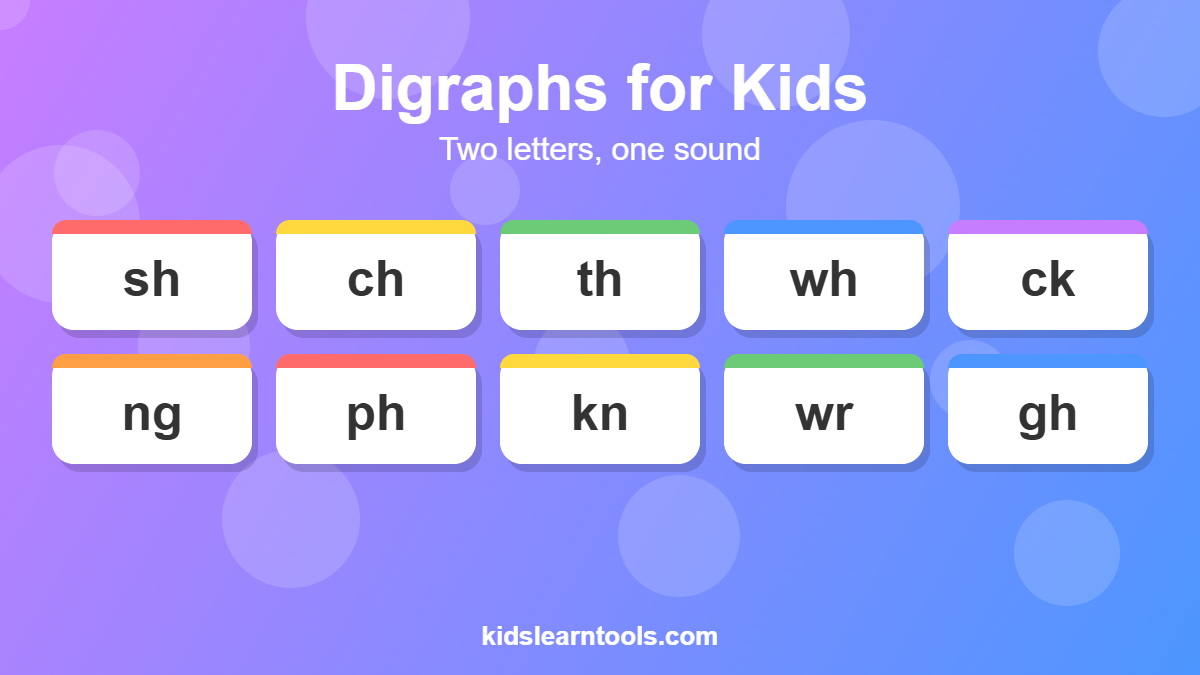
Digraphs are two letters that work together to make one sound. In the word ship, you do not hear an S sound and then an H sound. Instead, S and H join to make the new sound /sh/. Other common examples are ch, th, wh, ck, ee and oa.
In this guide, you will learn what digraphs are in simple words, the difference between consonant digraphs and vowel digraphs, a full digraphs list with 150+ example words, easy practice sentences, games and a step-by-step way to teach them to kids from kindergarten to 2nd grade.
What Are Digraphs?
A digraph is a pair of letters that spells a single sound (a single phoneme). The word comes from Greek: di means “two” and graph means “written.” So it is literally “two written letters” for one sound.
Here is an easy way to explain this idea to a child: “Some letters are best friends. When they stand next to each other, they make a brand-new sound together.”
- sh in shop, fish and wash
- ch in chin, lunch and much (see our full CH words list)
- th in this, thin and bath
- ee in see, tree and feet
Digraph Meaning in Phonics
In phonics, these letter pairs are taught right after kids can read simple CVC words like cat, pig and sun. Learning them opens the door to hundreds of new words such as shop, chat, duck and ring. Most children learn consonant digraphs in kindergarten or early 1st grade and vowel digraphs in 1st and 2nd grade.
Types of Digraphs
There are two main types of these letter teams:
- Consonant digraphs: two consonants that make one sound, such as sh, ch, th, wh, ph, ck and ng.
- Vowel digraphs: two letters (usually two vowels) that make one vowel sound, such as ai, ay, ee, ea, oa and oo.
You may also hear about trigraphs, which are three letters making one sound, like tch in catch, dge in bridge and igh in night. We cover them briefly below.
Example: More Letters, Fewer Sounds
Here is an easy way to see this idea in action. Count the letters in a word, then count the sounds you hear. Words with a letter team always have fewer sounds than letters.
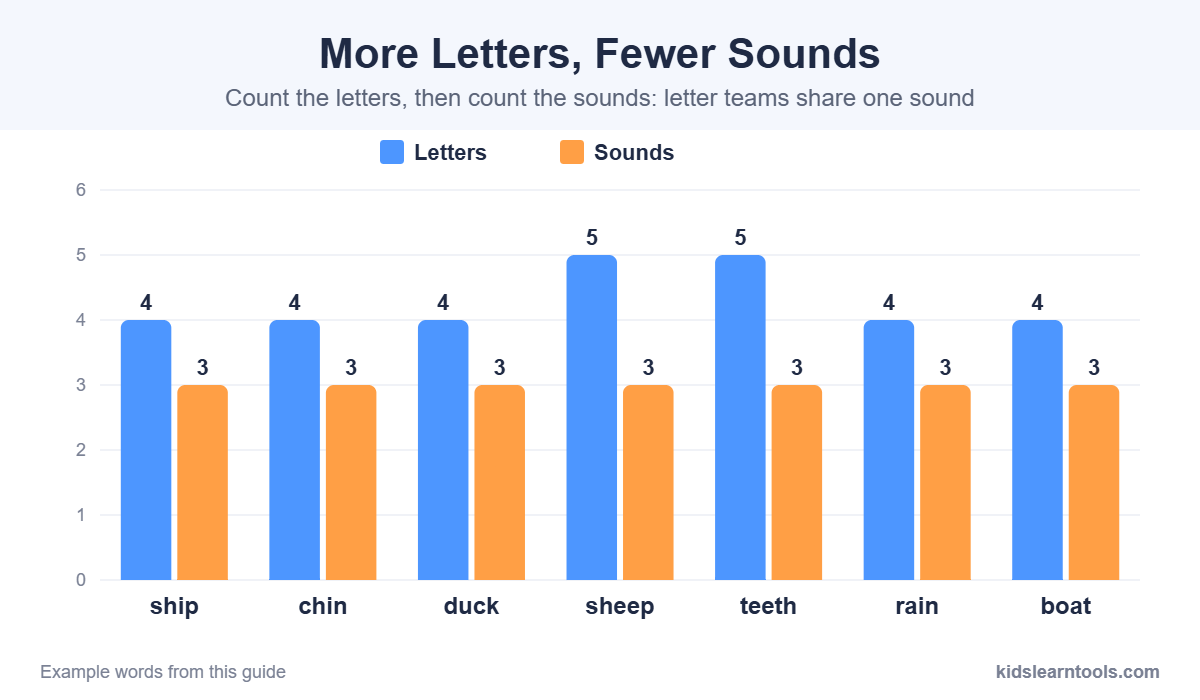
Look at ship: it has four letters (s-h-i-p) but only three sounds (/sh/ /i/ /p/). Sheep and teeth have five letters and still only three sounds, because they contain two letter teams each. Showing kids this simple pattern helps them stop sounding out every single letter.
Consonant Digraphs List With Examples
Consonant digraphs are usually the first letter teams kids learn. The big five for beginning readers are sh, ch, th, wh and ck. Here is the full list:
| Digraph | Sound | Beginning Words | Ending Words |
|---|---|---|---|
| sh | /sh/ | ship, shop, shell, sheep, shut | fish, dish, wish, brush, cash |
| ch | /ch/ | chin, chip, chop, chat, cheese | much, lunch, rich, bench, peach |
| th (voiced) | /th/ | this, that, the, them, then | with, smooth, bathe |
| th (unvoiced) | /th/ | thin, thick, think, thumb, three | bath, math, moth, path, tooth |
| wh | /w/ | when, what, whip, whale, wheel | (not used at the end) |
| ck | /k/ | (not used at the start) | duck, back, sock, kick, truck |
| ng | /ng/ | (not used at the start) | ring, sing, long, king, swing |
| ph | /f/ | phone, photo, phonics | graph, dolphin, alphabet |
| kn | /n/ | knee, knit, knock, know, knife | (not used at the end) |
| wr | /r/ | write, wrap, wrist, wrong, wren | (not used at the end) |
| gh | /f/ or /g/ | ghost, ghoul | laugh, rough, tough, cough |
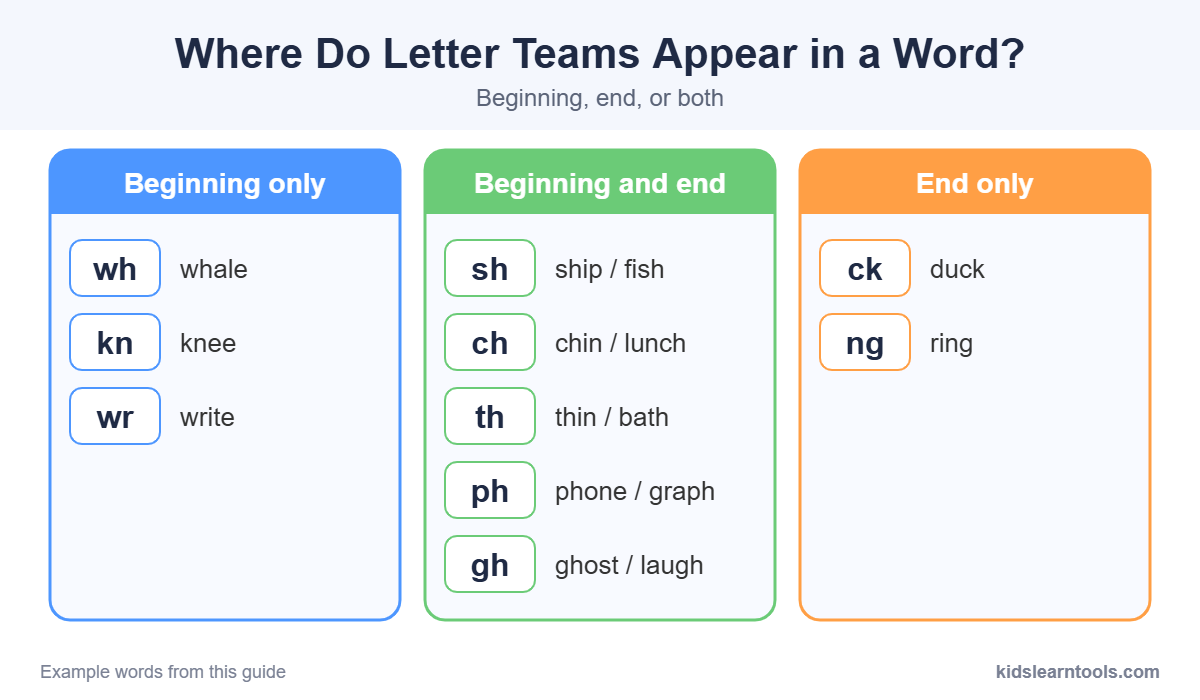
This diagram shows where each consonant pair usually appears. WH, KN and WR come at the start of a word. CK and NG come at the end. SH, CH, TH, PH and GH can show up in both places. Knowing this helps kids with spelling, too: a word that ends in a /k/ sound right after a short vowel, like duck, is usually spelled with CK.
SH Digraph Words
The SH sound is the “quiet please” sound. Put a finger to your lips and say “shhh.” For 120+ examples sorted by position, see our full list of SH words for kids.
- Beginning: ship, shop, shed, shell, shin, shut, sheep, shoe, shark, shape
- Ending: fish, dish, wish, cash, rush, brush, crash, flash, splash, trash
CH Digraph Words
The CH sound is the “train” sound: “ch-ch-ch-choo!”
- Beginning: chin, chip, chop, chat, chick, check, chest, cheese, chair, child
- Ending: much, such, rich, lunch, bunch, bench, pinch, punch, beach, peach
TH Digraph Words
TH is special because it has two sounds: a buzzy voiced TH (this) and a quiet, airy unvoiced TH (thin). For full lists and a mouth guide, read our complete post on TH words for kids.
- Voiced: this, that, the, them, then, they, there, mother, father, brother
- Unvoiced: thin, thick, think, thank, three, thumb, bath, math, moth, tooth
WH Digraph Words
In most American English, WH sounds like /w/. Many WH words are question words, so this is a great time to practice asking questions.
- Words: when, what, where, which, why, whip, whale, wheel, white, whisper
CK Digraph Words
CK makes the /k/ sound and comes at the end of a word, right after a short vowel. If your child already knows short a words, CK words like back and pack are a perfect next step.
- Words: back, pack, sack, deck, neck, kick, sick, lock, rock, sock, duck, luck, truck, black, stick
NG, PH, KN and WR Words
- NG: ring, sing, king, wing, long, song, hang, bang, swing, strong
- PH: phone, photo, phonics, graph, dolphin, elephant, alphabet, trophy
- KN: knee, knit, knot, knob, knock, know, knife, knight (the K is silent)
- WR: write, wrap, wrist, wren, wreck, wrong, wrote (the W is silent)
Vowel Digraphs List With Examples
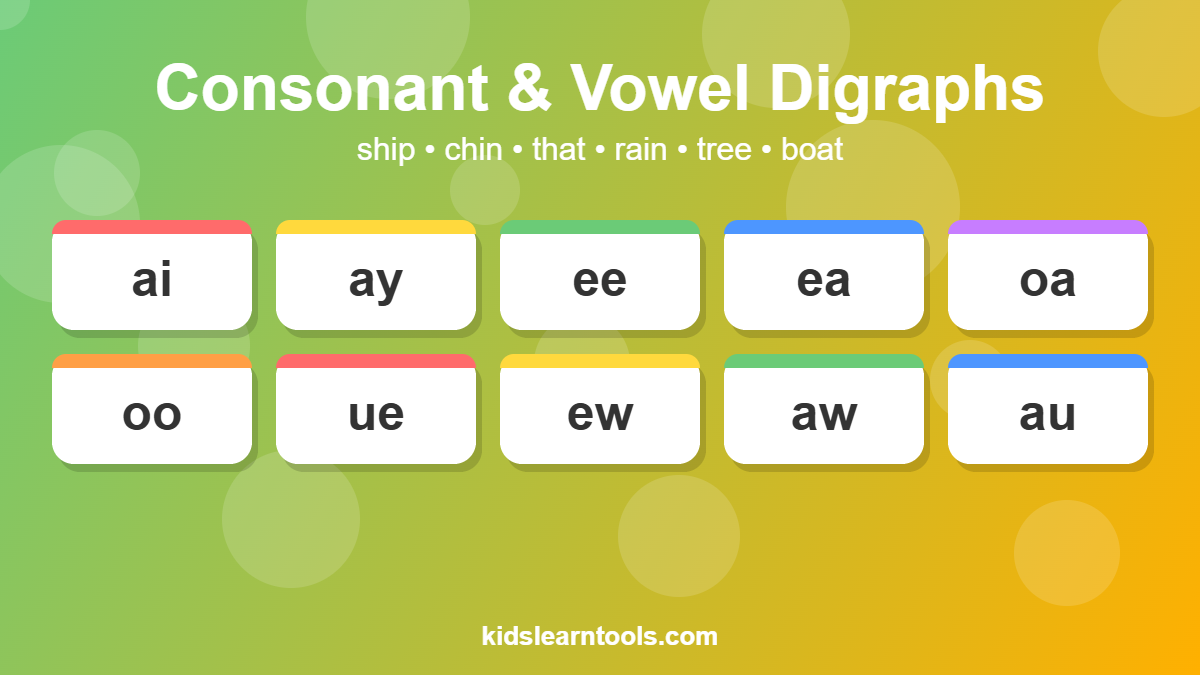
Vowel digraphs are two letters that make one vowel sound. A popular phonics rhyme says, “When two vowels go walking, the first one does the talking.” That works for many vowel teams (like ai, ee and oa), but not all of them, so it is best to teach each one with real words.
| Vowel Digraph | Sound | Example Words |
|---|---|---|
| ai | long a | rain, pain, tail, mail, train, paint |
| ay | long a | day, play, say, may, stay, tray |
| ee | long e | see, tree, bee, feet, green, sleep |
| ea | long e (or short e) | eat, sea, team, read, leaf / bread, head |
| oa | long o | boat, coat, road, soap, goat, toast |
| ow | long o (or /ow/) | snow, grow, slow, bowl / cow, now |
| oo | long or short oo | moon, food, zoo, spoon / book, look, cook |
| ie | long i (or long e) | pie, tie, lie / field, chief |
| ue | long u | blue, glue, true, clue |
| ew | long u | new, few, chew, grew, flew |
| au | /aw/ | haul, launch, sauce, August |
| aw | /aw/ | saw, paw, draw, straw, claw |
Note: Some teachers group oi, oy, ou and ow (as in cow) separately as diphthongs, because the sound glides from one vowel to another. For young kids, it is fine to simply call them “vowel teams.”
Digraphs vs. Blends: What Is the Difference?
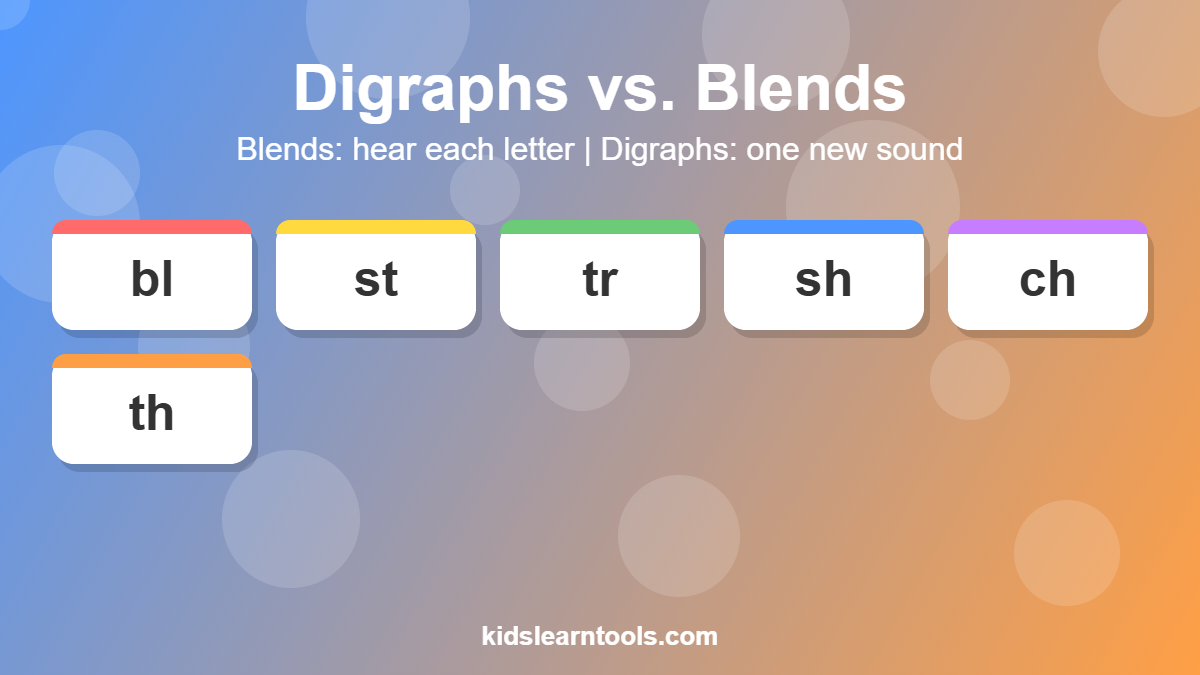
This is one of the most common questions parents and teachers ask. Both blends and digraphs are groups of letters, but they work in different ways:
| Consonant Blend | Digraph | |
|---|---|---|
| How many sounds? | Two or three sounds you can still hear | One new sound |
| Examples | bl, st, tr, fl, gr, sp, str | sh, ch, th, wh, ck, ng |
| Sample words | blue, stop, tree, flag | ship, chin, that, duck |
| Easy test | Say it slowly and you hear each letter | Say it slowly and you hear one sound |
A quick test: say stop slowly, “s-t-op.” You can hear both S and T. Now say shop slowly. You hear one sound, /sh/, not S and H. That tells you st is a blend and sh is a digraph.
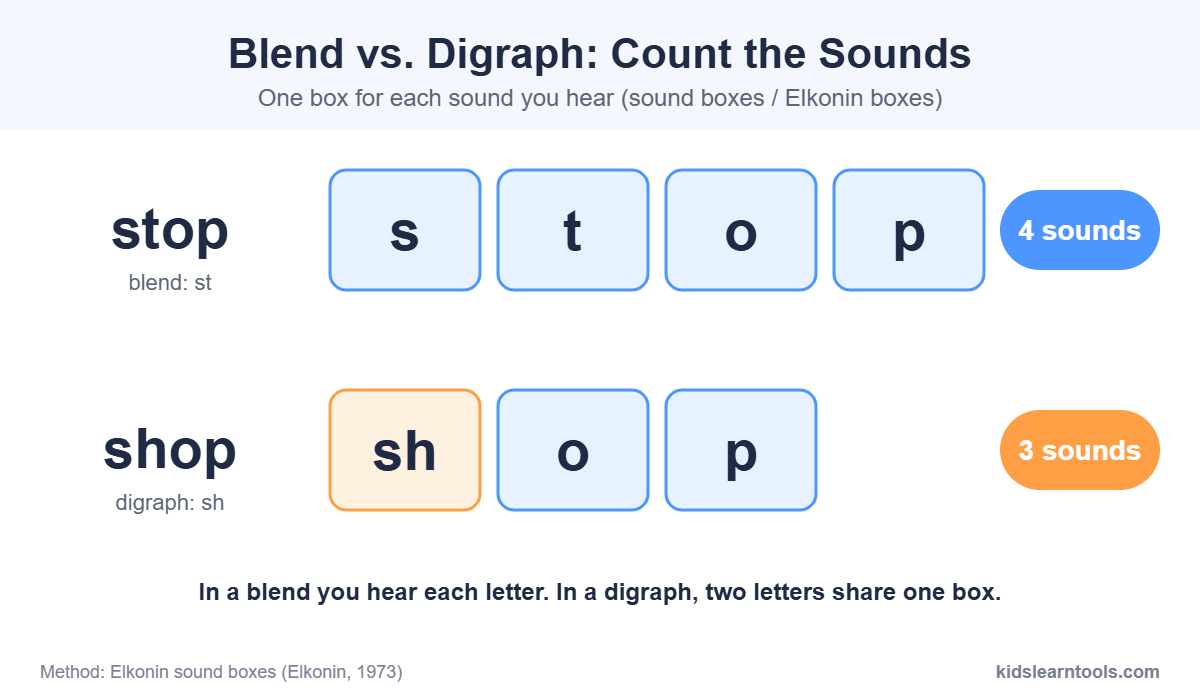
Many teachers use sound boxes, also called Elkonin boxes after the psychologist D. B. Elkonin, to make this difference clear (Elkonin, 1973). Kids push one counter into a box for each sound they hear. Stop needs four boxes, but shop needs only three, because S and H share a single box.
What About Trigraphs?
Once kids are comfortable with two-letter teams, they will meet trigraphs: three letters that make one sound.
- tch as in catch, match, watch, kitchen, itch
- dge as in bridge, badge, edge, fudge, judge
- igh as in high, night, light, right, sight
- air as in hair, fair, chair, stair
Digraph Sentences for Kids
Reading these words inside sentences helps kids practice in a real way. Ask your child to read each sentence and find the special letter pairs.
| Digraph | Practice Sentence |
|---|---|
| sh | The fish is in the dish. |
| ch | I had cheese for lunch. |
| th | This thin moth is on the path. |
| wh | When will the white whale come? |
| ck | The duck sat on a black rock. |
| ng | The king can sing a long song. |
| ph | Dad took a photo of the dolphin. |
| ai / ay | We play in the rain all day. |
| ee / ea | Three bees sat on a green leaf. |
| oa / oo | The goat ate food by the boat. |
How to Teach Digraphs to Kids
Kids learn best when they see, hear, say and write each new sound. Use these simple steps for each new sound:
Step 1: Introduce One Digraph at a Time
Start with sh, then ch, th, wh and ck. Spend about a week on each one. Make sure your child already knows single letter sounds well. If not, practice with our letter recognition activities first.
Step 2: Give Each Sound an Action
Actions make sounds stick. Put a finger to your lips for /sh/, move your arm like a train for /ch/, stick your tongue out a little for /th/, and blow out a candle for /wh/.
Step 3: Box the Digraph
Write a word and draw a box around the two-letter team. Then tap one finger for each sound. For ship, kids tap three times: /sh/ /i/ /p/. This shows them the two letters count as one sound.
Step 4: Sort Words
Write words on cards and have kids sort them into groups, such as “SH words” and “CH words,” or “blends” and “digraphs.” Sorting builds strong sound awareness.
Step 5: Read and Write
Finish with reading short sentences and writing these words. You can make free tracing pages for any word list with our letter tracing worksheet maker.
For research-based phonics guidance, Reading Rockets’ phonics and decoding resources are a trusted free place for parents and teachers to learn more.
Worked Example: A 10-Minute SH Lesson
Here is how the steps above fit into one short lesson. You only need a pencil, paper and a few small counters:
- Minutes 1–2 (Hear it): Say ship, shell, shop. Ask, “What sound do you hear at the start?” Show the quiet-finger action for /sh/.
- Minutes 3–4 (See it): Write S and H on a card. Explain that these two letters are partners that make one sound.
- Minutes 5–6 (Box it): Draw three sound boxes and map ship as sh | i | p, one counter per box.
- Minutes 7–8 (Read it): Read shop, fish, dish and wish, then the sentence “The fish is in the dish.”
- Minutes 9–10 (Write it): Your child writes two SH words from memory and draws a picture for one of them.
Use the same routine for CH, TH, WH and CK. Just change the action and the word list.
Fun Digraph Games and Activities
- Digraph Hunt: Give kids a picture book and a highlighter. Hunt for words with sh, ch or th and read them aloud together.
- Fishing for Digraphs: Put paper clips on word cards and “fish” with a magnet. Read each word you catch.
- Mystery Bag: Fill a bag with small toys (shell, chick, sock, ring). Kids pull one out and name the sound.
- Digraph Bingo: Call out a word and kids cover the matching letter pair on their card.
- Build the Word: Use letter tiles, keeping both partner letters on one tile, to build words like ch-i-p and sh-o-p.
- Sound Hopscotch: Write letter pairs in chalk squares. Kids say a word for each pair they land on.
Digraph Word List by Grade Level
| Grade | Digraphs to Learn | Example Words |
|---|---|---|
| Kindergarten | sh, ch, th, wh, ck | ship, chin, that, when, duck |
| 1st Grade | ng, ph, kn, wr, ai, ay, ee, ea, oa | ring, phone, knee, write, rain, see, boat |
| 2nd Grade | oo, ie, ue, ew, au, aw, gh + trigraphs | moon, pie, blue, new, saw, laugh, catch |
These sounds also show up in many common kindergarten sight words, such as the, this, that, what, when and she. Practicing both together gives kids double the benefit.
When Do Kids Learn Digraphs? (Common Core Chart)
In the United States, the Common Core reading standards place common consonant pairs in 1st grade (RF.1.3a), long-vowel teams in 1st grade (RF.1.3c) and more vowel teams in 2nd grade (RF.2.3b). Many phonics programs introduce SH, CH and TH a little earlier, in the second half of kindergarten, which is why the table above starts there.
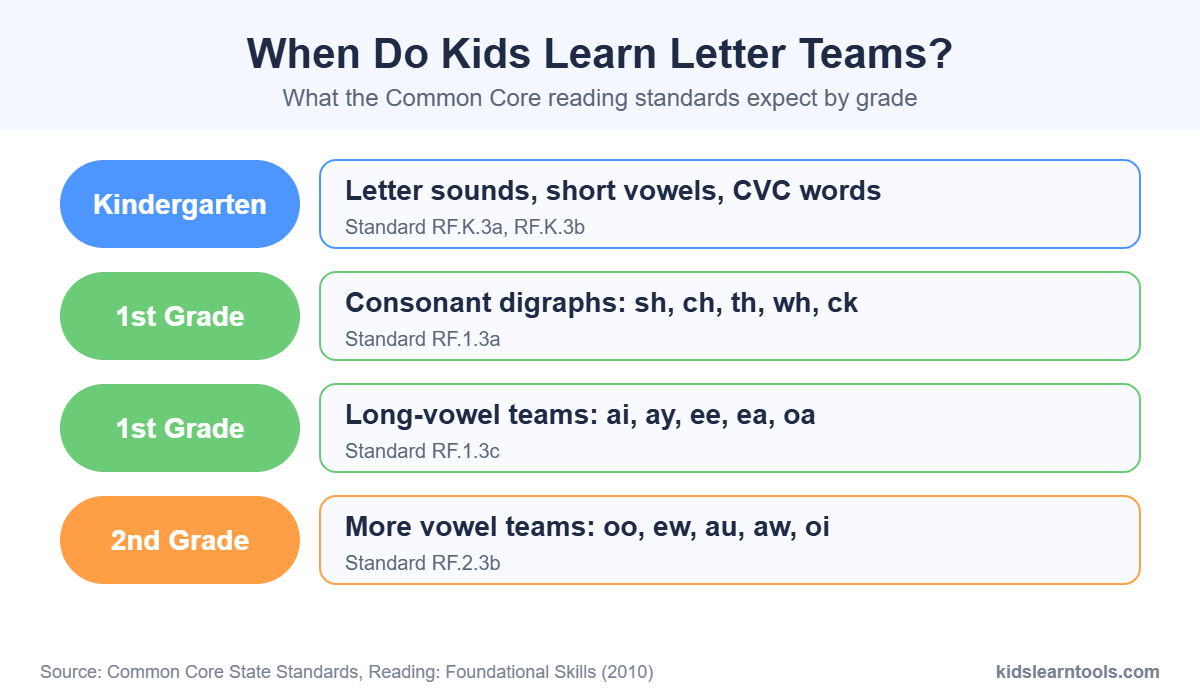
Research supports teaching these sounds in a clear order. The National Reading Panel (2000) found that systematic phonics instruction helps children in kindergarten through 6th grade, and has its strongest effect when it starts early.
Common Digraph Mistakes Kids Make
Almost every beginning reader makes a few of the same mistakes. The good news is that each one has a simple fix:
- Sounding out each letter: A child reads ship as “s-h-i-p.” Fix: box the two letters and remind them, “These two are friends and make one sound.”
- Mixing up sh and ch: These sounds feel similar. Fix: use the “quiet finger” action for /sh/ and the “train arm” action for /ch/, and practice pairs like ship/chip and shop/chop.
- Saying /f/ for th: Many young children say “fing” for thing. Fix: use a mirror so kids can see their tongue peek out between their teeth.
- Writing “k” instead of “ck”: Kids may spell duk for duck. Fix: teach the rule that CK comes right after a short vowel at the end of a short word.
- Reading every ea as long e: Words like bread and head break the rule. Fix: teach kids to try the long sound first, then the short sound, and pick the one that makes a real word.
Remember, mistakes are a normal part of learning. Gentle correction and lots of practice will help these sounds click.
Quick Digraph Check for Parents and Teachers
Not sure if your child is ready to move on? Try this simple five-minute check. Write the words below on cards and ask your child to read them:
- Consonant check: shop, chin, thin, when, duck, ring
- Vowel team check: rain, play, feet, boat, moon, eat
- Mixed check: sheep, chain, teeth, wheel, black, coach
If your child reads most words in each group correctly and without long pauses, they are ready for the next set. If a group is still hard, spend another week on just those sounds before adding more.
Frequently Asked Questions
What are digraphs in simple words?
Digraphs are two letters that make one sound. For example, S and H together make the /sh/ sound in ship.
What are the 5 main consonant digraphs?
The five main consonant digraphs taught first are sh, ch, th, wh and ck. Many lists also include ng and ph.
What is the difference between a blend and a digraph?
In a blend like st or bl, you can still hear each letter. In a digraph like sh or ch, the two letters make one new sound.
What are examples of vowel digraphs?
Common vowel digraphs are ai (rain), ay (day), ee (tree), ea (eat), oa (boat) and oo (moon).
What grade do kids learn digraphs?
Most kids learn consonant digraphs in kindergarten or early 1st grade, and vowel digraphs in 1st and 2nd grade.
How many digraphs are there in English?
There is no single official number, but most phonics programs teach around 10 consonant digraphs and 10 to 15 vowel digraphs.
Is CK a digraph?
Yes. CK is a consonant digraph that makes the /k/ sound, usually at the end of a word after a short vowel, as in duck and sock.
Final Thoughts
Digraphs are a big step in learning to read. Once kids understand that two letters can team up to make one sound, words like ship, chin, that, rain and boat become easy to read. Teach one sound at a time, use actions and games, and practice with real sentences every day. Celebrate small wins, like reading a new word on a cereal box or a street sign, because those moments build a lifelong love of reading. Keep a small notebook of every new word your child can read, and look back at it together each month so they can see how much they have grown as a reader.
Save this digraphs list and use it as your go-to phonics guide. When your child is ready for more, explore our other free phonics guides and printable learning tools for kids.
References
The facts, charts and teaching ideas in this guide are based on the following sources:
- National Governors Association Center for Best Practices & Council of Chief State School Officers. (2010). Common Core State Standards for English Language Arts, Reading: Foundational Skills, Standards RF.K.3, RF.1.3a, RF.1.3c and RF.2.3b. View the 1st grade standards and 2nd grade standards
- National Reading Panel. (2000). Teaching Children to Read: An Evidence-Based Assessment of the Scientific Research Literature on Reading and Its Implications for Reading Instruction. National Institute of Child Health and Human Development. Read the report (NICHD)
- Elkonin, D. B. (1973). U.S.S.R. In J. Downing (Ed.), Comparative Reading (pp. 551–579). Macmillan. How to use Elkonin boxes (Reading Rockets)
- Reading Rockets. Phonics and Decoding (topic guide). WETA Public Broadcasting. Visit the guide