Word Families for Kids: 37 Common Word Family Lists + Fun Activities
Word families are groups of words that share the same ending pattern, like cat, hat, bat and mat in the -at family. Each word has the same vowel and ending sound (the “rime”) and only the first sound changes. Once kids can read one word in a family, they can read many more, which makes word families a quick confidence-builder in kindergarten and first grade.
This guide gives you a complete word families list, starting with easy short vowel families and moving to the 37 most common word families. You will also find a teaching order, 10 simple activities and an important tip on how to use word families the right way.
What Is a Word Family?
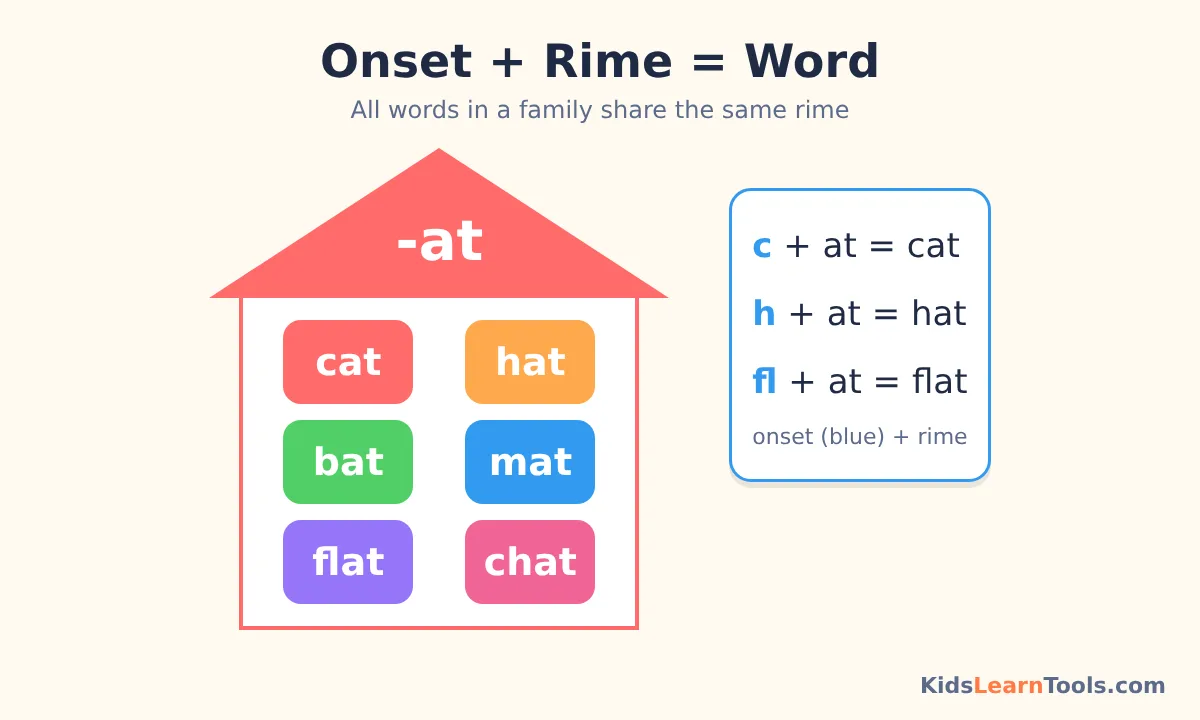
Every one-syllable word can be split into two parts:
- Onset: the sound or sounds before the vowel (c in cat, fl in flat).
- Rime: the vowel and everything after it (at in cat and flat).
A word family is all the words that share the same rime. The rime is also called a phonogram or a “chunk.”
| Onset | + | Rime | = | Word |
|---|---|---|---|---|
| c | + | at | = | cat |
| h | + | at | = | hat |
| fl | + | at | = | flat |
| ch | + | at | = | chat |
Word families vs rhyming words: All words in a word family rhyme, but not all rhyming words are in the same word family. Cat and hat are both in the -at family. Cake and break rhyme, but they are spelled differently, so they are not in the same family.
Why Word Families Help Kids Read
- One pattern, many words: learning -at helps kids read cat, bat, hat, mat, rat, sat, flat and chat.
- Faster reading: kids start to see chunks instead of single letters, which builds fluency.
- Better spelling: if you can spell cat, you can spell hat by changing one letter.
- Confidence: reading a whole list of words quickly feels like a big win for kids who struggle.
In 1970, researchers Richard Wylie and Donald Durrell found that just 37 rimes appear in about 500 words that children commonly read in the early grades. That is why so many teachers use the list of 37 word families below.
Short Vowel Word Families (Start Here)
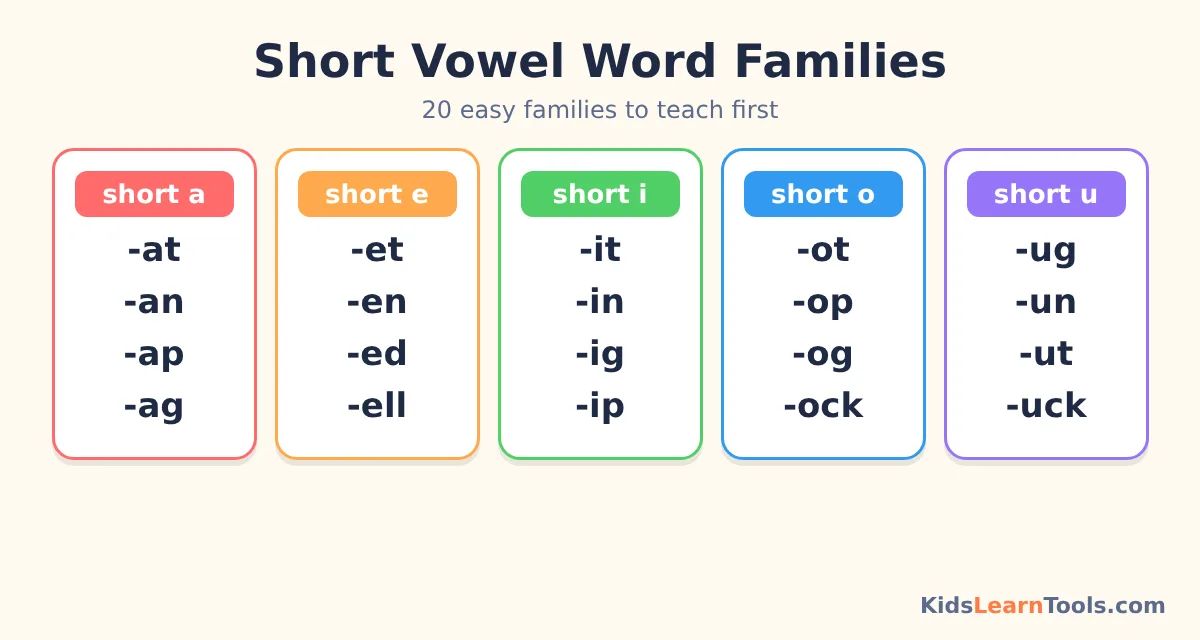
Start with short vowel word families, because they use the simple CVC pattern. Kids should know their short vowel sounds first. Here are the most useful families for each vowel.
Short A Word Families
| Family | Words |
|---|---|
| -at | bat, cat, fat, hat, mat, pat, rat, sat, vat, flat, chat, that |
| -an | can, fan, man, pan, ran, tan, van, plan, scan, than |
| -ap | cap, gap, lap, map, nap, tap, clap, flap, snap, trap |
| -ag | bag, rag, tag, wag, nag, flag, drag, snag, brag |
| -ad | bad, dad, had, mad, pad, sad, glad |
| -am | ham, jam, ram, yam, clam, slam, swam |
See more in our short a words list.
Short E Word Families
| Family | Words |
|---|---|
| -et | bet, get, jet, let, met, net, pet, set, vet, wet |
| -en | den, hen, men, pen, ten, then, when |
| -ed | bed, fed, led, red, wed, sled, shed |
| -eg | beg, leg, peg, keg |
| -ell | bell, fell, sell, tell, well, yell, shell, smell, spell |
See more in our short e words list.
Short I Word Families
| Family | Words |
|---|---|
| -it | bit, fit, hit, kit, lit, pit, sit, wit, spit, split |
| -in | bin, fin, pin, tin, win, chin, grin, skin, spin, thin |
| -ig | big, dig, fig, pig, wig, jig, twig |
| -ip | dip, hip, lip, rip, sip, tip, zip, ship, drip, trip |
| -ill | bill, fill, hill, mill, pill, will, spill, still |
Short O Word Families
| Family | Words |
|---|---|
| -ot | cot, dot, got, hot, lot, not, pot, rot, spot, shot |
| -op | hop, mop, pop, top, cop, chop, drop, shop, stop |
| -og | dog, fog, hog, jog, log, frog, clog |
| -ock | dock, lock, rock, sock, block, clock, flock, shock |
Short U Word Families
| Family | Words |
|---|---|
| -ug | bug, dug, hug, jug, mug, rug, tug, plug, slug, snug |
| -un | bun, fun, run, sun, spun, stun |
| -ut | but, cut, hut, nut, shut |
| -ub | cub, rub, sub, tub, club, scrub |
| -uck | duck, luck, tuck, stuck, truck, cluck |
The 37 Most Common Word Families (Complete List)
This is the classic list of 37 rimes from Wylie and Durrell. It mixes short vowel, long vowel and other vowel patterns, so use it after kids are confident with the short vowel families above.
| # | Word family | Example words |
|---|---|---|
| 1 | -ack | back, pack, sack, black, snack, track |
| 2 | -ail | mail, nail, tail, pail, snail, trail |
| 3 | -ain | rain, main, pain, train, chain, brain |
| 4 | -ake | bake, cake, lake, make, snake, shake |
| 5 | -ale | male, pale, sale, tale, whale, scale |
| 6 | -ame | game, name, same, came, frame, flame |
| 7 | -an | can, fan, man, pan, ran, plan |
| 8 | -ank | bank, tank, sank, thank, drank, blank |
| 9 | -ap | cap, map, nap, tap, clap, snap |
| 10 | -ash | cash, dash, rash, crash, splash, trash |
| 11 | -at | bat, cat, hat, mat, flat, chat |
| 12 | -ate | date, gate, late, plate, skate, crate |
| 13 | -aw | jaw, law, paw, saw, claw, straw |
| 14 | -ay | day, play, say, way, tray, stay |
| 15 | -eat | beat, heat, meat, seat, wheat, treat |
| 16 | -ell | bell, fell, sell, tell, well, shell |
| 17 | -est | best, nest, rest, test, west, chest |
| 18 | -ice | dice, mice, nice, rice, price, slice |
| 19 | -ick | kick, pick, sick, brick, stick, trick |
| 20 | -ide | hide, ride, side, wide, slide, bride |
| 21 | -ight | light, might, night, right, fight, bright |
| 22 | -ill | fill, hill, pill, will, spill, grill |
| 23 | -in | bin, pin, tin, win, chin, spin |
| 24 | -ine | fine, line, mine, nine, pine, shine |
| 25 | -ing | king, ring, sing, wing, swing, thing |
| 26 | -ink | pink, sink, wink, drink, think, blink |
| 27 | -ip | dip, hip, lip, zip, ship, drip |
| 28 | -it | bit, fit, hit, sit, kit, split |
| 29 | -ock | dock, lock, rock, sock, clock, block |
| 30 | -oke | joke, poke, woke, smoke, broke, spoke |
| 31 | -op | hop, mop, pop, top, shop, stop |
| 32 | -ore | more, sore, core, store, snore, shore |
| 33 | -ot | dot, hot, pot, not, spot, shot |
| 34 | -uck | duck, luck, tuck, truck, stuck, cluck |
| 35 | -ug | bug, hug, mug, rug, plug, slug |
| 36 | -ump | bump, jump, lump, dump, stump, plump |
| 37 | -unk | bunk, junk, sunk, trunk, skunk, chunk |
In What Order Should You Teach Word Families?
- Short a families: -at, -an, -ap, -ag. These are the easiest to hear.
- Other short vowel families: -ig, -in, -it, then -op, -ot, -og, then -ug, -un, then -en, -et.
- Families with ck, ll and ss: -ack, -ick, -ock, -uck, -ell, -ill.
- Families with blends and glued sounds: -est, -ump, -ank, -ink, -ing, -unk. See our consonant blends list.
- Families with digraphs: -ash, and words like ship and chop. See our digraphs guide.
- Long vowel families with silent e: -ake, -ate, -ame, -ide, -ine, -ice, -oke.
- Vowel teams and other patterns: -ail, -ain, -ay, -eat, -ight, -aw, -ore.
Teach one or two families a week. Then mix them together, because mixed practice shows if kids are really reading the words.
How to Teach Word Families the Right Way
Word families are very helpful, but they work best alongside full sound-by-sound blending. If kids only memorise the chunk, they may read cat, hat, mat from a list but get stuck when the words are mixed in a sentence.
Follow these simple steps:
- Hear the rhyme first. Say cat, hat, mat. Ask, “What sound is the same?” (at).
- Read the chunk. Show at and blend it: /a/ /t/ → at.
- Add an onset. Put a letter card in front: c + at = cat. Make sure kids also blend all sounds sometimes: /c/ /a/ /t/. Our blending sounds guide shows how.
- Swap the first letter. Change c to h, m, s, b. Kids read each new word.
- Mix the families. Read a mixed list: cat, pig, hop, sun, hen. This checks that kids look at the vowel, not just the ending.
- Read in sentences. “The fat cat sat on a hat.”
- Write the words. Dictate a word (“Write map“) so kids spell by sound and pattern.
10 Fun Word Family Activities
- Word family house: Draw a house with the rime on the roof (-at) and words in the windows (cat, hat, bat, mat).
- Flip book: Write the rime on a long strip and onset letters on short pages stapled on top. Flip to make new words.
- Word slider: Cut two slits in a card and slide a strip of letters through to change the first sound.
- Word family sort: Mix cards from two or three families and sort them into groups.
- Real or silly words: Make words with each letter: bat (real), zat (silly). Silly words prove kids are really decoding.
- Word ladder: Change one letter at a time: cat → hat → hot → hop → mop.
- Rhyme detective: Read a short poem and highlight all the words from one family.
- Word family bingo: Call out a word (bug); kids cover the -ug family square.
- Word search: Type one family’s words into our free Word Search Maker and print a puzzle.
- Trace and build: Kids trace the words, then build them with letter tiles. Make tracing pages with our letter tracing worksheet maker.
Word Family Sentences for Reading Practice
- The fat cat sat on the mat. (-at)
- Dan ran with a fan in the van. (-an)
- The big pig can dig. (-ig)
- Hop to the top and stop. (-op)
- The bug is snug in the rug. (-ug)
- Ten men had a red hen. (-en)
- I will fill the pail on the hill. (-ill)
- The duck is stuck in the truck. (-uck)
Common Word Family Mistakes (and Fixes)
| Mistake | Example | Fix |
|---|---|---|
| Reads only the ending and guesses the start | reads mat as “cat” | Point to the first letter and say its sound before reading the chunk. |
| Gets stuck when families are mixed | reads pig as “pag” after an -ag list | Always finish with a mixed list. Ask kids to look at the vowel first. |
| Thinks all rhyming words are spelled the same | spells bear as “bair” | Explain that some words rhyme but belong to different families. Sort them together. |
| Reads the list well but not in a sentence | remembers the list order | Shuffle the cards and use sentences every time. |
From My Classroom
During my teaching years, word families were one of my favourite tools for slow learners. A child who could read only a few words could read a whole family of -at words, and that success did wonders for their confidence. For many of them, it was the first time reading felt possible.
But I also learned that lists alone are not enough. Some children read a family list perfectly but stopped looking at the vowel when the words were mixed. So I always finished with mixed sorting work in peer groups. Children read each word aloud to their partner and agreed which family it belonged to. Talking it through together helped them look at every letter, not just the ending.
Word Families: Quick Summary
- A word family is a group of words with the same rime (ending chunk), like cat, hat and mat.
- Start with short vowel families (-at, -an, -ig, -op, -ug), then move to the 37 common families.
- Teach 1 to 2 families a week, then mix them so kids look at every letter.
- Use word families with full sound-by-sound blending, not instead of it.
- Make practice fun with houses, flip books, sorts and silly words.
Frequently Asked Questions About Word Families
What are word families?
Word families are groups of words that share the same ending pattern, like cat, hat and mat in the -at family. Only the first sound changes.
What are the 37 word families?
They are 37 common rimes found by Wylie and Durrell (1970): ack, ail, ain, ake, ale, ame, an, ank, ap, ash, at, ate, aw, ay, eat, ell, est, ice, ick, ide, ight, ill, in, ine, ing, ink, ip, it, ock, oke, op, ore, ot, uck, ug, ump and unk.
Which word family should I teach first?
Most teachers start with -at and -an because the short a sound is easy to hear and there are many simple words in these families.
What age should kids learn word families?
Kids usually start word families in kindergarten, around age 5, once they know most letter sounds. They keep using them with blends and long vowels in first grade.
Are word families and rhyming words the same?
Not exactly. Words in a word family always rhyme and share the same spelling pattern. Some rhyming words, like cake and break, are spelled differently, so they are in different families.
Do word families help with spelling?
Yes. When kids know one word in a family, they can spell many others by changing the first letter, for example cat, hat, bat and flat.