
A word search maker turns your own word list into a printable word search puzzle. Type your words or pick a ready-made list (sight words, CVC words, animals, seasons), choose Easy, Medium or Hard, and print the puzzle with a matching answer key. Kids can also solve it on screen by tapping the first and last letter of each word. It is free, needs no sign-up, and your words are never saved.
I made this word search generator for kids after 8 years of teaching in schools. Word searches are one of the easiest ways to make spelling and sight word practice feel like a game, and the best puzzles use the exact words your child is learning this week.
Make Your Free Word Search Puzzle
One word per line, or separate with commas. Letters only, up to 20 words. Spelling words work great.
Easy: words go across and down only.
Your words stay in your browser. Nothing is sent or saved.
Play on screen: tap the first letter of a word, then the last letter (or drag across it).
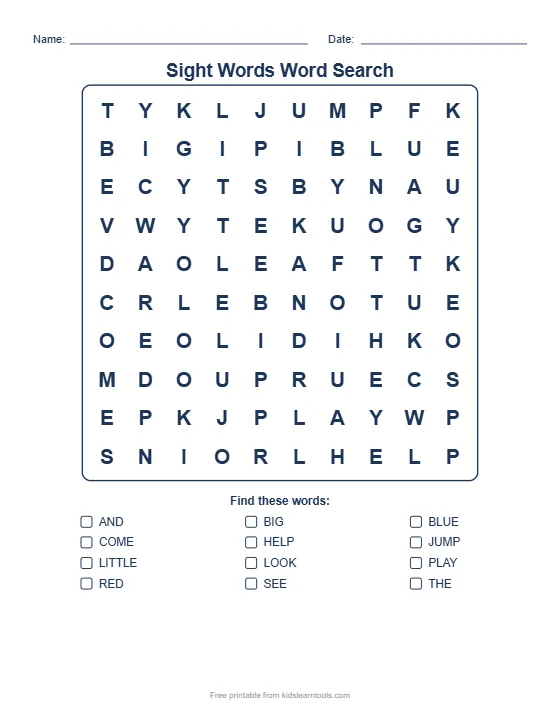
How to Make a Word Search for Kids
You can make a custom word search puzzle in under a minute:
- Add your words. Pick a ready-made list, or type your own words, one per line or separated by commas. You can use up to 20 words.
- Choose a level. Easy puts words across and down. Medium adds diagonal words. Hard uses all 8 directions, including backwards.
- Set the look. Choose the grid size (or leave it on Automatic), uppercase or lowercase letters, and a title.
- Play or print. Solve the puzzle on screen, or click “Print or save as PDF”. The answer key prints on the second page.
- Want a different puzzle? Click “Make a new puzzle” to mix up the same words in new places.
Word Search Levels: Easy, Medium and Hard
The right level keeps kids challenged without making them give up. Use this table to choose.
| Level | Word directions | Typical grid | Best for |
|---|---|---|---|
| Easy | Across (left to right) and down | 8 by 8 to 10 by 10 | Kindergarten and 1st grade, first word searches |
| Medium | Across, down and diagonal | 10 by 10 to 12 by 12 | 1st to 3rd grade |
| Hard | All 8 directions, including backwards | 12 by 12 to 15 by 15 | 3rd grade and up, and puzzle lovers |
For an extra challenge, turn off “Show the word list”. Kids then have to read the grid and find words on their own, which is a great test of sight word recognition.
Word Lists You Can Use
This free word search maker includes ready-made lists, so you can print a puzzle in one click. You can also edit any list or replace it with your own spelling words.
| Word list | Example words | Skill it practices |
|---|---|---|
| Sight words (pre-primer, primer, first grade) | the, and, said, could, every | Reading high-frequency words by sight |
| CVC words | cat, dog, sun, bed, cup | Phonics and short vowel sounds |
| Colors and shapes | yellow, purple, circle, triangle | Early vocabulary for preschool and kindergarten |
| Animals, ocean animals and body parts | zebra, octopus, knees, mouth | Science and everyday vocabulary |
| Seasons and holidays | pumpkin, turkey, mitten, snowman | Themed classroom fun for fall and winter |
| Space | planet, comet, galaxy, astronaut | Science vocabulary |
| Your spelling words | This week’s list from school | Spelling practice and test review |
Why Word Searches Are Good for Kids
A word search looks like a simple game, but kids practice several important skills while they play:
- Spelling. To find a word, kids hold its letter order in mind and match it letter by letter.
- Sight word recognition. Seeing the same word again and again helps kids read it quickly.
- Visual scanning. Moving the eyes across rows and down columns builds the tracking skills used in reading.
- Focus and patience. A word search asks kids to keep going until every word is found.
- Vocabulary. Themed puzzles introduce new words in a low-pressure way.
Which Age Is Ready for a Word Search?
Most kids can try an Easy word search around age 5, once they know their letters and can read a few short words. Use this guide as a starting point.
| Age / grade | Settings to try | Word list idea |
|---|---|---|
| Preschool (age 4 to 5) | Easy, 8 by 8, uppercase, 5 to 6 words | Colors or shapes, done together with an adult |
| Kindergarten (age 5 to 6) | Easy, automatic grid, word list on | Pre-primer sight words or CVC words |
| 1st grade (age 6 to 7) | Easy or Medium, lowercase | Primer and first grade sight words |
| 2nd to 3rd grade (age 7 to 9) | Medium or Hard, 12 by 12 or bigger | Weekly spelling words or science vocabulary |
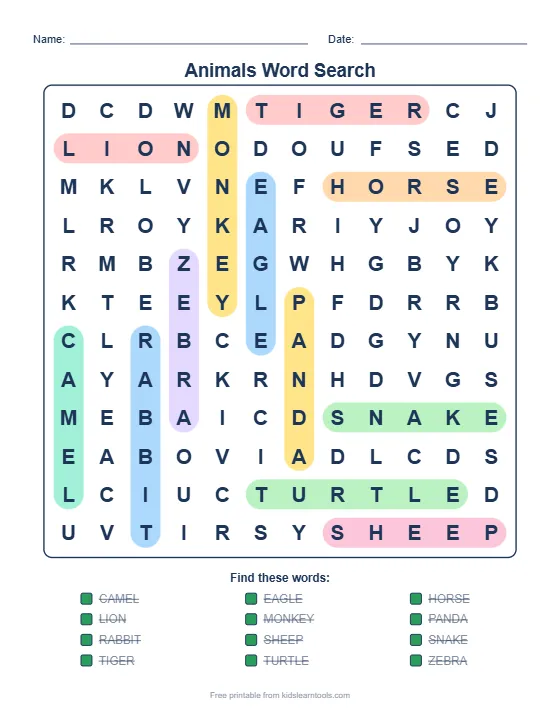
How to Use Word Searches for Spelling Practice
A word search becomes real spelling practice when you add a few simple steps before and after the puzzle:
- Read the list first. Say each word aloud with your child and spell it together.
- Break long words into parts. Clap the syllables of longer words (pump-kin, ham-bur-ger) so they are easier to remember and spot.
- Find and say. Each time your child finds a word, they say it and spell it out loud.
- Write it. After the puzzle, ask your child to write three of the words without looking.
- Turn off the list. On the next day, print the same words with the word list hidden for a quick review.
From My Classroom: Word Games That Build Lasting Spelling Skills
For eight years, I taught in schools and colleges, with a special focus on slow learners. I learned that kids remember words much better when they learn them through activities rather than through memorizing lists.
Breaking Difficult Words into Smaller Parts
When students struggled with long or unfamiliar words, I used phonics and syllable segmentation. I would write a word like appreciate on the board as ap-pre-ci-ate, pronounce each part clearly, and ask the kids to repeat it. Then they recalled the word and tried to spell it on their own. This chunking approach made difficult words manageable, and the kids did not forget them.
Learning Together in Groups
I also organized my class into three groups, Super, Duper and Average, and paired kids so they could learn from one another. Kids often feel more comfortable exploring new words with their peers, and it builds their confidence.
How This Applies to Word Searches
A word search fits naturally into this approach. Read and chunk the words first, then let your child find them in the puzzle. Pair a confident speller with a child who needs more support, and let them search together. Activities like these turn spelling practice into something kids enjoy, and what they learn through activities stays with them for a long time.
Classroom and Home Tips
- Early finishers: Keep a stack of puzzles with this week’s spelling words for kids who finish work early.
- Literacy centers: Print Easy and Medium versions of the same list so every group works at the right level.
- Partner race: Two kids solve the same puzzle, taking turns to find one word each.
- Screen time with a purpose: Let your child solve the puzzle on a tablet instead of a game app.
- Save ink: Print in black and white. The puzzle is designed to work without color.
More Free Learning Tools
- Name tracing generator: printable name tracing worksheets with handwriting lines
- Letter tracing worksheet maker: trace letters, words and names
- CVC words for kids: a full list of CVC words with activities
- Hundreds chart maker: printable 100 charts, puzzles and missing numbers
- Printable mazes for kids: more puzzle fun for early finishers
Frequently Asked Questions
Is this word search maker free?
Yes. You can make, print, download and play as many word search puzzles as you like, with answer keys, for free. There is no sign-up.
How do I make a word search for kids?
Type your words or choose a ready-made list, pick the Easy level so words go only across and down, and click “Print or save as PDF”. The answer key prints on the second page.
Can I make a word search with my child’s spelling words?
Yes. Choose “My own words” and type the spelling list, one word per line or separated by commas. You can add up to 20 words.
Can kids play the word search online?
Yes. Tap the first letter of a word and then the last letter, or drag across it. Found words are highlighted and crossed off the list.
Why did some of my words not fit?
A word cannot be longer than the grid. Choose a bigger grid size, use fewer words, or shorten very long words, then click “Make a new puzzle”.
What age is a word search good for?
Easy word searches work well from about age 5, once kids know their letters. Medium and Hard puzzles are better for 2nd grade and up.