Blending Sounds: How to Teach Kids to Blend, Step by Step
Blending sounds means joining individual sounds together to say a whole word, for example /c/ /a/ /t/ → cat. It is the key skill that turns knowing letter sounds into real reading. Kids usually start oral blending (by listening) in pre-K or kindergarten, and blending printed CVC words in kindergarten.
Many kids know all their letter sounds but still cannot read a simple word. That is normal, and it is almost always a blending problem. This guide explains what blending is, shows the steps in the right order, compares three blending methods, and gives you games, a 5-minute daily routine and fixes for the most common blending problems.
What Is Blending in Phonics?
Every word is made of small sounds called phonemes. The word sun has three phonemes: /s/ /u/ /n/. Blending is putting those phonemes together smoothly so they become one word.
There are two kinds of blending, and kids need both:
| Oral blending | Phonics blending (decoding) | |
|---|---|---|
| Uses letters? | No, listening only | Yes, kids read letters |
| Example | You say /m/ /o/ /p/, child says “mop” | Child sees mop, says each sound, then reads “mop” |
| Skill area | Phonemic awareness | Phonics and decoding |
| When | Pre-K and kindergarten | Kindergarten and first grade |
Blending vs segmenting: Blending puts sounds together for reading (/d/ /o/ /g/ → dog). Segmenting breaks a word into sounds for spelling (dog → /d/ /o/ /g/). They are two sides of the same skill, so practice both.
Is My Child Ready to Blend Sounds?
Before you start blending printed words, check these four things:
- ✅ Knows the sounds of several letters, including at least one or two vowels (start with m, s, a, t, p, i, n).
- ✅ Can hear and say the first sound in a word (“What sound does fish start with?”).
- ✅ Can blend syllables orally (“rain…bow” → rainbow).
- ✅ Can blend onset and rime orally (“c…at” → cat).
If a child cannot do the last two yet, do not worry. Stay with oral games (steps 1 to 4 below) for a while. If letter sounds are still shaky, our letter sounds video and letter recognition activities are a good place to start.
The Blending Ladder: 8 Steps from Easy to Hard
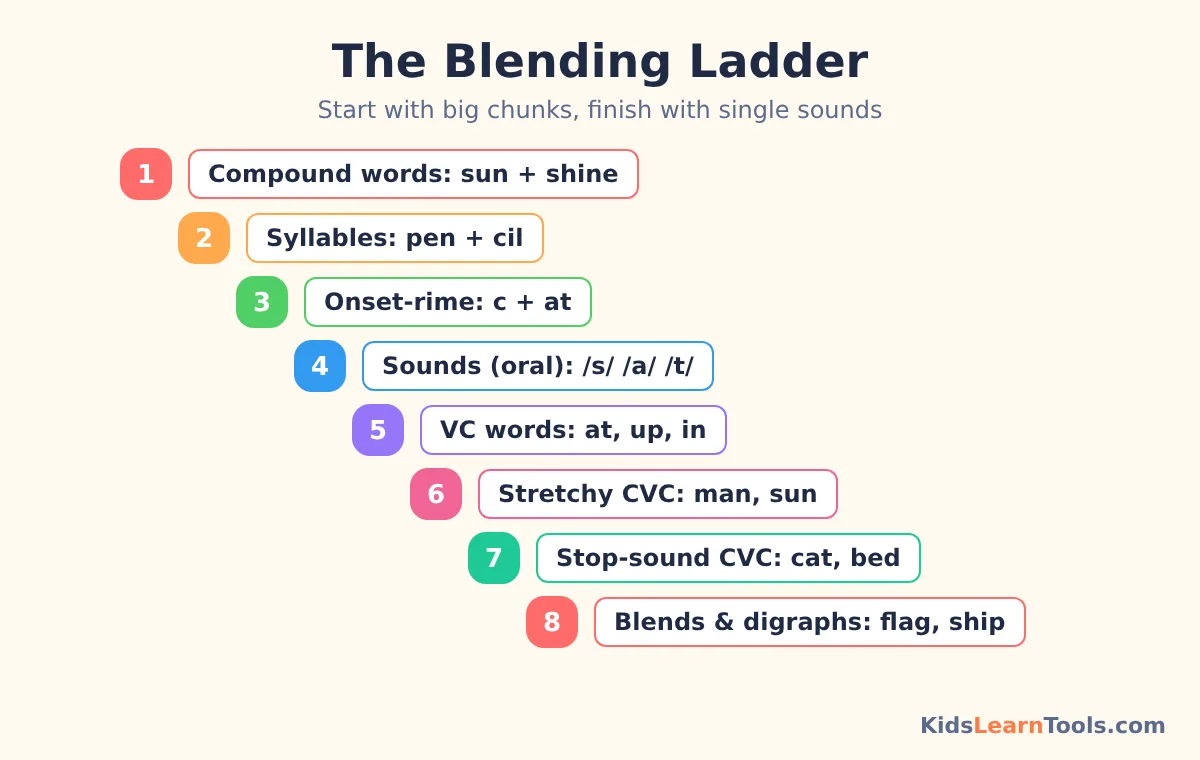
Blending is easiest with big chunks of sound and gets harder as the chunks get smaller. Move up one step at a time.
- Compound words (oral): sun…shine → sunshine, cup…cake → cupcake.
- Syllables (oral): ta…ble → table, pen…cil → pencil.
- Onset and rime (oral): c…at → cat, m…op → mop, s…un → sun.
- Two and three phonemes (oral): /u/ /p/ → up, /s/ /a/ /t/ → sat.
- VC words in print: at, in, up, on, it, am.
- CVC words with stretchy sounds: sam, man, fan, sun, mom, fin, run.
- CVC words with stop sounds: cat, bed, dig, top, bug. See our full CVC words list.
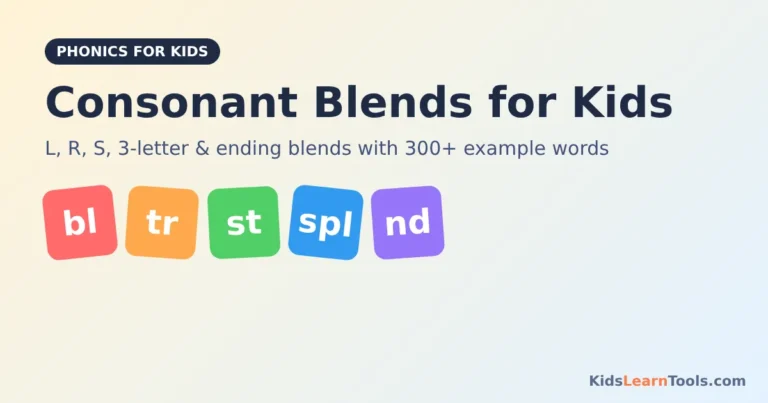
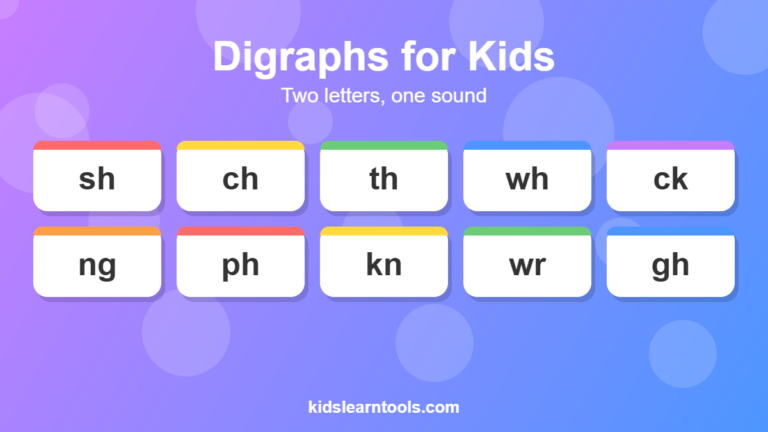
- Longer words: words with consonant blends (flag, nest) and digraphs (ship, chin), then decodable sentences and books.
This order matches early reading standards. For example, Common Core RF.K.2 asks kindergarten kids to blend syllables and onsets and rimes, and RF.1.2.b asks first graders to blend single-syllable words, including words with consonant blends.
Why Start with “Stretchy” Sounds?
Some sounds can be held for a long time. These are called continuous sounds: m, s, f, l, n, r, v, z and all the vowels. Try it: you can say “mmmmmm” for as long as you have breath.
Other sounds can only be said quickly. These are stop sounds: b, c/k, d, g, p, t. If kids try to stretch them, they add an extra “uh” (buh, kuh, tuh), and cat becomes “kuh-a-tuh.”
That is why words like man, sun, fan and mom are easiest to blend. Kids can slide from one sound into the next without stopping: “mmmaaannn” → man.
| Easiest to blend | A little harder | Hardest |
|---|---|---|
| Stretchy start: sam, man, fan, sun, ram, lip | Stop sound at the end: sat, map, fig, mud | Stop sound at the start: cat, dog, bed, tub |
3 Ways to Teach Blending (Which One to Use?)
1. Continuous Blending
Kids say each sound without stopping, holding it until they move to the next: “sssuuunnn” → sun. Many reading experts prefer this method because the sounds never get separated, so kids don’t forget them. It works best with stretchy sounds.
2. Successive (Cumulative) Blending
Kids blend as they go. Say the first sound, add the second and blend them, then add the third:
- /m/ → /m/ /a/ → “ma” → /m/ /a/ /p/ → “map”
This is a great choice for kids who forget the first sound by the time they reach the last one.
3. Onset-Rime or “Body-Coda” Blending
Kids blend in two chunks. Either the first consonant + the rest (c + at), or the first two sounds + the last (ca + t). This works well with word families and is a good bridge for kids who struggle with three single sounds.
| Method | Example (sun) | Best for |
|---|---|---|
| Continuous | “sssuuunnn” → sun | Most kids, words with stretchy sounds |
| Successive | s → su → sun | Kids who forget sounds |
| Onset-rime | s + un → sun | Kids who need bigger chunks |
Tip: Avoid the old “say each sound separately, then guess the word” method (/s/… /u/… /n/…). The long gaps make it hard for many kids to hold the sounds in memory.
A 5-Minute Daily Blending Routine
Short daily practice works much better than one long session a week. Here is a simple routine for home or class:
- Warm-up, oral (1 minute): “Robot talk.” You say 3 to 5 words in robot sounds (/p/ /i/ /g/), and your child says the word.
- Sound review (1 minute): Flash the letter cards you are using today. Child says the sound, not the letter name.
- Build and blend (2 minutes): Build 4 or 5 CVC words with letter tiles. Child touches each letter, says the sound and blends.
- Read it in a sentence (1 minute): One short sentence with today’s words, like “The pig sat in the mud.”
Stop while your child is still enjoying it. Five happy minutes every day is better than twenty tired ones.
10 Fun Blending Sounds Games and Activities
- Robot talk: Speak like a robot (/c/ /u/ /p/) and let your child “translate.”
- I spy, robot style: “I spy a /b/ /a/ /g/.” Child finds the bag.
- Blending slide: Draw a slide on paper with letters on it. Kids slide a finger down, saying the sounds faster and faster until the word pops out.
- Toy car road: Write a CVC word on a “road.” Drive a toy car over each letter slowly, then fast.
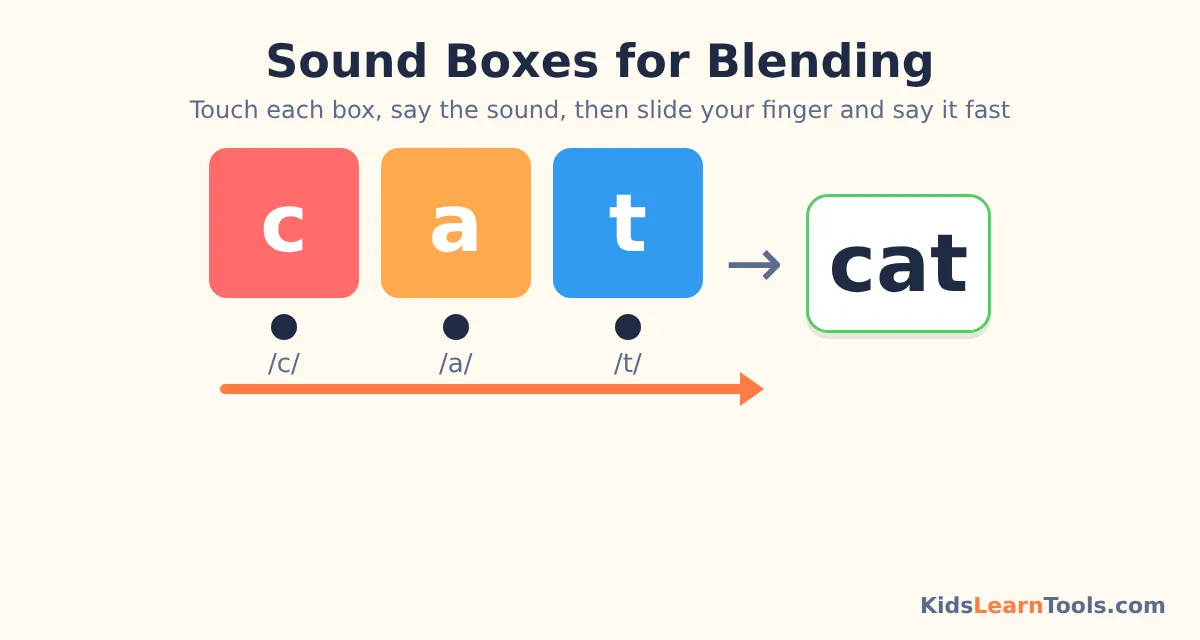
- Sound boxes: Draw three boxes. Push one counter into each box as you say each sound, then sweep your finger under them to blend.
- Stretchy snake: Pull a rubber band or slinky as you stretch the sounds, then let it go back as you say the word.
- Mystery bag: Put small toys in a bag. Say the name in sounds (/h/ /e/ /n/) and the child pulls out the right one.
- Word ladder: Change one letter at a time: cat → hat → hot → hop → mop.
- Real or silly?: Blend made-up words (zib, mog) too. Nonsense words show if kids are really blending or just guessing from memory.
- Read and find: After blending a list of words, find them in a puzzle made with our free Word Search Maker.
My Child Can’t Blend Sounds: Problems and Fixes
| What you see | Likely reason | What to do |
|---|---|---|
| Says the sounds correctly but cannot say the word (/c/ /a/ /t/ → “tac” or silence) | Sounds are too far apart, so they are forgotten | Use continuous or successive blending. Say “Say it fast!” and model it. Go back to oral blending games. |
| Adds “uh” to sounds (“kuh-a-tuh”) | Stop sounds are being stretched | Model short, clipped sounds. Use words that start with stretchy sounds (man, sun) first. |
| Forgets the first sound (/m/ /a/ /p/ → “ap”) | Working memory is full | Use successive blending (m → ma → map). Keep a finger on the first letter. |
| Guesses a word from the first letter (sun → “snake”) | Relying on the first letter or pictures | Cover the word and reveal one letter at a time. Use nonsense words so guessing doesn’t work. |
| Changes the vowel (pen → “pin”) | Vowel sounds not secure | Practice the tricky vowels separately. See our short vowel words guide. |
| Slow, effortful sounding out | Letter-sound knowledge is not automatic yet | Do 1-minute daily letter-sound flash reviews until each sound comes instantly. |
Most kids “click” with blending after a few weeks of daily practice. If a child still cannot blend simple spoken words after steady practice through kindergarten, it is a good idea to talk to their teacher or a reading specialist. Early help makes a big difference.
How Do You Know a Child Has Mastered Blending?
- They can blend spoken CVC words you say in sounds, quickly and correctly.
- They can read new CVC words they have never seen before, including nonsense words.
- They stop saying every sound out loud and start “whisper blending,” then reading words at a glance.
- They can read a short decodable sentence without stopping on every word.
When these feel easy, move on to blend words, digraphs like sh words and th words, and simple sight words from our kindergarten sight words list.
From My Classroom
Over eight years of teaching, many of the children I supported were slow learners, and blending was where many of them got stuck. They knew their letter sounds, but when they tried to read a word they said each sound separately and then could not put the sounds together. For these children, the answer was not more flashcards. It was short, regular practice in joining sounds.
I used phonics and syllable methods side by side: we blended big chunks first, like syllables, and then moved to single sounds. I also used peer groups, where children took turns saying words in sounds for a partner to blend. Every small success was celebrated, because for a child who struggles, confidence is just as important as the skill itself.
Blending Sounds: Quick Summary
- Blending means joining sounds into a word: /s/ /u/ /n/ → sun.
- Start with oral blending (compound words, syllables, onset-rime) before printed words.
- Begin with stretchy sounds (m, s, f, l, n, r) and VC or CVC words.
- Use continuous blending for most kids, successive blending for kids who forget sounds.
- Practice 5 minutes a day with games, and use nonsense words to check real blending.
Frequently Asked Questions About Blending Sounds
What does blending sounds mean?
Blending sounds means joining individual letter sounds together to say a whole word. For example, /c/ /a/ /t/ blended together makes cat.
At what age should a child be able to blend sounds?
Many kids can blend simple spoken words orally by age 4 to 5. Most learn to blend printed CVC words during kindergarten, around age 5 to 6. Every child is different, so steady daily practice matters more than age.
Why can my child say the sounds but not blend them?
Usually the sounds are said too slowly and separately, so the child forgets the first sound before reaching the last. Continuous blending (“sssuuunnn”) or successive blending (s → su → sun) helps keep the sounds together.
What is the difference between blending and segmenting?
Blending joins sounds into a word for reading (/d/ /o/ /g/ → dog). Segmenting breaks a word into its sounds for spelling (dog → /d/ /o/ /g/).
Which words are easiest for blending practice?
VC words like at and up, and CVC words that start with stretchy sounds, like man, sun, fan and sam, are the easiest because kids can slide from one sound to the next without stopping.
How long does it take to learn blending?
With 5 to 10 minutes of daily practice, many kids start blending CVC words within a few weeks. Some kids need longer, and that is normal.