Kindergarten Math Worksheets: 8 Free Printables + Month-by-Month Guide
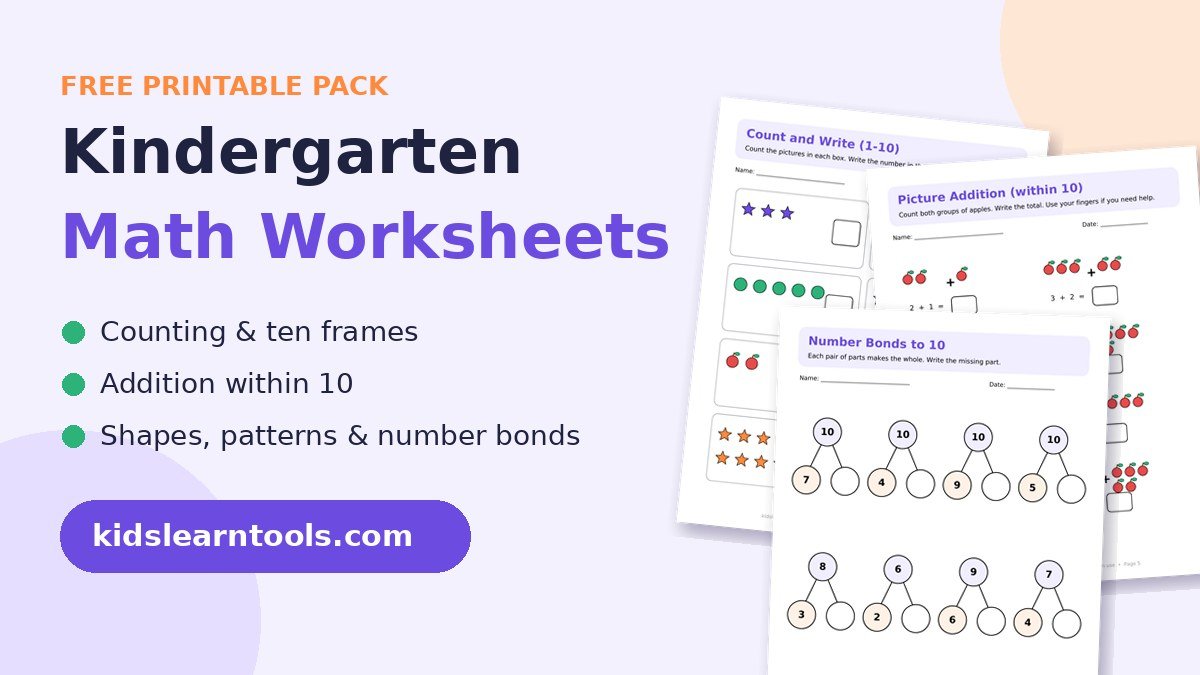
Kindergarten math worksheets are short printable pages that help kids aged 5 to 6 practice counting, number writing, comparing groups, adding and subtracting within 10, shapes, patterns and simple measuring. The best ones use pictures, ten frames and real objects first, and take only 10 to 15 minutes a day.
Below you will find a free pack of 8 kindergarten math worksheets with an answer key, a month-by-month plan for the whole school year, a skills table based on the Common Core, real-life practice ideas, and the mistakes I saw most often in my own classroom.
Free Kindergarten Math Worksheets (Printable PDF)
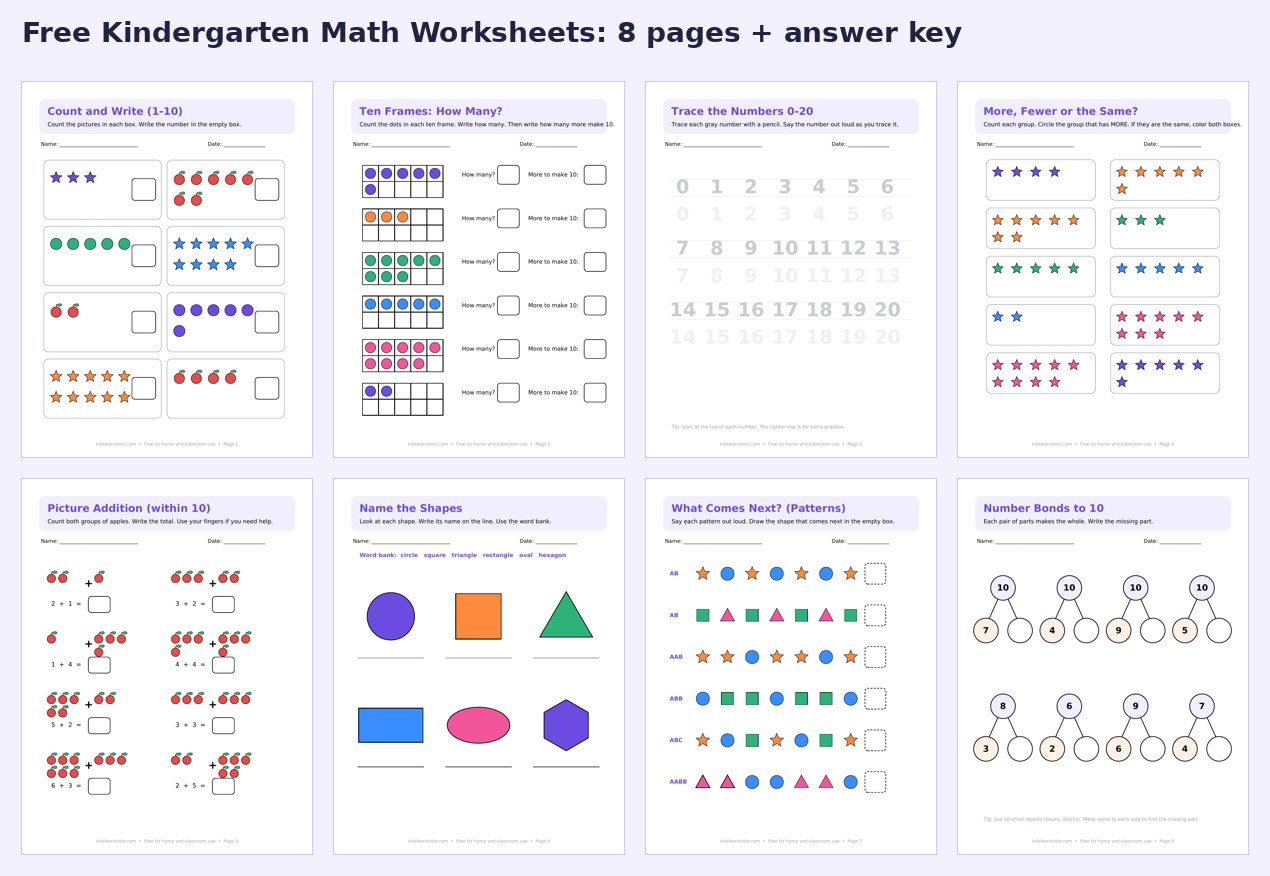
Every page in this pack was made for kids who are still building number sense, so the pictures are big, the instructions are short, and there is plenty of space to write. Print the pages you need, or the whole set.
⬇ Download the free kindergarten math worksheets pack (PDF, 9 pages)
| Page | Worksheet | Skill practiced | Best time of year |
|---|---|---|---|
| 1 | Count and Write (1-10) | Counting objects, writing numerals | Aug-Oct |
| 2 | Ten Frames: How Many? | Subitizing, making 10 | Oct-Dec |
| 3 | Trace the Numbers 0-20 | Number formation | Aug-Nov |
| 4 | More, Fewer or the Same? | Comparing groups | Oct-Dec |
| 5 | Picture Addition (within 10) | Adding with pictures | Dec-Mar |
| 6 | Name the Shapes | 2D shape names | Sep-Oct |
| 7 | What Comes Next? (Patterns) | AB, AAB, ABB, ABC patterns | Sep-Nov |
| 8 | Number Bonds to 10 | Part-part-whole, partners of 10 | Jan-Apr |
| 9 | Answer Key | For parents and teachers | – |
Need more pages? Our free math worksheet generator makes a new addition or subtraction sheet every time you click, with a 0-5 range for Pre-K and a 0-10 range for kindergarten, plus an answer key. For counting practice, print a chart from the hundreds chart maker.
What Math Do Kids Learn in Kindergarten?
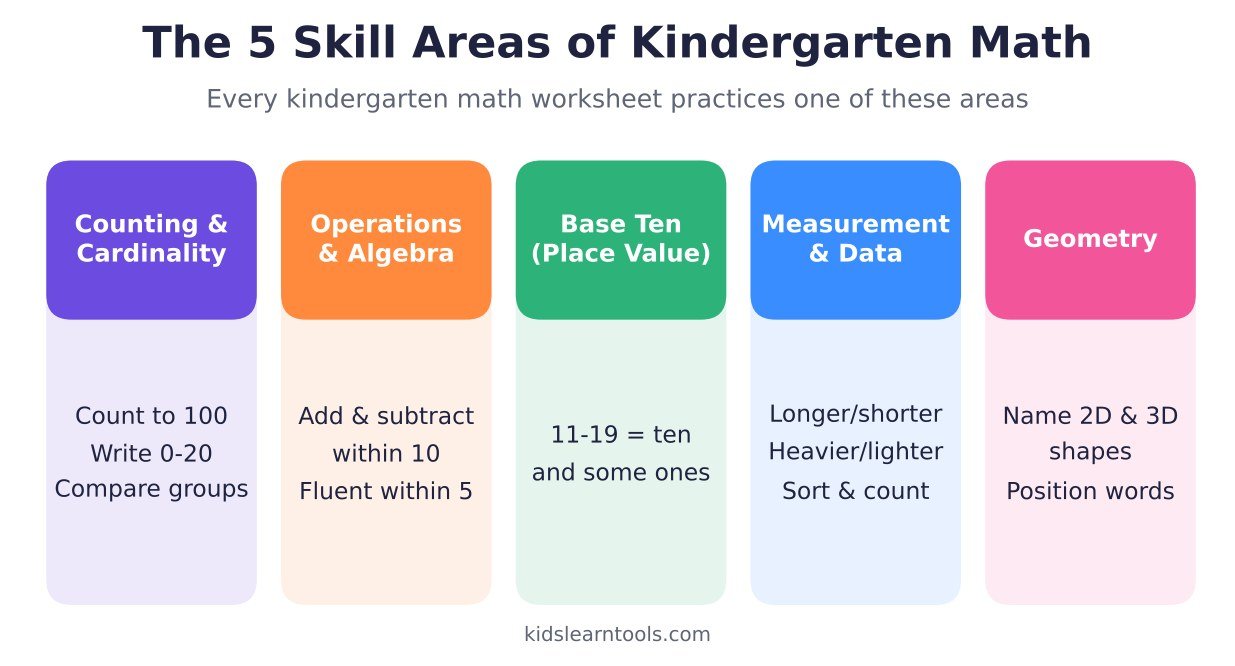
Kindergarten math covers five skill areas. In the US, most schools follow the Common Core kindergarten math standards or a state version of them. Good kindergarten math worksheets match these five areas, so you always know what your child is practicing and why.
| Skill area | What kids should be able to do by the end of kindergarten | Worksheet types that help |
|---|---|---|
| Counting and Cardinality | Count to 100 by ones and tens; write numbers 0-20; count up to 20 objects; know the last number said tells “how many”; compare two groups and two numbers | Count and write, number tracing, ten frames, more or fewer |
| Operations and Algebraic Thinking | Add and subtract within 10 using objects or drawings; solve simple word problems; find the partner that makes 10; add and subtract within 5 fluently | Picture addition, number bonds, story problems |
| Number and Operations in Base Ten | Show 11-19 as one ten and some ones (14 = 10 + 4) | Ten frames, place value mats |
| Measurement and Data | Compare length and weight (longer, shorter, heavier); sort objects and count each group | Compare and measure, sorting sheets |
| Geometry | Name shapes in any size or position; tell 2D from 3D shapes; use position words like above, below, beside | Shape naming, shape hunts, patterns |
Notice what is not on the list: kindergarten does not include written column addition, multiplication, money or telling time to the minute. If a worksheet asks for those, it is meant for older kids.
Types of Kindergarten Math Worksheets (and When to Use Each)
There are many kinds of kindergarten math worksheets online. Here are the ones that actually build skills, in the order most kids need them.
1. Counting and number writing worksheets
These kindergarten math worksheets ask kids to count a group of pictures and write the number. They teach one-to-one correspondence, meaning one number word for each object. Start with groups of 1-5, then 1-10. When your child is ready for bigger numbers, move on to our guide on counting to 100.
2. Number tracing worksheets
Tracing teaches the correct way to form each numeral, starting at the top. Pair them with fine motor activities if your child still finds holding a pencil hard.
3. Ten frame worksheets
A ten frame is a 2 x 5 grid, and it shows up on many kindergarten math worksheets. Kids learn to “see” a number without counting every dot (this is called subitizing). Ten frames are also the bridge to addition, number bonds and teen numbers.
4. Comparing worksheets (more, fewer, the same)
These ask “Which group has more?” Kids can match objects one by one or count both groups. The words more, fewer, greater than and less than become part of their math language.
5. Addition and subtraction worksheets
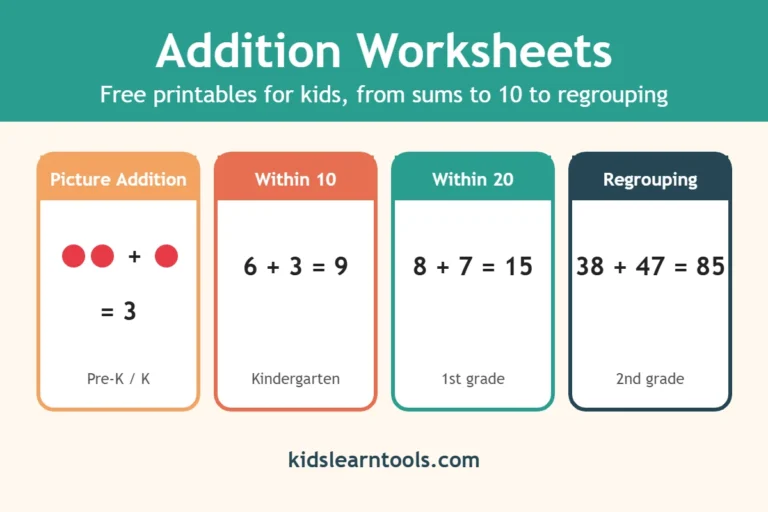
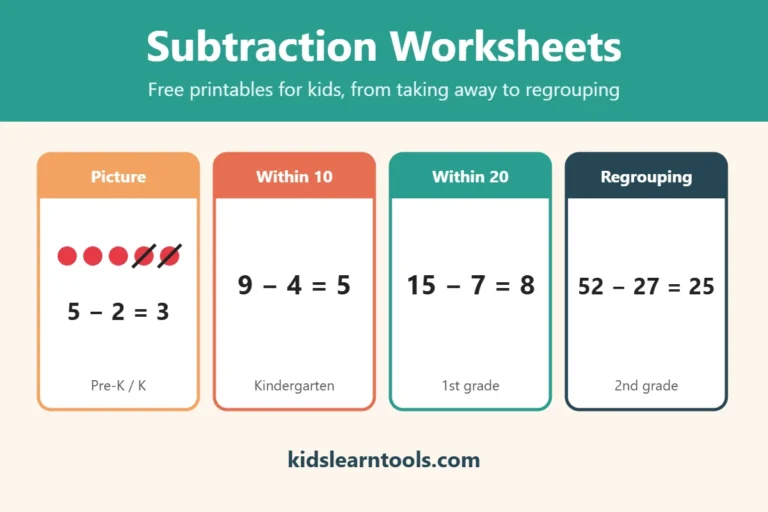
In kindergarten, these should use pictures, fingers or objects, and stay within 10. Fluent facts within 5 come by the end of the year. Check our number bonds guide for the part-part-whole method that makes addition easier, and try the online addition quiz for kids for quick, screen-based review.
6. Shapes, patterns and measurement worksheets
These build geometry and early algebra. Kids name circles, squares, triangles, rectangles and hexagons, finish AB and ABB patterns, and compare lengths. Our shapes video for kids is a nice warm-up before a shape page.
7. Skip counting and hundreds chart worksheets
Toward the end of kindergarten, many kids enjoy counting by 10s and 5s on a hundreds chart. Use our skip counting guide and these 15 hundreds chart activities when your child can count to 100 by ones.
Kindergarten Math Worksheets: Month-by-Month Plan
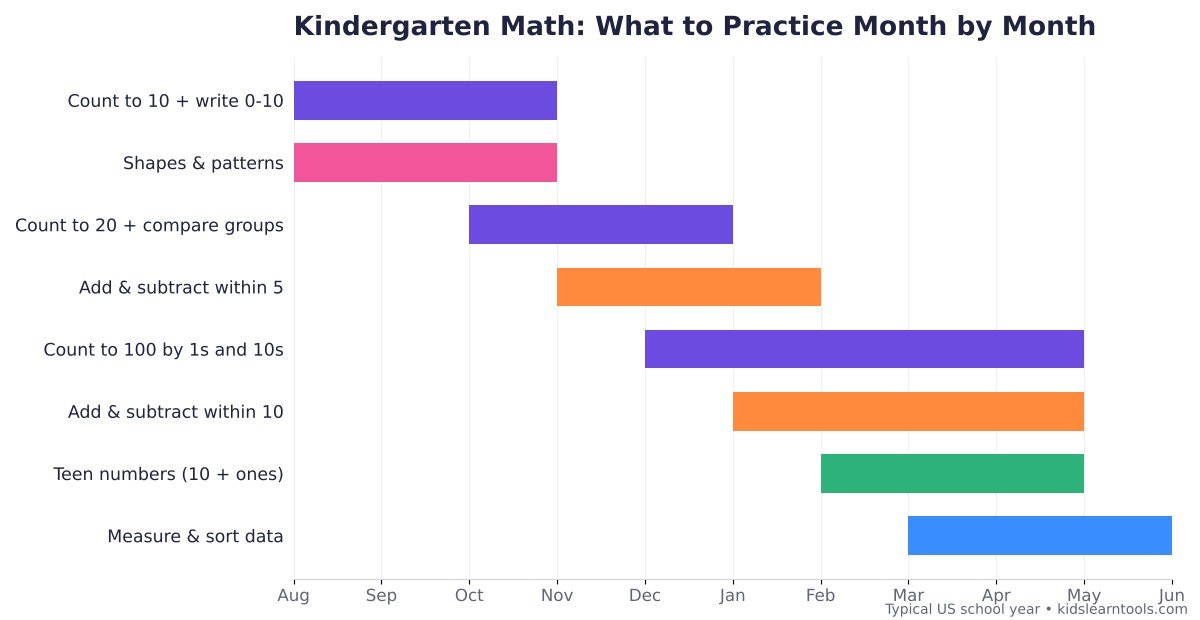
Kids learn math in layers. This plan follows a typical US school year (August to June) and shows when each type of kindergarten math worksheet makes the most sense. If your child is ahead or behind, simply move along the chart at their pace.
| Months | Main focus | Worksheets to use | Quick goal check |
|---|---|---|---|
| Aug-Oct | Numbers 0-10, shapes, patterns | Count and write, number tracing, shapes, patterns | Counts 10 objects correctly and writes 0-10 |
| Oct-Dec | Numbers to 20, comparing, ten frames | Ten frames, more or fewer, number tracing 11-20 | Says which group has more; sees 5 on a ten frame without counting |
| Dec-Feb | Adding and taking away within 5, counting to 100 | Picture addition, hundreds chart, story problems | Solves “3 apples and 2 more” with fingers or pictures |
| Jan-Apr | Within 10, partners of 10, teen numbers | Number bonds, ten frames 11-19, mixed picture problems | Knows all partners of 10 (1+9, 2+8…) |
| Mar-Jun | Measuring, sorting, review | Compare length and weight, sorting and graphing, mixed review | Adds and subtracts within 5 quickly; counts to 100 |
How to Use Kindergarten Math Worksheets the Right Way
A worksheet is the last step, not the first. Research-based math teaching uses the Concrete, Pictorial, Abstract (CPA) approach: kids first touch real objects, then see pictures, and only then work with numbers alone. Most kindergarten math worksheets belong in the middle (pictorial) step.
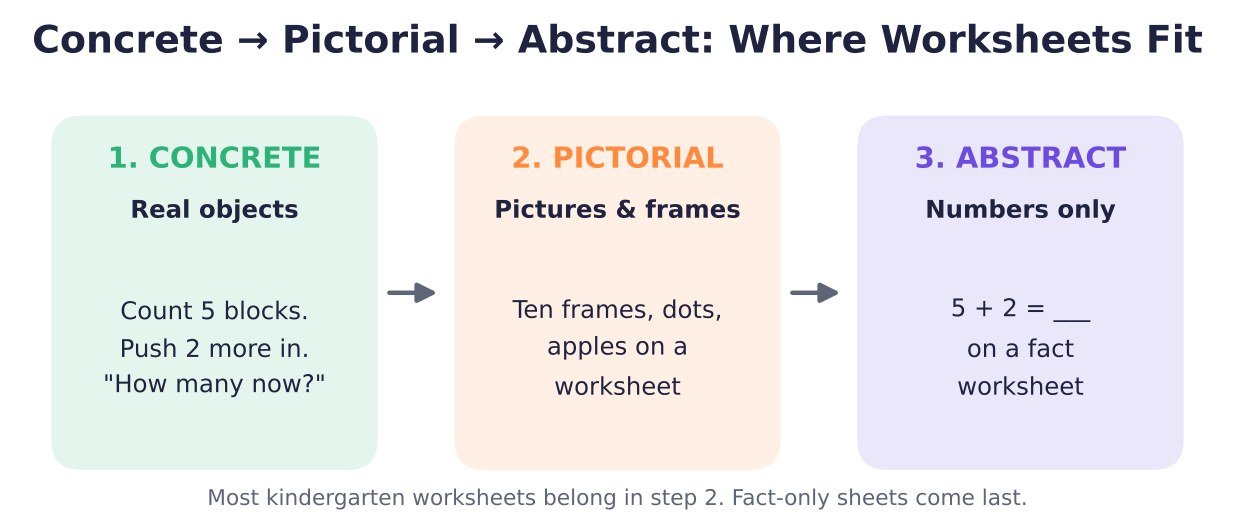
- Start with objects. Before the “Picture Addition” page, act out the same problems with 10 buttons or blocks.
- Keep it short. One page, or even half a page, is enough. Most 5-year-olds focus well for about 10 to 15 minutes.
- Talk while they work. Ask “How did you know?” more often than “Is it right?” Explaining builds real understanding.
- Point and touch. Ask your child to touch each picture as they count. This stops double-counting.
- Repeat with small changes. Doing a similar page 3 or 4 times over two weeks works better than 10 new pages in one day.
- Stop on a good note. End while your child still feels successful, even if the page is not finished.
| Age / level | Pages per session | Session length | Sessions per week |
|---|---|---|---|
| Pre-K (age 4) | ½ page | 5-10 minutes | 2-3 |
| Kindergarten, start of year | ½-1 page | 10 minutes | 3-4 |
| Kindergarten, end of year | 1-2 pages | 10-15 minutes | 4-5 |
Real-Life Math Examples to Pair With Each Worksheet
Kids remember math best when they see it outside the paper. After each worksheet, try one of these quick everyday activities. They take almost no time and need nothing you do not already have at home.
| Worksheet skill | Real-life example | What to say |
|---|---|---|
| Counting objects | Setting the table: one plate for each person | “We have 4 people. How many spoons do we need?” |
| Number writing | Writing the number of apples on a shopping list | “Can you write 6 next to apples?” |
| Comparing groups | Sharing grapes between two bowls | “Who has more? How can we make it the same?” |
| Addition within 10 | Adding toy cars to a parking line | “5 cars are parked. 3 more come. How many now?” |
| Subtraction within 10 | Eating crackers at snack time | “You had 7 crackers and ate 2. How many are left?” |
| Shapes | A walk to spot shapes: stop signs, windows, wheels | “What shape is that sign? How many sides?” |
| Patterns | Lining up socks or blocks: red, blue, red, blue | “What comes next in our sock pattern?” |
| Measuring | Comparing shoes or measuring a table with hands | “Is Dad’s shoe longer or shorter than yours?” |
A fun example from a real kitchen: ask your child to count out 10 strawberries, then “eat” 3 for a story problem. They see 10 – 3 = 7 with their own eyes (and get a snack). That one moment teaches more than five abstract kindergarten math worksheets.
Common Mistakes With Kindergarten Math Worksheets
Even the best kindergarten math worksheets can backfire if they are used the wrong way. Watch out for these common mistakes:
- Skipping objects. Jumping straight to “3 + 4 = __” before a child understands what adding means leads to guessing.
- Too many problems on one page. A page with 30 problems looks scary to a 5-year-old. Choose 6 to 10.
- Only rote counting. Saying 1 to 20 is not the same as counting 20 objects. Practice both.
- Ignoring reversed numbers. Writing 3, 5, 7 or 9 backward is very common at this age. Gently show the start point; do not make it a big deal.
- Using worksheets as punishment. If math feels like a chore, kids switch off. Keep it playful and short.
- Never checking understanding. Use the answer key, but also ask your child to show you one problem with real objects.
How to Adapt Kindergarten Math Worksheets for Every Child
Every child learns at a different speed. The same page can be made easier or harder in seconds, so one set of kindergarten math worksheets can serve a whole family or classroom.
| If your child… | Make it easier | Make it harder |
|---|---|---|
| Gets tired of writing | Let them point, circle or use stickers instead of writing numbers | Ask them to write the number word too (three, seven) |
| Miscounts big groups | Cover half the page; count only 1-5 | Add a “How many more to make 10?” question |
| Finds addition hard | Act out each problem with counters first | Turn each problem into a story: “5 birds sat, 2 more came…” |
| Finishes very fast | Check one answer together with real objects | Ask them to make their own problem for you to solve |
| Is learning English | Read the instructions aloud and show one example | Practice math words: more, fewer, add, take away, equal |
Kids who need more time are not “bad at math.” They usually need more hands-on practice before paper. Kids who race ahead benefit from talking about their thinking, not just doing more pages.
🍎 From My Classroom
In my eight years of teaching, many of my students were slow learners, and math worksheets were often where they felt most stuck. I noticed that the problem was rarely the worksheet itself. It was that we handed them paper before they had held the numbers in their hands.
So I changed my routine. Every math page started with a small basket of counters. A child would build “4 and 2” on a ten frame mat first, then draw it, and only then write 4 + 2 = 6. I also paired a confident child with a child who needed support, so they could explain their thinking to each other. Within a few weeks, kids who used to cry over number pages were asking for “one more sheet.” Objects first, pictures second, numbers last: it works at home too.
Quick Kindergarten Math Skills Checklist
Use this list to see which kindergarten math worksheets your child needs next. Tick a skill only if your child can do it most of the time without help. For the full picture of school readiness, see our kindergarten readiness checklist.
- Counts to 20 out loud (and to 100 by the end of kindergarten)
- Counts up to 10 objects, touching each one once
- Writes numbers 0 to 10, then 0 to 20
- Says which of two groups has more or fewer
- Recognizes small amounts (1-5) on a ten frame without counting
- Adds and subtracts within 5 using fingers or objects
- Knows the partners of 10 (like 6 + 4 and 7 + 3)
- Names a circle, square, triangle, rectangle and hexagon
- Copies and extends an AB pattern
- Compares two objects by length or weight
More Free Kindergarten Math Resources
Use these free tools and guides on Kids Learn Tools to keep practice fresh after you finish the kindergarten math worksheets pack:
- Math Worksheet Generator: unlimited addition and subtraction sheets with answer keys.
- Printable Hundreds Chart: filled and blank 1-100 charts for counting practice.
- Color by Number Generator: coloring pages that double as number practice.
- Printable Mazes: problem-solving and pencil control.
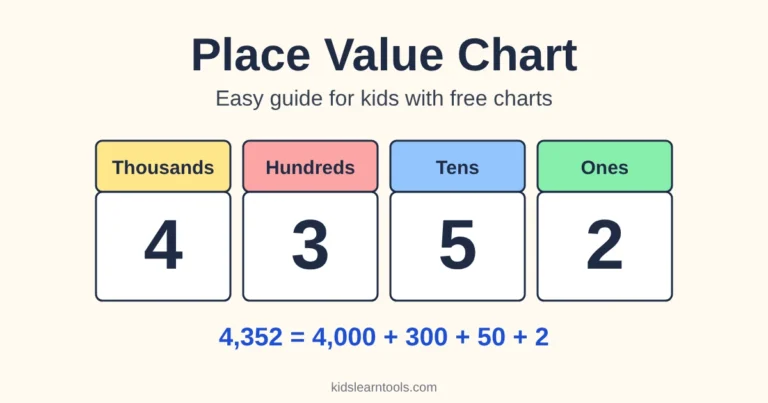
- Place Value Chart: for kids ready to explore tens and ones.
- Counting Song for Kids 1 to 10: a short video warm-up before counting pages.
Key Takeaways
- Kindergarten math worksheets should cover counting, operations within 10, teen numbers, measurement and shapes.
- Use real objects first, picture-based kindergarten math worksheets second and number-only sheets last.
- Keep sessions to 10-15 minutes and 1 page; consistency beats quantity.
- Link every worksheet to a real-life moment like snack time, shopping or setting the table.
- Download the free 8-page pack above and follow the month-by-month plan.
Frequently Asked Questions
What math should a kindergartener know?
By the end of kindergarten, most kids can count to 100 by ones and tens, write numbers 0 to 20, count up to 20 objects, compare groups, add and subtract within 10 using objects or pictures, and name basic 2D and 3D shapes.
Are kindergarten math worksheets good for kids?
Yes, when they are short and used after hands-on play. Kindergarten math worksheets help kids practice and show what they understand. They should not replace counting real objects, games and everyday math talk.
How many math worksheets should a kindergartener do a day?
One page, or half a page, is enough for most kindergarteners. Aim for 10 to 15 minutes, 3 to 5 days a week. Short, regular practice works better than long sessions.
What should I teach first in kindergarten math?
Start with counting objects from 1 to 10 and writing those numbers. Then move to comparing groups, ten frames, numbers to 20, and finally adding and subtracting within 5 and then within 10.
Can kindergarteners do addition and subtraction?
Yes. Kindergarteners learn to add and subtract within 10 using objects, fingers, drawings and ten frames, and they become fluent with facts within 5 by the end of the year.
Are these kindergarten math worksheets free?
Yes. The 8-page kindergarten math worksheets pack and answer key on Kids Learn Tools are free to print for home and classroom use. No sign-up is needed.