
Kindergarten Readiness Checklist: 40+ Skills to Check (Free Printable)
A kindergarten readiness checklist is a simple list of the skills most kids have before they start kindergarten, usually around age 5. It covers six areas: social and emotional skills, self-care, language and listening, early reading, early math, and motor skills. No child needs to tick every box. The checklist simply shows you what to practice in the months before school starts.
Below you’ll find the full kindergarten readiness checklist by skill area, a free printable version, easy home activities for each skill, a month-by-month plan and answers to the questions parents ask most.
What Does “Kindergarten Ready” Mean?
Being kindergarten ready does not mean your child can already read or write. Kindergarten teachers expect to teach those things. Readiness means your child has the basic skills to learn in a classroom: they can follow simple directions, take care of their own needs, get along with other kids and sit and listen for a short time.
Most teachers will tell you the same thing: social and self-care skills matter more on the first day than knowing letters. A child who can open a lunchbox, ask for help and take turns settles in much faster than one who can count to 50 but cries when they can’t zip their coat.
What Age Do Kids Start Kindergarten?
In most U.S. states, kids start kindergarten when they are 5 years old by a cut-off date, often between August 1 and September 1. Some states have later cut-offs. In the UK, kids start Reception (the first school year) the September after they turn 4. In Pakistan and India, kids usually enter KG or prep at around 4 to 5. Always check the exact rules of your local school or district.
The Complete Kindergarten Readiness Checklist
Use this kindergarten readiness checklist as a guide. A check mark means your child can do it most of the time, not perfectly.
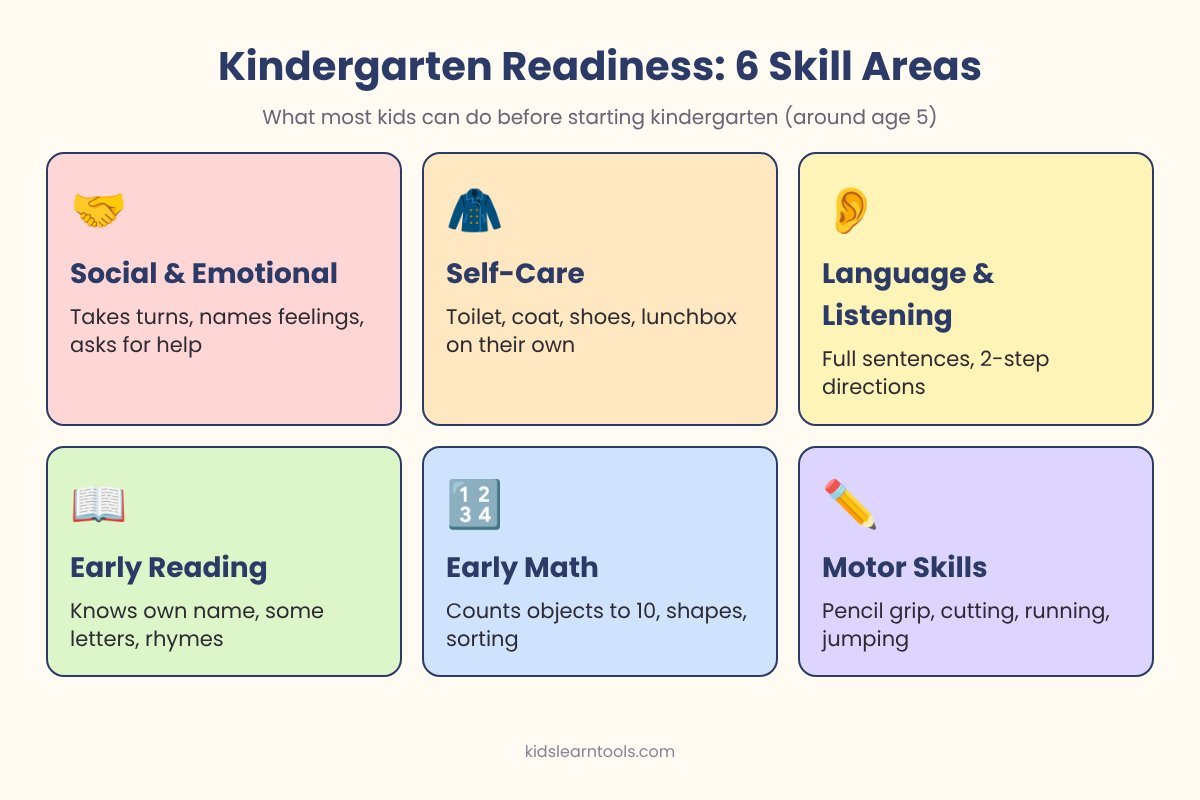
1. Social and Emotional Skills
- Separates from parents without long distress
- Plays and shares with other kids
- Takes turns in a game or conversation
- Follows simple rules (like “walk inside”)
- Uses words to show feelings (“I’m sad,” “I’m angry”)
- Calms down with an adult’s help after being upset
- Asks an adult for help when needed
- Finishes a short task before moving to the next one
2. Self-Care and Independence
- Uses the toilet on their own and washes hands
- Puts on and takes off a coat and shoes (velcro is fine)
- Opens a lunchbox, snack packets and water bottle
- Eats without help
- Knows their full name
- Knows a parent’s name and, ideally, a phone number
- Puts toys and belongings away when asked
- Blows their nose and covers a cough
3. Language and Listening
- Speaks in full sentences of 5–6 words or more
- Is understood by adults outside the family
- Follows 2-step directions (“Get your shoes and sit by the door”)
- Listens to a short story and answers simple questions about it
- Asks and answers “who, what, where” questions
- Retells a simple event in order (first, then, last)
4. Early Reading (Literacy) Skills
- Recognizes their own name in print
- Names some letters, especially those in their name
- Knows that print goes from left to right
- Holds a book the right way and turns pages one at a time
- Hears rhyming words (cat / hat)
- Knows some letter sounds (like /m/ for “m”)
Letters and sounds come at very different speeds. If your child is not there yet, our letter recognition activities are a gentle place to start.
5. Early Math Skills
- Counts out loud to 10 (many kids reach 20)
- Counts up to 10 objects, touching one at a time
- Recognizes numbers 0–10
- Names basic shapes: circle, square, triangle, rectangle
- Sorts objects by color, size or shape
- Understands “more,” “less,” “bigger” and “smaller”
- Copies or continues a simple pattern (red, blue, red, blue…)
6. Fine and Gross Motor Skills
- Holds a crayon or pencil with fingers, not a fist
- Draws a circle, a cross and a simple person
- Uses child safety scissors to cut on a line
- Tries to write their first name
- Runs, jumps with two feet and climbs stairs
- Catches and throws a large ball
- Hops on one foot a few times
Kindergarten Readiness Checklist at a Glance
This table shows which skills matter most and the easiest way to build each one at home.
| Skill area | Most important skill | Easy home practice | Time a day |
|---|---|---|---|
| Social & emotional | Taking turns and naming feelings | Board games, play dates | Built into play |
| Self-care | Toilet, coat, lunchbox on their own | “Practice school mornings” | 10 minutes |
| Language & listening | Following 2-step directions | Read aloud and ask questions | 15–20 minutes |
| Early reading | Knowing their name and some letters | Letter games, name tracing | 5–10 minutes |
| Early math | Counting objects to 10 | Count snacks, toys, steps | 5–10 minutes |
| Motor skills | Holding a pencil correctly | Play dough, cutting, drawing | 10 minutes |
Kindergarten Readiness Checklist Example
Here is how one parent might use the kindergarten readiness checklist. Sara is 5 and starts school in four months. Her mom ticked each skill Sara can do most of the time and counted the ticks in each area.
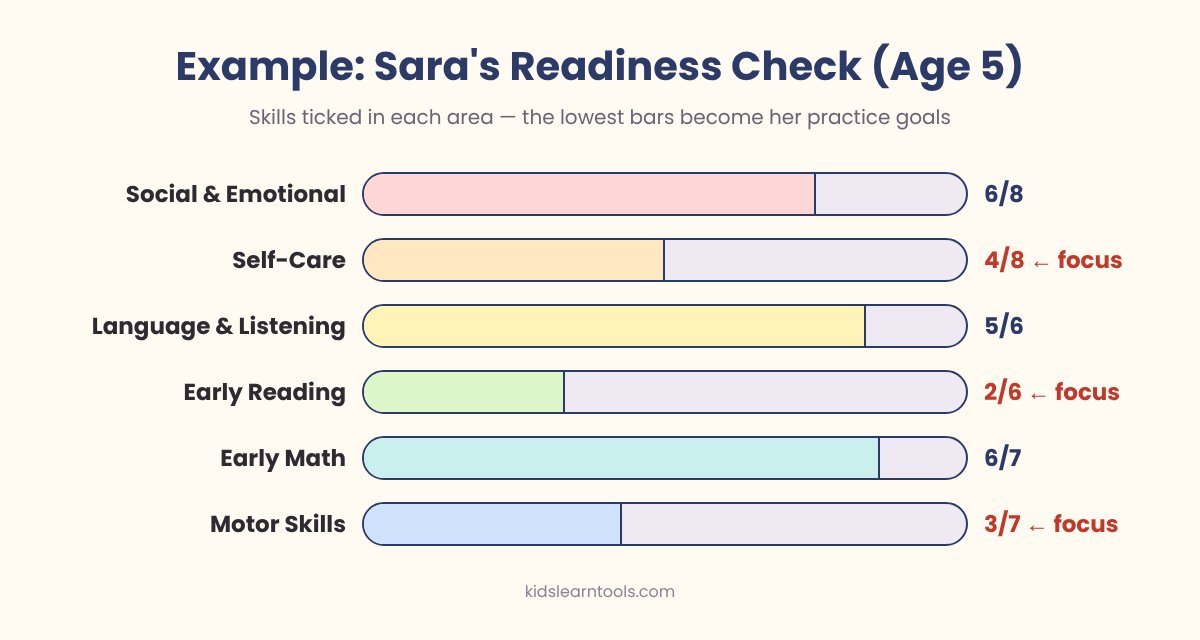
Sara is strong in early math and language, but three areas are below half. So her mom picked three practice goals, one from each low area:
| Low area | Goal | How they practice | Check again |
|---|---|---|---|
| Self-care (4/8) | Opens her lunchbox and snack packets alone | Packs and eats a “school lunch” at home 3 times a week | In 4 weeks |
| Early reading (2/6) | Recognizes her name and its letters | Name tracing, finding “S” in signs and books | In 4 weeks |
| Motor skills (3/7) | Holds a crayon with her fingers | Play dough, short crayons, drawing for 10 minutes | In 4 weeks |
After a month, her mom checks the list again and picks new goals. This is the whole method: check, choose 2–3 goals, practice through play, check again.
Which Kindergarten Readiness Skills Matter Most?
If you only have time for a few things, focus on these. Teachers mention them again and again:
- Using the toilet independently. This is the one skill most schools truly expect.
- Following simple directions. Classrooms run on “line up,” “sit down” and “get your folder.”
- Managing feelings. A child who can say “I need help” instead of melting down will learn more.
- Self-care with belongings. Coats, shoes, lunchboxes and backpacks.
- Sitting and listening for 10–15 minutes. Story time is a daily routine in kindergarten.
Academic skills like letters and numbers are helpful, but kindergarten teachers expect to teach them.
Home Activities for Each Kindergarten Readiness Skill
All of this fits into about an hour a day, spread across normal family life. Here is one simple way to split it:
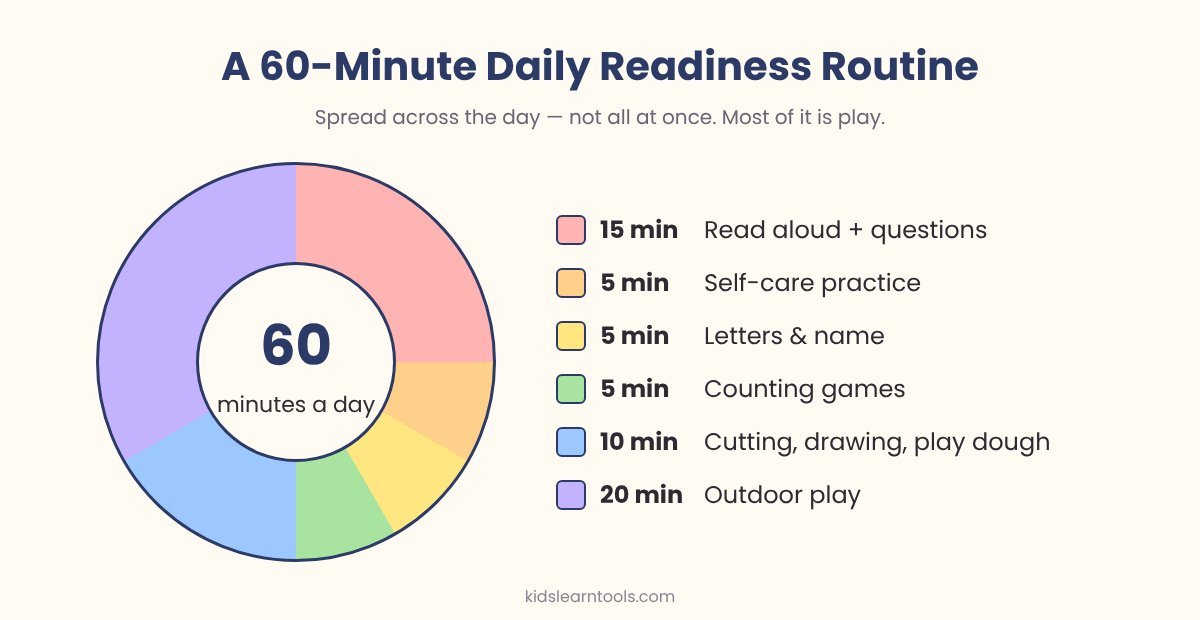
Social and emotional
- Play simple board games and card games that need turn-taking.
- Name feelings during the day: “You look frustrated. Do you want help?”
- Practice short goodbyes: leave your child with a family member for an hour, and come back when you said you would.
Self-care
- Do a “school morning” practice run: dress, eat breakfast and put on shoes by a set time.
- Pack a real lunchbox and let your child open every container at home first.
- Teach the “flip trick” for putting on a coat.
Language and early reading
- Read aloud for 15–20 minutes a day and ask, “What happened first? What happened next?”
- Play “I spy something that starts with /b/.”
- Sing rhyming songs and play rhyme games. Our ABC song for kids is a fun start.
- Practice writing their name with our free name tracing worksheet maker.
Early math
- Count real things every day: grapes, stairs, spoons on the table.
- Go on a shape hunt around the house (clock = circle, door = rectangle).
- Sort laundry by color or toys by size.
- When counting to 10 is easy, try our guide on counting to 100.
- When your child is ready for paper practice, print our free kindergarten math worksheets for counting, ten frames, shapes and patterns.
Fine and gross motor
- Squeeze, roll and cut play dough to build hand strength.
- Trace letters and shapes with our letter tracing worksheets.
- Do simple mazes with a crayon — try our printable mazes for kids.
- Play outside daily: running, jumping, climbing and ball games.
For more hand-strength ideas sorted by age, see our 35 fine motor activities for preschoolers.
Everyday Examples to Practice at Home
Use these real-life examples to practice the skills on the kindergarten readiness checklist without any worksheets.
Examples of 2-step directions
| Easy | Harder |
|---|---|
| “Pick up your shoes and bring them to me.” | “Put your cup in the sink, then wash your hands.” |
| “Get a book and sit on the sofa.” | “Find your red socks and put them in the basket.” |
| “Close the door and turn off the light.” | “Take out two spoons and put one on each plate.” |
Examples of feeling words to teach
| Situation | What your child can say |
|---|---|
| A friend takes their toy | “I’m upset. Can I have it back, please?” |
| They can’t open a packet | “I need help, please.” |
| They miss you at school | “I feel sad. When is pick-up time?” |
| Waiting for a turn | “Can I go next?” |
Examples of math in daily life
- Snack time: “Count 8 crackers. Now eat 2. How many are left?”
- Setting the table: “We are 4 people. How many forks do we need?”
- Shopping: “Find 3 round fruits and 1 long one.”
- Laundry: “Make a pile of big socks and a pile of small socks.”
Month-by-Month Kindergarten Prep Plan
You don’t need to cram. A calm, steady plan in the year before school works best. Start by going through the kindergarten readiness checklist about 12 months ahead, then follow the steps below.
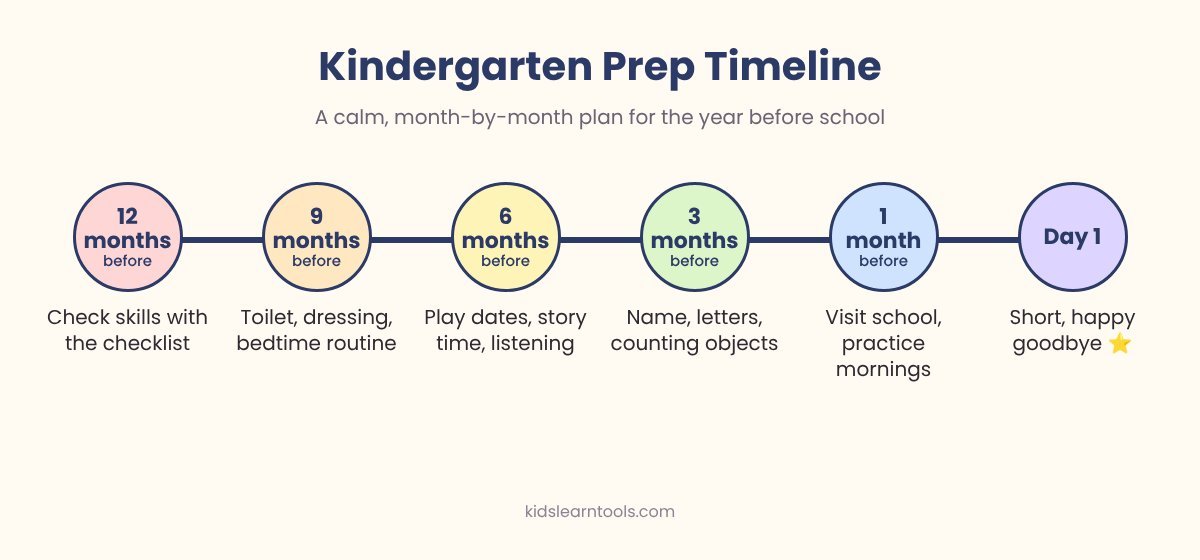
| When | Focus | What to do |
|---|---|---|
| 12 months before | Check where your child is | Go through the kindergarten readiness checklist; note 3–4 skills to work on |
| 9 months before | Self-care and routines | Toilet independence, dressing, a regular bedtime |
| 6 months before | Social skills and listening | Play dates, story time, 2-step directions |
| 3 months before | Early reading and math | Name writing, letter games, counting objects |
| 1 month before | School routines | Visit the school, practice the morning routine, read books about starting school |
| First week | Confidence | Short, positive goodbyes; talk about the best part of each day |
What If My Child Isn’t Ready Yet?
Many parents worry when their child can’t tick every box on a kindergarten readiness checklist. Please don’t. Kids grow very quickly between ages 4 and 6, and a skill that is missing in spring often appears by autumn. Here is what to do:
- Focus on 2–3 skills at a time, not the whole list.
- Keep practice short and playful. Five minutes of a game beats 30 minutes of worksheets.
- Talk to the preschool teacher or the kindergarten teacher. They see hundreds of kids and can tell you what is normal.
- Ask about readiness screenings. Many schools run a short check before or at the start of kindergarten.
- Speak with your pediatrician if you are worried about speech, hearing, motor skills or behavior. The CDC developmental milestones are a helpful guide for that talk. Early support makes a big difference.
Some families with summer-birthday kids choose to wait a year (often called “redshirting”). This is a personal decision. Talk it through with your child’s teacher and your school before deciding.
🍎 From My Classroom
In eight years of teaching, I worked closely with slow learners, and many of them started school with the same worry from their parents: “My child is behind.” What I saw again and again was that the kids who settled fastest were not the ones who knew the most letters. They were the ones who could ask for help, open their own lunch and take turns. So my advice to parents was always the same: build independence first and confidence second, and the academics will follow. I also placed new kids in small peer groups with one calm, confident classmate. Within a few weeks, most of the “not ready” kids were joining in happily.
First-Week Kindergarten Readiness Checklist (Routines)
A kindergarten readiness checklist covers skills, but small routines often decide how the first week of kindergarten feels. Start these about 3 to 4 weeks before school begins so they feel normal by day one:
- Sleep: move bedtime and wake-up time to the school schedule, a little earlier each week.
- Morning practice: do a “pretend school morning” with breakfast, getting dressed and putting on shoes by a set time.
- Lunch practice: let your child open their lunchbox, water bottle and snack packs on their own.
- Backpack job: your child packs and carries their own bag, and puts their folder back after school.
- Goodbye routine: keep goodbyes short and the same every day, like a hug and “See you at 3.”
- Visit the school: walk or drive past the school, and play on its playground if you can.
- Name labels: show your child their name on their bag, jacket and lunchbox so they can find their things.
Add these routines to your kindergarten readiness checklist. They lower stress for kids and parents alike, and they give your child a quick win every morning before learning even begins.
Free Printable Kindergarten Readiness Checklist
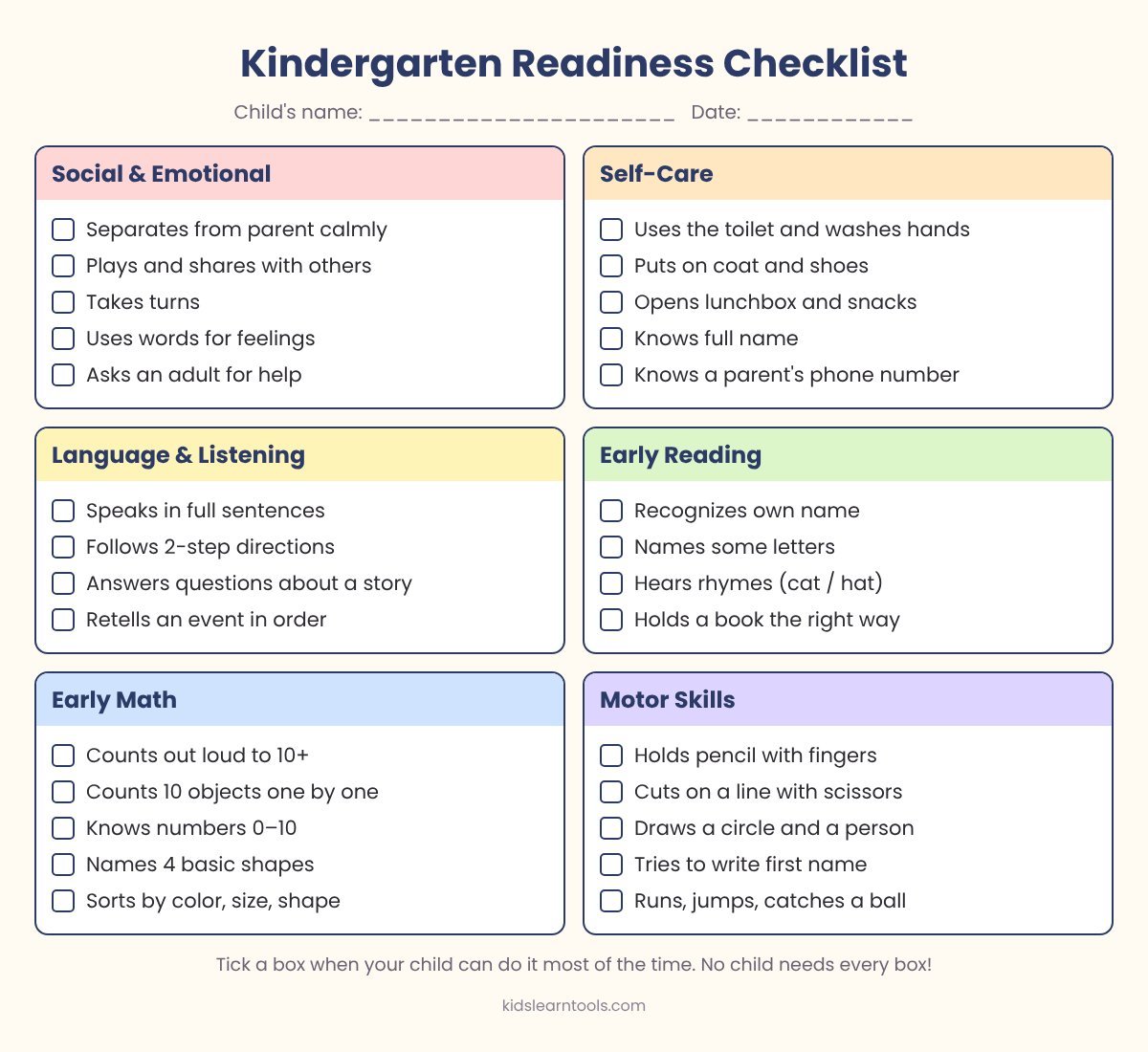
Print the one-page kindergarten readiness checklist below and stick it on your fridge. Tick a skill when your child can do it most of the time. Check it again every two or three months to see the progress.
Key Takeaways
- Kindergarten readiness covers six areas: social-emotional, self-care, language, early reading, early math and motor skills.
- Independence and social skills matter more on day one than reading or counting.
- No child needs to tick every box. Use the kindergarten readiness checklist to choose what to practice.
- Short, playful daily practice in the year before school is enough.
- If you’re worried, talk to your child’s teacher or pediatrician early.
Frequently Asked Questions
How do I use a kindergarten readiness checklist?
Go through the kindergarten readiness checklist with your child in a relaxed way, ticking skills they can do most of the time. Pick 2 or 3 unticked skills to practice through play, and check the list again every few months.
What should a child know before kindergarten?
Before kindergarten, most kids can use the toilet on their own, follow 2-step directions, play and take turns, recognize their name, count to 10, name a few letters and hold a crayon with their fingers. They do not need to read yet.
Does my child need to read before kindergarten?
No. Reading is taught in kindergarten. It helps if your child enjoys books, knows some letters and can hear rhymes, but reading words is not expected on the first day.
What letters should a child know before kindergarten?
There is no fixed number. Many kids know the letters in their own name and a handful of others. Knowing more is a bonus, not a requirement.
Should my child be able to write their name before kindergarten?
It is helpful but not required. Many kids can write some or all of their first name, often in capital letters. Name tracing practice is a gentle way to build this skill.
What is a kindergarten readiness assessment?
It is a short check that some schools give before or at the start of kindergarten. A teacher looks at skills like counting, letters, listening and motor skills to see what support each child needs. It is not a pass-or-fail test.
How can I tell if my child is not ready for kindergarten?
Signs include great difficulty separating from parents, not yet using the toilet, trouble following simple directions or very short attention for activities. Talk to your preschool teacher or pediatrician; many of these skills grow quickly with support.
