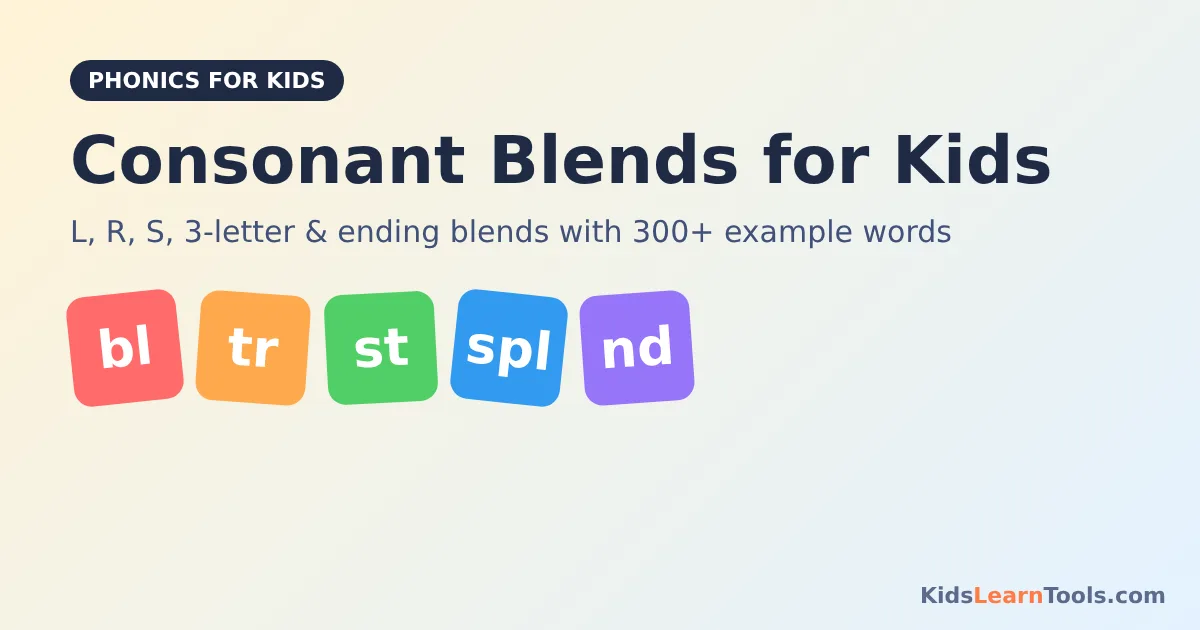
Consonant Blends for Kids: Complete List of L, R, S and Ending Blends
Consonant blends are two or three consonants that sit together in a word, where you can still hear each sound, like bl in black, st in stop or str in string. They are also called consonant clusters. Blends can come at the beginning of a word (beginning blends) or at the end (ending blends, like nd in hand).
Kids usually learn blends after they can read simple CVC words with short vowels. This guide gives you a complete consonant blends list with example words, explains how blends are different from digraphs, and shows a simple order and games to teach them.
Consonant Blends vs Digraphs: What Is the Difference?
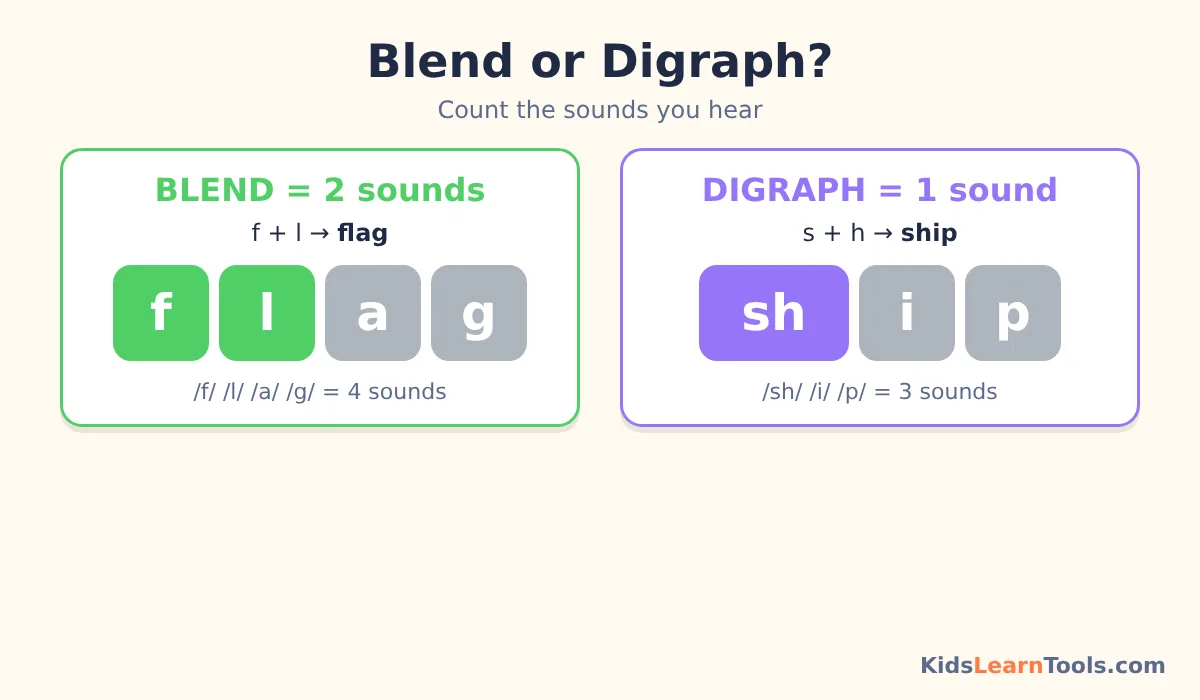
This is the question parents and teachers ask most. The difference is about the number of sounds you hear.
| Consonant blend | Consonant digraph | |
|---|---|---|
| What it is | Two or three consonants, each sound is heard | Two letters that make one new sound |
| Number of sounds | 2 or 3 sounds | 1 sound |
| Examples | bl, cr, st, nd, str | sh, ch, th, wh, ck, ph |
| Example words | black = /b/ /l/ /a/ /k/ | ship = /sh/ /i/ /p/ |
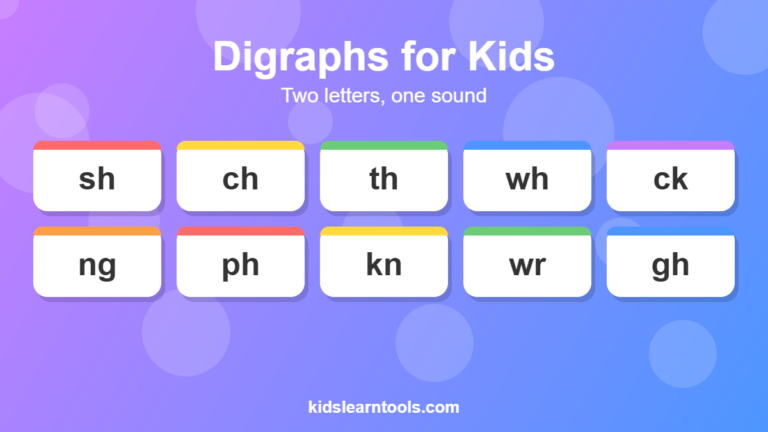
A quick test for kids: say the letters slowly. If you can hear both letters (f-l-ag), it is a blend. If the letters make a brand new sound (sh-ip), it is a digraph. Learn more in our digraphs guide, or practice single digraphs with sh words, ch words, th words and wh words.
Complete Consonant Blends List (At a Glance)
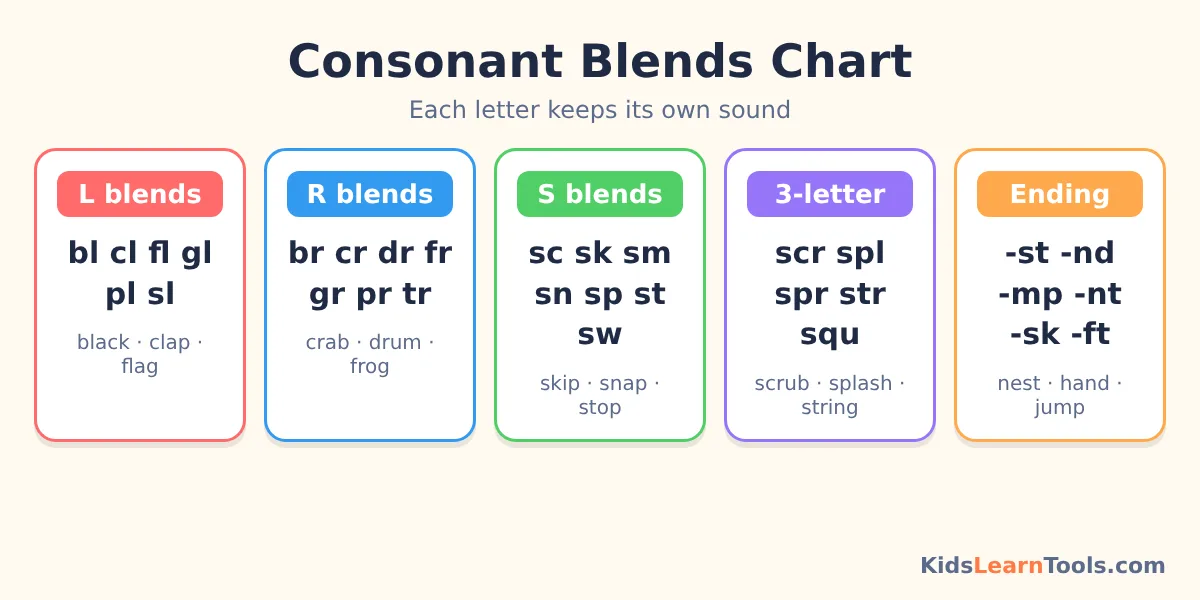
| Type | Blends | How many |
|---|---|---|
| L blends | bl, cl, fl, gl, pl, sl | 6 |
| R blends | br, cr, dr, fr, gr, pr, tr | 7 |
| S blends | sc, sk, sm, sn, sp, st, sw | 7 |
| W blends | tw, dw | 2 |
| 3-letter blends | scr, spl, spr, str, squ | 5 |
| Ending blends | -st, -nd, -mp, -nt, -sk, -lt, -lk, -ft, -lp, -sp, -pt, -ct, -lf | 13 |
L Blends List
In L blends, the letter l comes second. All example words below use short vowels, so kids can sound them out.
| Blend | Example words |
|---|---|
| bl | black, blob, bled, blend, blip, blush, block, bluff |
| cl | clap, clip, clock, club, clam, cliff, clan, cluck |
| fl | flag, flip, flat, flop, flex, fluff, flock, flash |
| gl | glad, glass, glob, glum, glen, glint, gloss, glop |
| pl | plan, plug, plum, plot, plus, plop, plank, plant |
| sl | sled, slip, slam, slug, slap, slim, slot, slept |
R Blends List
| Blend | Example words |
|---|---|
| br | brag, brim, brush, brick, bran, brat, brunch, brand |
| cr | crab, crib, crop, crust, cram, crack, crisp, crash |
| dr | drum, drip, drop, dress, drag, drill, drift, drank |
| fr | frog, from, fresh, frill, frizz, frost, fret, fridge |
| gr | grab, grin, grip, grass, grill, grub, grand, grunt |
| pr | press, prod, prop, print, prim, prank, prom, prep |
| tr | trap, trip, truck, trot, trim, trash, track, trend |
S Blends List
| Blend | Example words |
|---|---|
| sc | scab, scan, scat, scuff, scalp, scamp, scum, scant |
| sk | skip, skid, skin, skunk, skill, skit, skull, skim |
| sm | smell, smash, smog, smug, smack, smock, smelt, smudge |
| sn | snap, snack, snip, snug, sniff, snob, snag, snuck |
| sp | spin, spot, spell, sped, spill, spun, spit, speck |
| st | stop, step, stick, stuck, stem, stamp, stiff, stack |
| sw | swim, swam, swell, swift, swept, swish, swig, swat |
W Blends: tw and dw
- tw: twin, twig, twist, twelve, twitch, twill
- dw: dwell, dwelt (dw is rare; teach it only after the common blends)
3-Letter Blends List
Three-letter blends have three consonant sounds together. Teach them only after kids are confident with two-letter blends.
| Blend | Example words |
|---|---|
| scr | scrap, scrub, scratch, scrimp, scruff |
| spl | splash, split, splat, splint, splendid |
| spr | sprint, spring, sprig, sprang, sprung |
| str | strap, strip, string, stress, struck, strong |
| squ | squid, squish, squint, squash, squad (qu makes /kw/) |
What about thr, shr and chr? These mix a digraph with a consonant (thr = /th/ + /r/), so some programs call them “digraph blends.” Examples: thrill, throb, thrush, shred, shrimp, shrub, Chris.
Ending Blends List (Final Consonant Blends)
Ending blends come at the end of a word, after the vowel. Kids often drop one of the two sounds (saying “han” for hand), so slow practice really helps here.
| Ending blend | Example words |
|---|---|
| -st | best, fast, last, nest, must, list, cost, dust |
| -nd | hand, band, sand, pond, wind, fund, bend, end |
| -mp | lamp, jump, camp, stump, bump, limp, damp, pump |
| -nt | tent, plant, hunt, mint, sent, went, dent, print |
| -sk | desk, mask, task, tusk, disk, risk, ask, husk |
| -lt | belt, melt, felt, quilt, kilt, tilt, adult, spilt |
| -lk | milk, silk, bulk, hulk, elk |
| -ft | gift, left, raft, soft, lift, loft, sift, drift |
| -lp | help, gulp, yelp, pulp, kelp |
| -sp | wisp, crisp, clasp, gasp, lisp |
| -pt | kept, slept, swept, wept, crept |
| -ct | fact, act, insect, duct, pact |
| -lf | elf, self, shelf, gulf |
A note on -nk and -ng: Words like pink, bank, sing and long are often taught as “welded sounds” or glued sounds (ink, ank, ing, ong) instead of normal blends, because the n changes its sound. Teach them as chunks, not letter by letter.
Words with Blends at Both Ends
These CCVCC words are a great “challenge round” once kids can read beginning and ending blends separately:
blend, stamp, plant, crust, trust, drift, frost, grand, print, stump, crisp, slept, swept, twist, blast, clump, grunt, trend, skunk, stomp
Which Blends Should Kids Learn First?
Kids should be reading CVC words with all short vowel words before starting blends. A simple teaching order:
- S blends (st, sp, sn, sm, sl): s can be stretched (“sssstop”), so it is easy to hold and add the next sound.
- L blends (bl, cl, fl, pl, gl): l is also stretchy and easy to hear.
- R blends (tr, dr, cr, gr, fr, br, pr): taught after L blends, because many kids are still learning to say the r sound clearly.
- Ending blends (-st, -nd, -mp, -nt): some programs teach these before beginning blends. Either order works if you go slowly.
- 3-letter blends (str, spl, scr, spr, squ): taught last.
This fits what most first grade phonics standards expect. For example, the Common Core standard RF.1.2.b asks kids to blend sounds orally to make single-syllable words, including consonant blends.
How to Teach Consonant Blends: Step by Step
- Start with listening. Say sip and slip. Ask, “Which word has an extra sound?” Kids should hear the blend before they read it.
- Build from a CVC word. Write lip, then add s in front: slip. Write rap, then add t: trap. Kids see that a blend is just one more sound.
- Blend the two consonants first. Say /f/ /l/ → “fl,” then add the rest: fl-ag → flag. Our guide on how to teach blending sounds explains this in detail.
- Use sound boxes. Draw four boxes for flag and put one sound in each. This shows that fl is two sounds, not one.
- Read in families. Blends work well with word families: at → flat, chat; ip → slip, trip, drip.
- Read and write sentences. Short sentences with blends turn word practice into real reading.
Consonant Blend Sentences for Practice
- The frog sat on a big flat rock.
- A crab is in the sand.
- Stop and clap your hands.
- The drum is on the desk.
- Brad slept in a tent.
- The skunk is in the grass.
- Fran has a pink dress.
- We swim fast in the pond.
- The twins jump and spin.
- Do not spill the milk.
Fun Consonant Blend Games and Activities
- Blend sort: Give kids picture cards and three trays labelled L, R and S. They say each word and place it in the right tray.
- Add-a-letter: Start with a word like top. Add s → stop. Start with lap, add c → clap. Kids love seeing a word “grow.”
- Blend wheel: Put blends on an outer circle (bl, fl, sl) and a word ending in the middle (-ip). Turn and read: blip, flip, slip.
- Blend bingo: Call out a word (truck), and kids cover the blend (tr) on their board.
- Blend word search: Type your blend words into our free Word Search Maker and print a puzzle in seconds.
- Trace and write: Create tracing sheets for blend words with our letter tracing worksheet maker.
Common Mistakes with Blends (and Easy Fixes)
| Mistake | Example | Fix |
|---|---|---|
| Dropping the second consonant | reads frog as “fog” | Point to each letter. Use sound boxes so every sound gets a box. |
| Dropping a sound at the end | reads hand as “han” | Practice pairs: han/hand, ten/tent, bum/bump. |
| Adding an “uh” between sounds | “buh-lack” for black | Say the first sound short and quick, then slide into l. Practice with stretchy blends first (sl, fl). |
| Switching the order | reads slip as “lisp” | Use a finger or pointer to read strictly left to right. |
| Treating a blend like a digraph | says one sound for st | Remind kids: “In a blend, both friends speak.” |
Reading problem or speech sound? Some kids can read blends but still say them unclearly, for example “twain” for train or “poon” for spoon. Simplifying clusters is common in early speech, and sounds like r can take until around age 6 to 8 to develop fully. If a child’s speech is hard to understand for their age, talk to a speech-language therapist.
From My Classroom
Working mostly with slow learners, I noticed that blends were often the point where reading confidence dropped. A child who could read top easily might stop at stop. The new letter itself was not the problem; the child simply had not yet learned to hear two consonant sounds together. So I always started with listening before reading, saying words slowly and asking children which sounds they could hear.
I also kept blend practice in small peer groups. Children sorted and read blend words with a partner, so a stronger reader could model the sounds while a quieter child joined in without pressure. Building from words they already knew, like lip to slip, made each new blend feel like a small step rather than a big jump.
Consonant Blends: Quick Summary
- A consonant blend is two or three consonants where each sound is heard (bl, st, str).
- A digraph is different: two letters make one new sound (sh, ch, th).
- Main groups: L blends, R blends, S blends, 3-letter blends and ending blends.
- Teach blends after short vowel CVC words, starting with stretchy S and L blends.
- Use listening games, sound boxes and “grow a word” to help kids hear every sound.
Frequently Asked Questions About Consonant Blends
What is a consonant blend?
A consonant blend is two or three consonants together in a word where you can hear each sound, like bl in black, st in stop or str in string. It is also called a consonant cluster.
What is the difference between a blend and a digraph?
In a blend, each consonant keeps its own sound (fl in flag). In a digraph, two letters join to make one new sound (sh in ship).
How many consonant blends are there?
Most phonics programs teach about 20 common beginning blends (L, R and S blends), around 5 three-letter blends and about a dozen common ending blends. Exact lists vary a little from program to program.
What grade do kids learn consonant blends?
Kids usually start blends at the end of kindergarten or in first grade, after they can read CVC words with short vowels.
What are 3-letter blends?
Three-letter blends are three consonants with three sounds together, like scr (scrub), spl (splash), spr (spring), str (string) and squ (squid).
Is “ng” a consonant blend?
No. In words like sing and long, ng makes one sound, so it works like a digraph. Many programs teach ng and nk as glued or welded sounds (ing, ank).