Short Vowel Words for Kids: 250+ Word Lists for A, E, I, O and U
Short vowel words are words where the vowel makes its short, quick sound, like the a in cat, the e in bed, the i in pig, the o in dog and the u in sun. Most short vowel words follow the closed syllable rule: one vowel is “closed in” by a consonant after it. They are the first words kids learn to sound out, which is why kindergarten and first grade phonics starts here.
This guide gives you ready-to-use short vowel word lists for each vowel, from simple CVC words to blend words and two-syllable words. You will also find the rule explained in plain words, a teaching order that works, sentences for reading practice, games and fixes for the most common mistakes.
What Are Short Vowel Sounds?
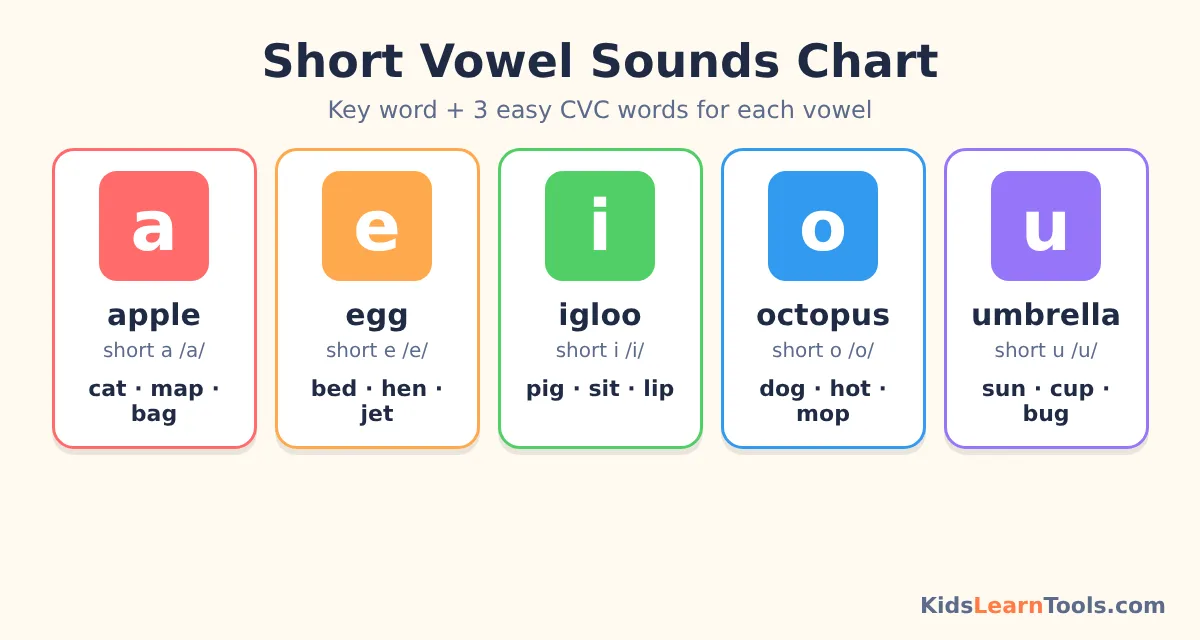
English has five vowel letters: a, e, i, o and u. Each one can make a short sound and a long sound. The long sound “says its name” (a in cake). The short sound is different and quicker (a in cat).
In dictionaries and some phonics programs, a short vowel is marked with a small curved line called a breve (ă, ĕ, ĭ, ŏ, ŭ).
| Vowel | Key word | Sound | Mouth tip for kids | Example words |
|---|---|---|---|---|
| Short a (ă) | apple | /a/ as in cat | Open wide, like a little yawn | cat, map, bag |
| Short e (ĕ) | egg | /e/ as in bed | Smile a little, jaw drops slightly | bed, hen, jet |
| Short i (ĭ) | itch / igloo | /i/ as in pig | Small smile, quick sound | pig, sit, lip |
| Short o (ŏ) | octopus | /o/ as in dog | Round open mouth, like at the doctor (“ahh”) | dog, hot, mop |
| Short u (ŭ) | up / umbrella | /u/ as in sun | Relaxed mouth, like a tiny tummy push “uh” | sun, cup, bug |
Note: The short o sound changes a little with accent. In American English, hot sounds close to “haht.” Teach the sound the way it is spoken where your child lives.
The Short Vowel Rule (Closed Syllable Rule)
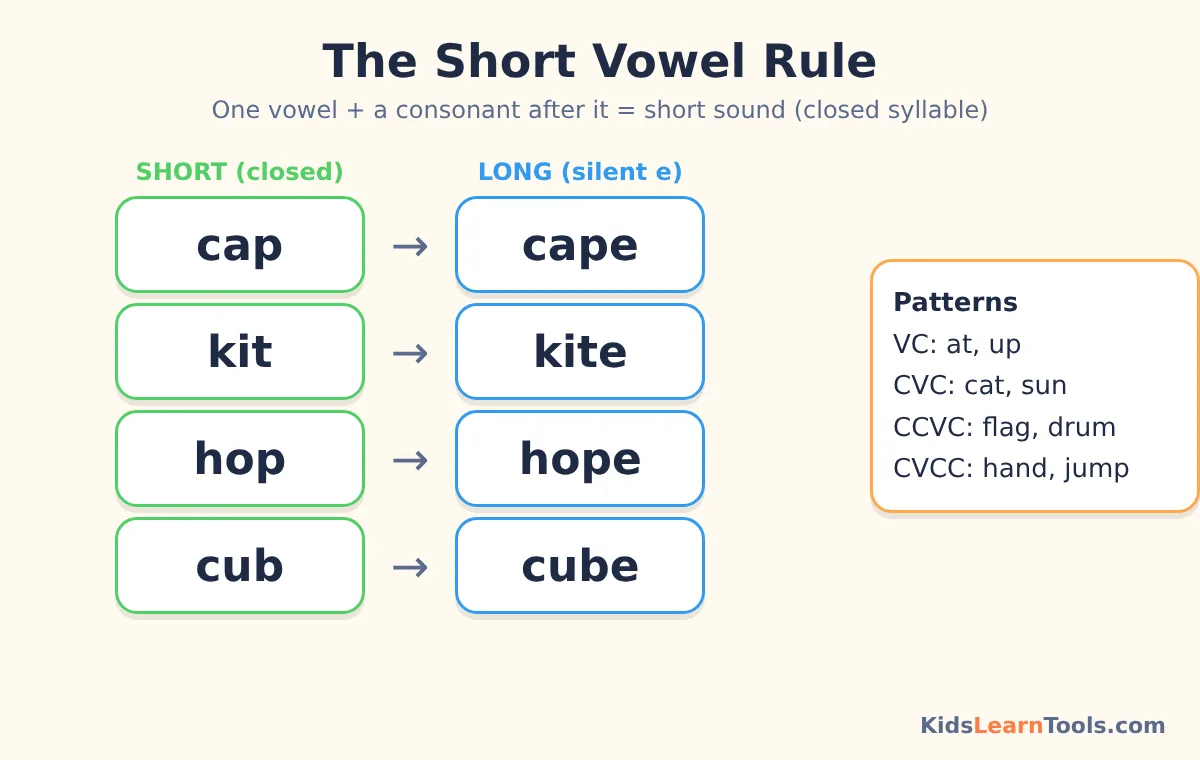
The easiest way to spot a short vowel word is this rule:
When a word or syllable has only one vowel, and that vowel is followed by a consonant, the vowel usually makes its short sound.
This is called a closed syllable, because the consonant “closes the door” on the vowel. Look at these patterns:
- VC: at, in, up, on, it
- CVC: cat, pen, sit, hot, bug
- CCVC (blend or digraph at the start): flag, step, ship, frog, drum
- CVCC (blend or digraph at the end): hand, nest, milk, sock, jump
- CCVCC: stamp, dress, twist, clock, trunk
Compare it with long vowel words. When a silent e is added, the vowel usually becomes long: cap → cape, kit → kite, hop → hope, cub → cube. Showing kids these pairs helps them see why the short sound happens.
Watch out for tricky words. A few common words break the rule, such as was, said, have, put, of and what. Teach these as heart words or sight words, not as short vowel words. You can find more in our kindergarten sight words list.
Short A Words List
Short a is usually taught first because the sound is clear and easy to hear. For a much longer list with sentences and games, see our full guide to short a words.
Short A CVC Words
cat, bat, hat, mat, rat, sat, fan, man, pan, can, van, ran, cap, map, tap, nap, lap, bag, rag, tag, wag, dad, bad, sad, had, jam, ham, ram, yam, wax, tax, fax
Short A Words with Blends and Digraphs
clap, flag, crab, glad, snap, trap, hand, sand, band, lamp, camp, stamp, plant, black, snack, track, glass, grass, path, bath, chat, that, splash, trash
Short E Words List
Short e is often the hardest short vowel for kids to hear, because it sounds close to short i. Our full short e words guide has 150+ more words and practice games.
Short E CVC Words
bed, red, fed, led, wed, hen, pen, ten, men, den, jet, net, pet, wet, vet, get, let, met, set, leg, peg, beg, keg, web, yes, yet, hem, Ben, Ted
Short E Words with Blends and Digraphs
sled, step, nest, desk, bell, tent, dress, spell, belt, west, best, help, left, melt, sent, shell, chest, then, them, check, fresh, swept, slept
Short I Words List
Short I CVC Words
pig, big, dig, wig, fig, jig, pin, tin, win, fin, bin, kin, sit, hit, kit, bit, fit, lit, pit, lip, hip, dip, zip, rip, sip, tip, rib, fib, kid, lid, hid, rid, mix, six, fix
Short I Words with Blends and Digraphs
swim, milk, gift, drip, hill, mint, twin, spin, stick, skip, slip, grin, trip, crib, list, fist, lift, ship, fish, chip, chin, thin, with, wish, brick, quick
Short O Words List
Short O CVC Words
dog, log, fog, hog, jog, hot, pot, dot, cot, not, got, lot, top, mop, hop, pop, cop, box, fox, ox, rod, nod, cob, job, sob, mob, Tom, Bob
Short O Words with Blends and Digraphs
frog, stop, clock, spot, drop, pond, sock, lost, block, crop, plot, trot, flop, smog, soft, cost, shop, shot, chop, moth, rock, knock
Short U Words List
Short U CVC Words
bug, rug, hug, mug, jug, dug, sun, bun, run, fun, gun, nun, cup, pup, cut, nut, hut, but, gum, hum, sum, tub, cub, rub, bus, mud, bud, tug, yum
Short U Words with Blends and Digraphs
drum, duck, jump, plum, truck, skunk, hunt, brush, snug, club, crust, trust, stuck, plug, slug, bump, lunch, much, such, shut, shrub, thump
Two-Syllable Short Vowel Words
Once kids can read one-syllable words, they can read longer words made of two closed syllables. Teach them to split the word between the two middle consonants (rab | bit), read each part, then put it together.
| Word | Split | Vowels |
|---|---|---|
| rabbit | rab | bit | short a + short i |
| napkin | nap | kin | short a + short i |
| picnic | pic | nic | short i + short i |
| sunset | sun | set | short u + short e |
| muffin | muf | fin | short u + short i |
| kitten | kit | ten | short i + short e |
| hotdog | hot | dog | short o + short o |
| puppet | pup | pet | short u + short e |
| cactus | cac | tus | short a + short u |
| insect | in | sect | short i + short e |
| basket | bas | ket | short a + short e |
| goblin | gob | lin | short o + short i |
Short Vowel Minimal Pairs (Great for Listening Practice)
Minimal pairs are words that change by only one sound. Changing just the vowel shows kids how much the middle sound matters. Say each set slowly and ask, “What changed?”
- bag – beg – big – bog – bug
- pan – pen – pin
- hat – hit – hot – hut
- tap – tip – top
- bat – bet – bit – but
- pat – pet – pit – pot
- sack – sick – sock
You can turn this into a quick game: write b _ g on a whiteboard and let your child swap the vowel cards to build five real words.
Short Vowel Sentences for Reading Practice
These decodable sentences use mostly short vowel words, plus a few common sight words (the, a, is, on, in).
- The cat sat on a mat.
- Ben has a red pen.
- The pig is big.
- A dog sat on a log.
- The bug is on the rug.
- Dad had a hot cup.
- Jen can get the net.
- Sam hid in the box.
- The fox ran up the hill.
- Pam has fun in the sun.
In What Order Should You Teach Short Vowels?
There is no single “correct” order, but many phonics programs use one that keeps similar sounds apart. A simple order that works well at home and in class:
- Short a – clear, open sound and many easy words.
- Short i – very different from a, so kids do not mix them up.
- Short o – round mouth, easy to see and feel.
- Short u – quick “uh” sound.
- Short e – taught last because it is easy to confuse with short i.
After each new vowel, mix it with the vowels already learned. Mixed review is what makes reading stick. Before this stage, kids should know their letter sounds. Our letter sounds video and letter recognition activities can help.
How to Teach Short Vowel Words: 6 Simple Steps
- Hear the sound first. Say a word and ask, “What sound is in the middle?” Work out loud before using letters.
- Connect sound to letter. Show the vowel card with its picture (apple, egg, igloo, octopus, umbrella).
- Blend VC words. Start with two-sound words: at, in, up, on. Then add a first sound to make CVC words. Our step-by-step guide on blending sounds shows exactly how.
- Read CVC word lists. Use one vowel at a time with our CVC words list.
- Read in word families. Patterns like -at, -ig and -op help kids read many words fast. See our word families list.
- Move to blends and digraphs. When CVC words feel easy, add consonant blends (flag, nest) and digraphs (ship, chop, moth).
Fun Short Vowel Games and Activities
- Vowel sort: Make five columns (a, e, i, o, u). Kids read picture or word cards and place each one in the right column.
- Vowel swap: Build p _ t with letter tiles. Swap the middle letter to make pat, pet, pit, pot.
- Vowel hand signs: Give each vowel an action (a = bite an apple, e = crack an egg, i = scratch an itch, o = open mouth wide, u = point up). Kids do the action when they hear the sound.
- Roll and read: Write six words on a sheet, roll a dice and read the word that matches the number.
- Short vowel word search: Make a custom puzzle with your word list in our free Word Search Maker.
- Trace and say: Kids trace short vowel words while saying each sound. Create practice sheets with our letter tracing worksheet maker.
Common Short Vowel Mistakes (and How to Fix Them)
| Mistake | Example | What to do |
|---|---|---|
| Mixing up short e and short i | reads pen as “pin” | Practice e/i minimal pairs only (pen/pin, bed/bid, ten/tin). Use a mirror so kids see the mouth change. |
| Saying the long vowel | reads hop as “hope” | Remind them of the closed syllable rule: one vowel + a consonant after it = short sound. |
| Skipping the middle sound | reads bug as “bg” or guesses “big” | Point to each letter. Ask them to say the vowel sound alone, then blend again. |
| Guessing from the first letter | reads sun as “sock” | Cover the word and reveal one letter at a time, left to right. |
| Adding “uh” to consonants | “cuh-a-tuh” for cat | Model short, clipped stop sounds (/k/ not “kuh”). Start with stretchy words like man, sun, fan. |
From My Classroom
In my eight years of teaching in schools and colleges, my focus was always on slow learners. With short vowels, I saw the same pattern again and again: children could read words like cat and dog, but lost confidence as soon as the middle sound changed. I learned to slow down, work on one vowel sound at a time, and only mix vowels once each sound felt easy. Small, quick wins mattered more than long lessons.
Peer groups helped a lot. I paired a confident reader with a child who was still building confidence, and they practised short vowel words together. Children who were shy to read in front of the whole class were much more willing to read to a friend. When a child was ready, we moved from single sounds to syllables, reading two-syllable words like rab-bit and sun-set one chunk at a time.
Short Vowel Words: Quick Summary
- A short vowel is the quick sound of a, e, i, o or u, as in cat, bed, pig, dog, sun.
- One vowel followed by a consonant (closed syllable) usually makes the short sound.
- Start with VC and CVC words, then move to blends, digraphs and two-syllable words.
- Teach short e and short i apart, and use minimal pairs to train the ear.
- Practice a little every day with sorts, games and decodable sentences.
Frequently Asked Questions About Short Vowel Words
What are short vowel words?
Short vowel words are words where the vowel makes its short sound, like a in cat, e in bed, i in pig, o in dog and u in sun. They usually have one vowel followed by a consonant.
What are the 5 short vowel sounds?
The five short vowel sounds are short a (apple), short e (egg), short i (igloo), short o (octopus) and short u (umbrella).
How do you know if a vowel is short or long?
If a word or syllable has one vowel and it is followed by a consonant, the vowel is usually short (cap, kit). If the word ends in a silent e or has two vowels together, the vowel is usually long (cape, kite, rain).
What age should kids learn short vowel words?
Most kids start short vowel words in kindergarten, around age 5 to 6, once they know most letter sounds. Many keep practising them with blends and digraphs in first grade.
Which short vowel should I teach first?
Many teachers start with short a, then i, o, u and finally e. Short e and short i sound similar, so teaching them apart helps kids avoid confusion.
Are CVC words and short vowel words the same?
Not exactly. All CVC words like cat and sun have short vowels, but short vowel words also include longer words like flag, nest, jump and rabbit.