Counting to 100: How to Teach Kids Step by Step (Charts, Games & Tips)
Counting to 100 means saying the numbers from 1 to 100 in the correct order, without skipping or repeating any. Most kids learn it in kindergarten. The trick is that kids do not have to memorize 100 separate words. They learn 1 to 19, then the ten “decade” words (twenty, thirty, forty…), and then repeat the same 1-to-9 pattern inside every decade.
This guide shows you how to teach counting to 100 step by step, with charts, a 6-week plan, games, common mistakes and a free hundreds chart you can print today.
What Does Counting to 100 Mean?
Counting to 100 is a rote counting skill. A child says the number names in order: one, two, three… all the way to one hundred. It is the first big number goal in early math, and it is listed in the U.S. Common Core standards for kindergarten (standard K.CC.A.1: “Count to 100 by ones and by tens”).
There are actually three different counting skills, and it helps to know which one you are teaching:
| Counting skill | What the child does | Example |
|---|---|---|
| Rote counting | Says the numbers in order from memory | “…47, 48, 49, 50” |
| Rational counting (one-to-one) | Touches one object for each number and knows the last number is the total | Counts 23 buttons and says “There are 23” |
| Counting on | Starts from any number, not just 1 | “Start at 56 and keep going” → 57, 58, 59… |
A child can rote count to 100 and still struggle to count 30 real objects. So we practice all three, but rote counting comes first.
At What Age Should a Child Count to 100?
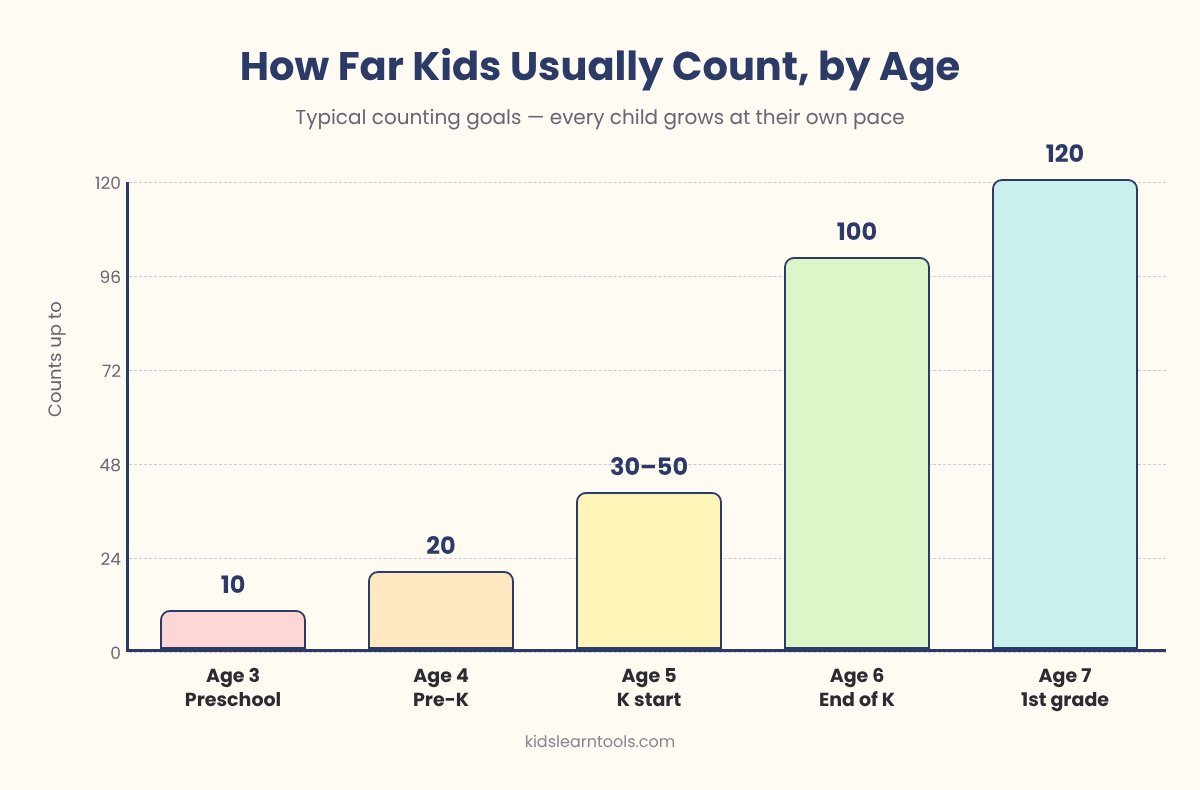
Most kids can count to 100 by the end of kindergarten (around age 6). Many 4-year-olds count to 10 or 20, and many 5-year-olds reach 30 to 50 before the “decade” words click. Every child is different, so use this as a guide, not a test.
| Age / grade | Typical counting goal | What to practice |
|---|---|---|
| Age 3 (preschool) | Count to 5–10 | Counting songs, fingers, toys |
| Age 4 (Pre-K) | Count to 20 | The “teen” numbers 11–19, counting objects to 10 |
| Age 5 (kindergarten start) | Count to 30–50 | Decade words, counting by 10s |
| Age 6 (end of kindergarten) | Count to 100 by 1s and 10s | Crossing decades, counting on from any number |
| Age 7 (1st grade) | Count to 120, start at any number | Counting backward, skip counting by 2s and 5s |
If your child is well behind these ranges by the end of kindergarten, talk with their teacher. Usually it only means they need more short, daily practice.
Why Is Counting to 100 Important?
Counting to 100 is not just a party trick. It builds the base for almost everything kids learn in math over the next three years:
- Place value: hearing “forty-seven” as 4 tens and 7 ones starts here. (See our place value guide for kids.)
- Addition and subtraction: “counting on” from a number is the first adding strategy kids use.
- Skip counting and times tables: counting by 10s, 5s and 2s grows straight out of counting by 1s.
- Number sense: kids learn that 68 comes after 67 and is bigger than 59.
- Confidence: reaching 100 is a big, proud moment. Many schools even celebrate a “100th Day of School.”
The Patterns That Make Counting to 100 Easy
The secret to counting to 100 is pattern, not memory. Once kids see the patterns below, they only need to remember a few new words.
Pattern 1: The ones digit repeats 0–9 in every row
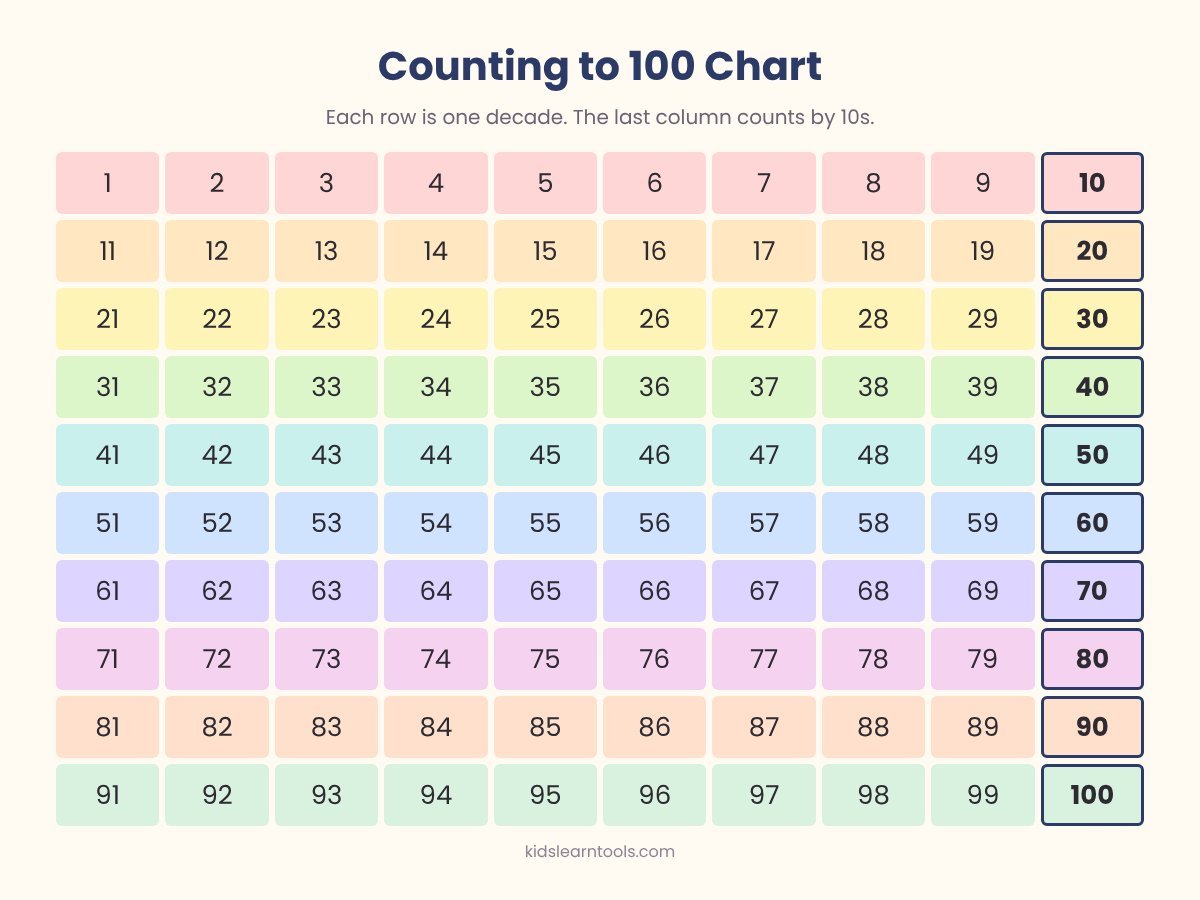
Look at any row of a hundreds chart. The last digit always goes 1, 2, 3, 4, 5, 6, 7, 8, 9, 0. Twenty-one, twenty-two, twenty-three… sounds just like one, two, three with “twenty” in front.
Pattern 2: The tens digit goes up by 1 in each row
Going down a column, the tens digit grows: 3, 13, 23, 33, 43… Each step down is 10 more.
Pattern 3: Only 10 new “decade words” to learn
| Tens | Decade word | Sounds like | Tip |
|---|---|---|---|
| 20 | twenty | “two” → twen-ty | Irregular — practice extra |
| 30 | thirty | “three” → thir-ty | Irregular — practice extra |
| 40 | forty | four-ty | Spelled without the “u” |
| 50 | fifty | “five” → fif-ty | Irregular — practice extra |
| 60 | sixty | six-ty | Regular |
| 70 | seventy | seven-ty | Regular |
| 80 | eighty | eight-y | Regular |
| 90 | ninety | nine-ty | Regular |
| 100 | one hundred | — | The finish line! |
Notice that “-ty” means “tens.” Sixty is six tens. Kids who hear this link start to understand place value at the same time.
Pattern 4: The tricky “teens” (11–19)
The numbers 11 to 19 break the pattern. We say “eleven” and “twelve,” not “ten-one” and “ten-two,” and in “fourteen” the 4 is said first even though the 1 is written first. This is why many kids get stuck before 20. Spend extra time here before moving on.
Here is the whole difference in one picture. Read each pair out loud and clap on the loud part:

How to Teach Counting to 100: A 6-Week Plan
Short, daily practice works much better than long lessons. Aim for 5 to 10 minutes a day. Move to the next step only when your child is confident with the current one.
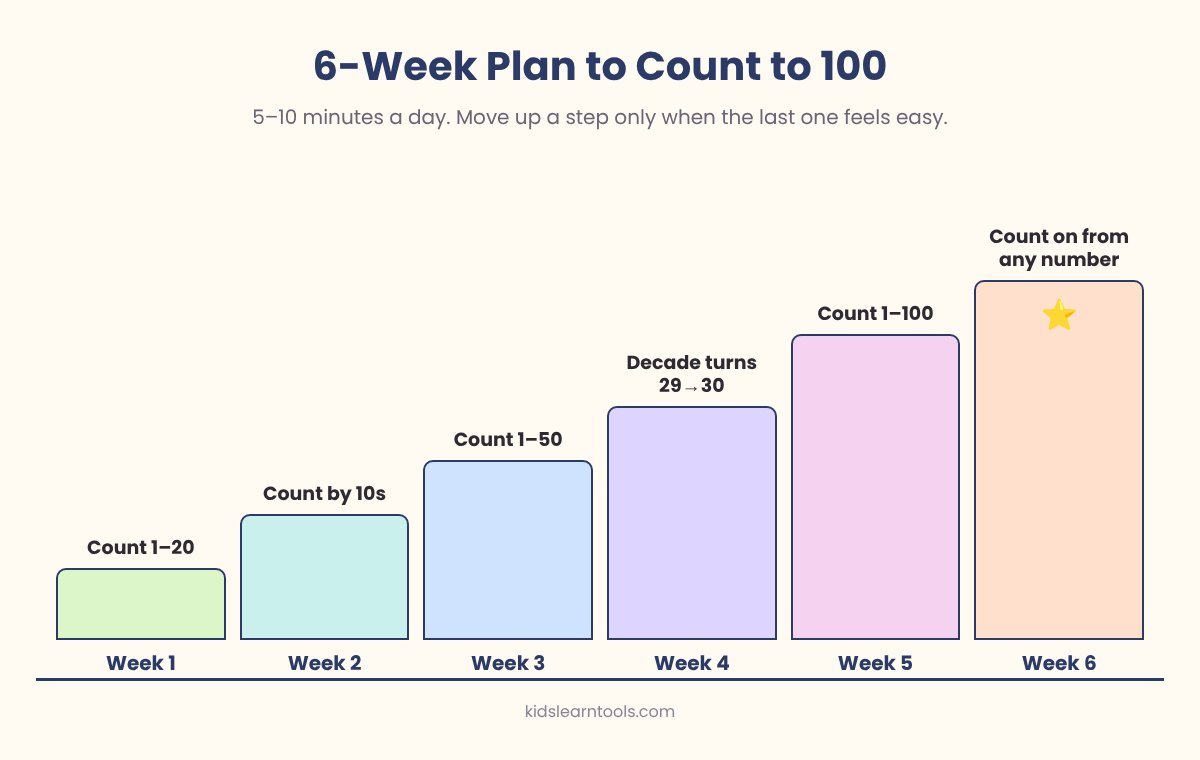
| Week | Goal | Daily activity (5–10 minutes) |
|---|---|---|
| Week 1 | Count 1–20 smoothly | Count steps, toys and claps; extra practice on 11–19 |
| Week 2 | Count by 10s to 100 | Sing or chant 10, 20, 30… 100; point to the right-hand column of a hundreds chart |
| Week 3 | Count 1–50 | Count along a hundreds chart, one row per day added |
| Week 4 | Cross the decades | Practice the “turn” numbers: 29→30, 39→40, 49→50 |
| Week 5 | Count 1–100 | Full count with the chart, then with the chart covered |
| Week 6 | Count on from any number | “Start at 63 and count to 75”; counting games below |
Step 1: Make 1 to 20 rock-solid
Everything after 20 repeats the same pattern, so 1 to 20 must be strong first. Count real things: stairs, grapes, blocks, cars on the road. If 11 to 19 are shaky, practice just those numbers for a few days.
Step 2: Teach counting by 10s
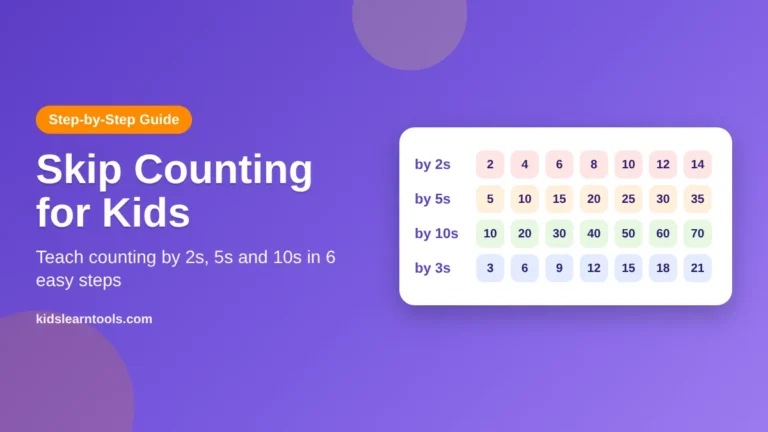
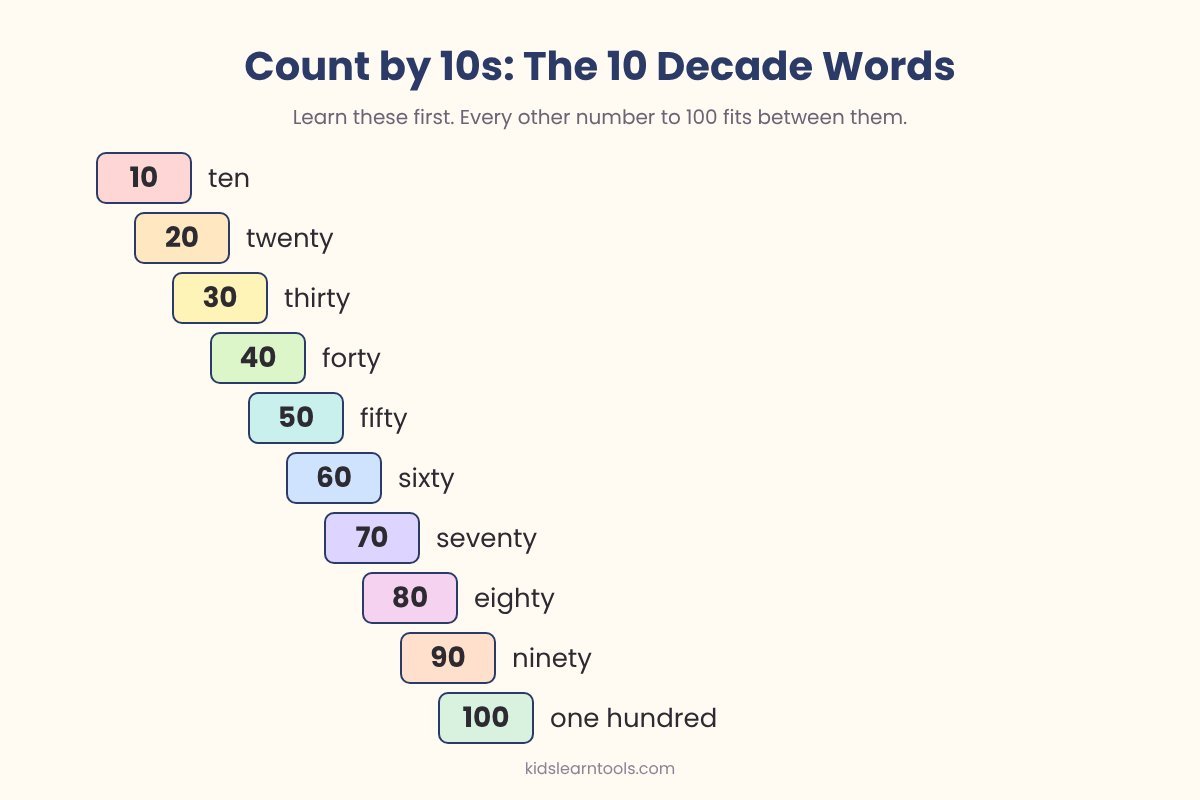
Counting by 10s gives kids the “skeleton” of 100: ten, twenty, thirty, forty, fifty, sixty, seventy, eighty, ninety, one hundred. Once they know these ten words in order, they always know what comes after a “9” number. Our skip counting guide has more ideas for counting by 10s, 5s and 2s.
Step 3: Add one row at a time
Use a hundreds chart and add one new row each day: 1–30, then 1–40, then 1–50. Let your child point to each number as they say it. Pointing keeps them from skipping.
Step 4: Practice the decade “turns”
The hardest moment in counting to 100 is the turn from a 9 number to the next ten. Practice these small pieces on their own:
- 27, 28, 29, 30
- 47, 48, 49, 50
- 67, 68, 69, 70
- 87, 88, 89, 90
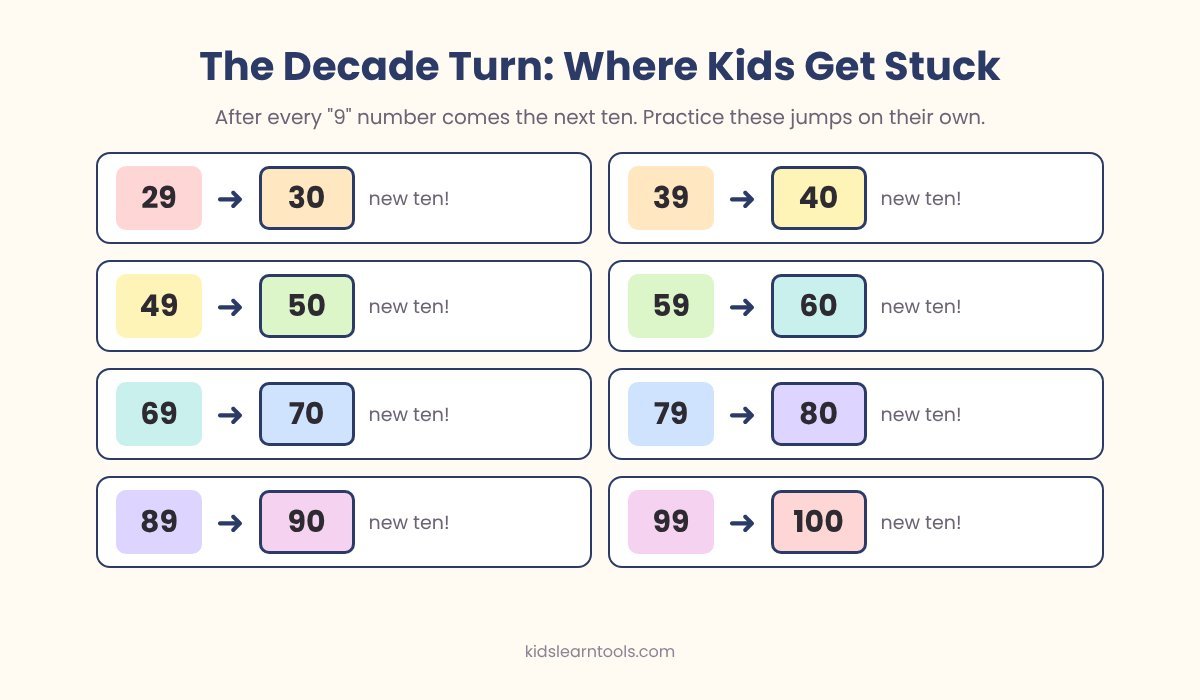
A helpful question is: “After twenty-nine, what is the next ten?” Kids who know counting by 10s can answer it.
Step 5: Count with the chart covered
Once your child counts to 100 with the chart, cover rows with paper and count again. Then try without the chart at all. This moves the skill from “reading” to remembering.
Step 6: Count on from any number
Ask, “Start at 34 and count to 50.” This is harder than starting at 1, and it is the skill kids use later for adding. Keep it playful, like a game.
Hundreds Chart: Your Best Counting to 100 Tool
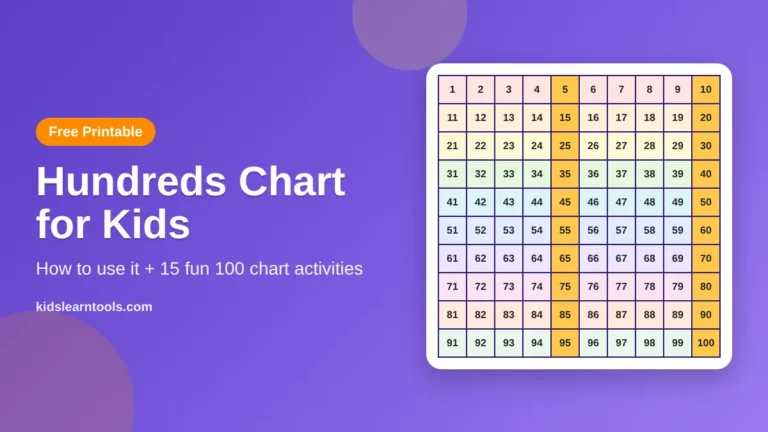
A hundreds chart shows 1 to 100 in ten rows of ten. It makes every counting pattern easy to see, and it is the single most useful tool for this skill.
You can print a ready-made chart or make your own:
- Free printable hundreds chart — print and stick it on the fridge.
- Hundreds Chart Maker — make a blank, partly filled or color-coded chart for practice.
- 15 fun hundreds chart activities — games to use with the chart once kids can count.
Tip: make a “missing numbers” chart with the maker tool. Leave out the decade turns (30, 40, 50…) and let your child fill them in. It is a quick check of exactly where they get stuck.
12 Fun Counting to 100 Activities
Games keep counting practice fresh. Pick one or two a day.
- Counting walk: count steps on a walk. Can you reach 100 before the corner?
- Ten-frame cups: put 10 small objects in each cup. Count the cups by 10s, then the extras by 1s.
- Stick-a-sticker chart: add one sticker to a hundreds chart every day. On day 100, celebrate.
- Collection of 100: collect 100 small things (buttons, pasta, beads) in groups of 10.
- Clap and count: clap on every number, stomp on every ten (10, 20, 30…).
- Missing number hunt: cover 5 numbers on the chart with coins. Your child names the hidden numbers.
- What comes next? Say “fifty-eight” and your child says the next three numbers.
- Counting songs: songs make long counts easy to remember. Start with our counting song for kids 1 to 10, then move to a count-to-100 song.
- Puzzle chart: cut a printed hundreds chart into 6–8 pieces and put it back together.
- Exercise count: jumping jacks to 20, toe touches to 30, then rest.
- Bead strings: thread 100 beads, changing color every 10. It shows what 100 really looks like.
- Start-anywhere dice: roll two dice to make a number (a 4 and a 6 make 46). Count on from there to the next ten.
Many of these also build hand strength. For more ideas, see our fine motor activities for preschoolers.
Counting to 100 Examples (Step by Step)
These worked examples show exactly what to say and do. Try one a day with your child.
Example 1: Counting on from 46 to 53
Say: “Let’s start at 46.” Your child continues: 47, 48, 49… Stop and ask, “What ten comes next?” They answer “fifty,” then go on: 50, 51, 52, 53. What it teaches: counting on and crossing a decade.
Example 2: Counting 34 objects with tens and ones
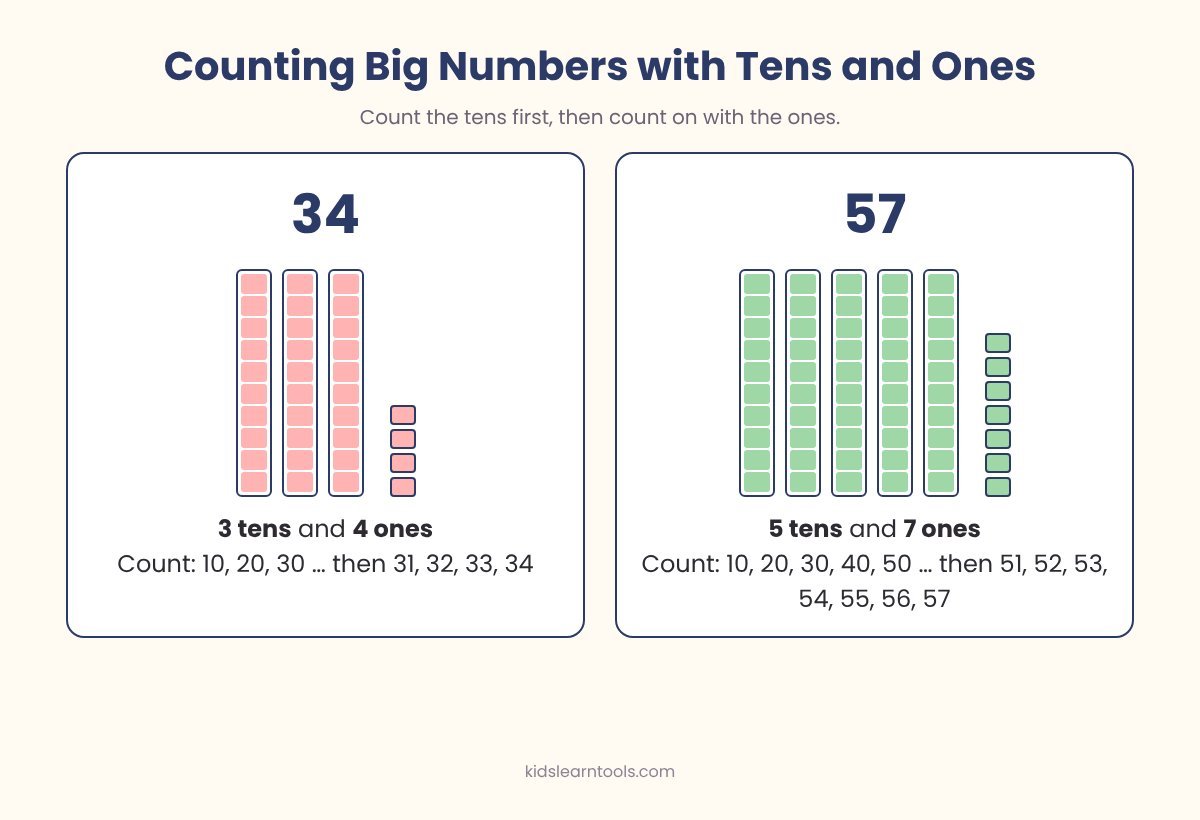
Put 34 blocks on the table. Help your child make towers of 10. They get 3 towers and 4 single blocks. Count the towers by 10s (10, 20, 30), then count on with the singles (31, 32, 33, 34). What it teaches: big numbers are counted in tens, which is the start of place value.
Example 3: Finding the missing numbers
| Question | Answer | Hint to give |
|---|---|---|
| 27, 28, ___, 30 | 29 | “What comes just before thirty?” |
| 58, 59, ___, 61 | 60 | “After 59 comes a new ten.” |
| ___, 72, 73, 74 | 71 | “Count backward one from 72.” |
| 96, 97, 98, ___, ___ | 99, 100 | “What is the finish line?” |
Example 4: Counting by 10s from a number that isn’t 10
Start at 7 and add ten each time: 7, 17, 27, 37, 47, 57, 67, 77, 87, 97. Show it on a hundreds chart: your child’s finger moves straight down one column. What it teaches: each row of the chart is 10 more.
Example 5: One more and one less
| One less | Number | One more |
|---|---|---|
| 18 | 19 | 20 |
| 39 | 40 | 41 |
| 64 | 65 | 66 |
| 89 | 90 | 91 |
Ask, “What number is one more than 89?” This small question checks the hardest part of counting to 100 in seconds.
Common Mistakes When Counting to 100 (and Quick Fixes)
| Mistake | Example | Why it happens | Quick fix |
|---|---|---|---|
| Stuck at the decade turn | “…28, 29, twenty-ten” | Doesn’t know the next decade word | Practice counting by 10s first |
| Skipping a decade | “…59, 70, 71” | Decade words not in order yet | Point along the right-hand column of the chart |
| Teen confusion | “…13, 14, 15, 16, 18” | Teens don’t follow the pattern | Extra practice with 11–19 only |
| Mixing up -teen and -ty | Says “sixteen” for 60 | The words sound alike | Stress the ending: “six-TEEN” vs “SIX-ty” |
| Fifty / fifteen swap | “…49, fifteen” | Same sound as above | Show both numbers side by side on the chart |
| Losing place | Repeats or skips numbers | Counting too fast without pointing | Point to each number; slow, steady pace |
| “Ten-ty” for 100 | “…98, 99, ten-ty” | Over-uses the pattern (a good sign!) | Praise the logic, then teach “one hundred” |
🍎 From My Classroom
In my eight years of teaching, I worked mostly with slow learners, and counting to 100 was where many of them lost confidence. They would race to 29 and then freeze. What helped most was splitting the count into small pieces. We learned the ten “decade words” first, as a chant, and only then filled in the numbers between them. I also paired a confident counter with a child who was still learning, and they took turns pointing on the hundreds chart. The child who struggled heard the pattern again and again without any pressure. Within a few weeks, most of them could count to 100 and were proud to show it to the class.
Counting to 100 Practice: Worksheet Ideas
Once your child can say the numbers, writing them builds a deeper memory. Try these worksheet ideas: For a full set of printable pages by skill, see our kindergarten math worksheets pack.
- Fill in the missing numbers on a partly blank hundreds chart.
- Number before and after: ___ 45 ___
- Count by 10s: 10, 20, ___, 40, ___, ___
- Write 1 to 100 on a blank 10 × 10 grid, one row per day.
- Count and write: count groups of objects (up to 30) and write the number.
You can make all of these for free with our Hundreds Chart Maker and Math Worksheet Generator.
What Comes After Counting to 100?
When counting to 100 is easy, kids are ready for these next steps:
- Count to 120 (a 1st grade goal) and count backward from 20, then from 100.
- Skip counting by 2s, 5s and 10s — see our skip counting guide.
- Tens and ones: understanding that 47 is 4 tens and 7 ones, with a place value chart.
- Adding within 10 and 20 using number bonds.
Key Takeaways
- Most kids count to 100 by the end of kindergarten (about age 6).
- Learn 1–20 first, then counting by 10s, then fill in each decade.
- The hardest spots are the teens (11–19) and the decade turns (29→30).
- A hundreds chart makes every pattern easy to see.
- Five to ten minutes of playful daily practice beats long lessons.
Frequently Asked Questions
How long does it take a child to learn to count to 100?
With 5 to 10 minutes of daily practice, most kindergarten kids who can already count to 20 learn to count to 100 in about 4 to 8 weeks. Some need longer, and that is normal.
Should a 5-year-old be able to count to 100?
Not always. Many 5-year-olds count to 30 or 50. Counting to 100 is an end-of-kindergarten goal, so most kids reach it around age 6.
What is the fastest way to teach counting to 100?
Teach counting by 10s first. Once kids know the ten decade words in order, they only need to repeat 1 to 9 inside each decade. A hundreds chart and daily counting songs speed this up.
Why does my child get stuck at 29 or 39?
The “turn” from a 9 number to the next ten needs a new decade word. If your child doesn’t know which ten comes next, they stop. Practicing counting by 10s fixes this.
What is the difference between rote counting and counting objects?
Rote counting is saying numbers in order from memory. Counting objects (rational counting) means touching one item per number and knowing the last number tells how many. Kids need both skills.
Is counting to 100 a kindergarten standard?
Yes. In the U.S. Common Core, standard K.CC.A.1 says kindergarten kids should count to 100 by ones and by tens.