Addition Worksheets for Kids: Free Printables from Single Digit to Regrouping
Addition worksheets give kids step-by-step practice with adding numbers, starting with picture addition and sums to 5, then sums to 10 and 20, then two-digit addition and regrouping (carrying). Kids learn fastest when each worksheet focuses on one strategy, such as counting on, doubles, making 10 or using a number line, and practice lasts 10–15 minutes a day.
Addition is the first big math skill kids learn, and almost everything after it depends on it: subtraction, place value, multiplication and money. This guide shows you which addition worksheets to use at each level, the strategies behind them, and how to fix the mistakes kids make most.
Addition Worksheets by Level
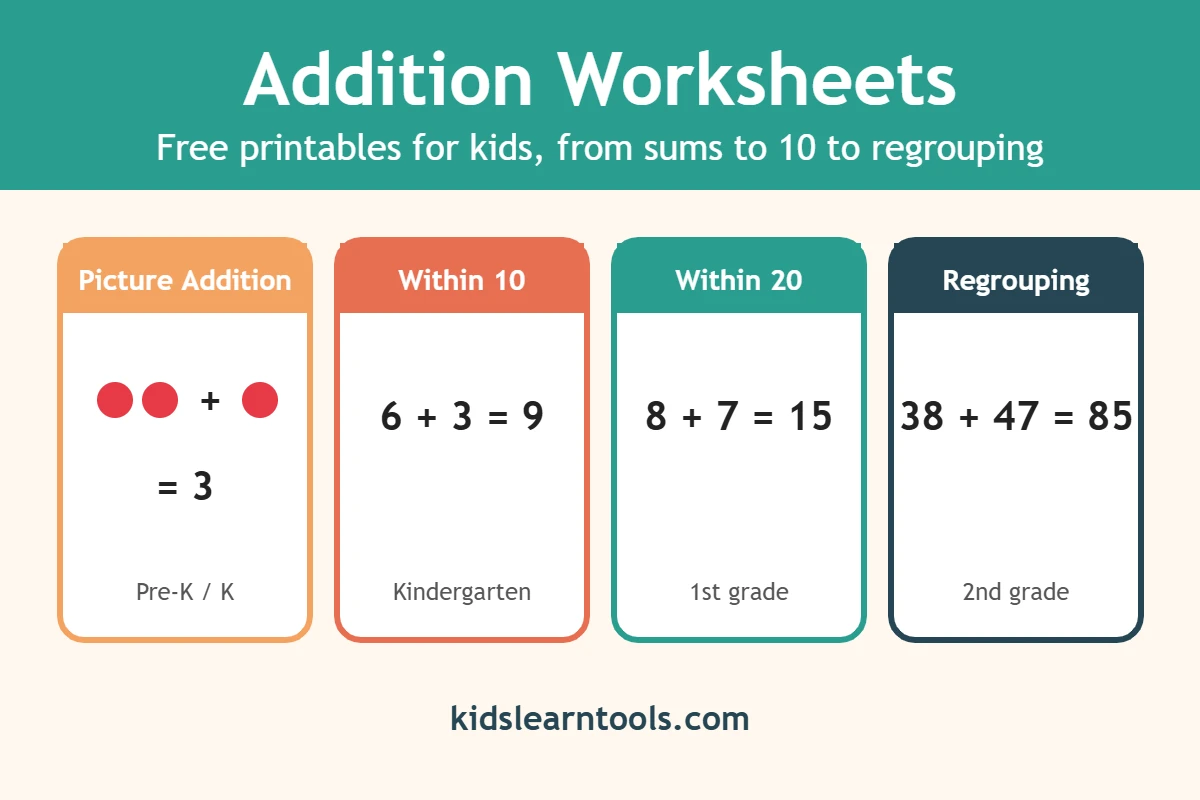
Use this table to pick the right starting point. If your child gets more than 2 problems wrong on a page, go one level back.
| Level | Type of addition | Example | Typical grade |
|---|---|---|---|
| 1 | Picture addition, sums to 5 | 2 apples + 1 apple = 3 | Pre-K / K |
| 2 | Simple addition within 10 | 6 + 3 = 9 | Kindergarten |
| 3 | Single digit addition within 20 | 8 + 7 = 15 | 1st grade |
| 4 | Adding tens and 2-digit + 1-digit | 40 + 30, 34 + 5 | 1st grade |
| 5 | 2-digit addition without regrouping | 23 + 45 = 68 | 2nd grade |
| 6 | 2-digit addition with regrouping | 38 + 47 = 85 | 2nd grade |
| 7 | 3-digit addition with regrouping | 256 + 378 = 634 | 3rd grade |
Need endless practice at one level? Our free math worksheet generator creates new addition sheets in seconds.
Picture Addition Worksheets (Sums to 5)
Kids count two groups of pictures and write the total. This is the bridge between counting and adding. Use real objects like buttons or blocks alongside the sheet.
Simple Addition Worksheets (Within 10)
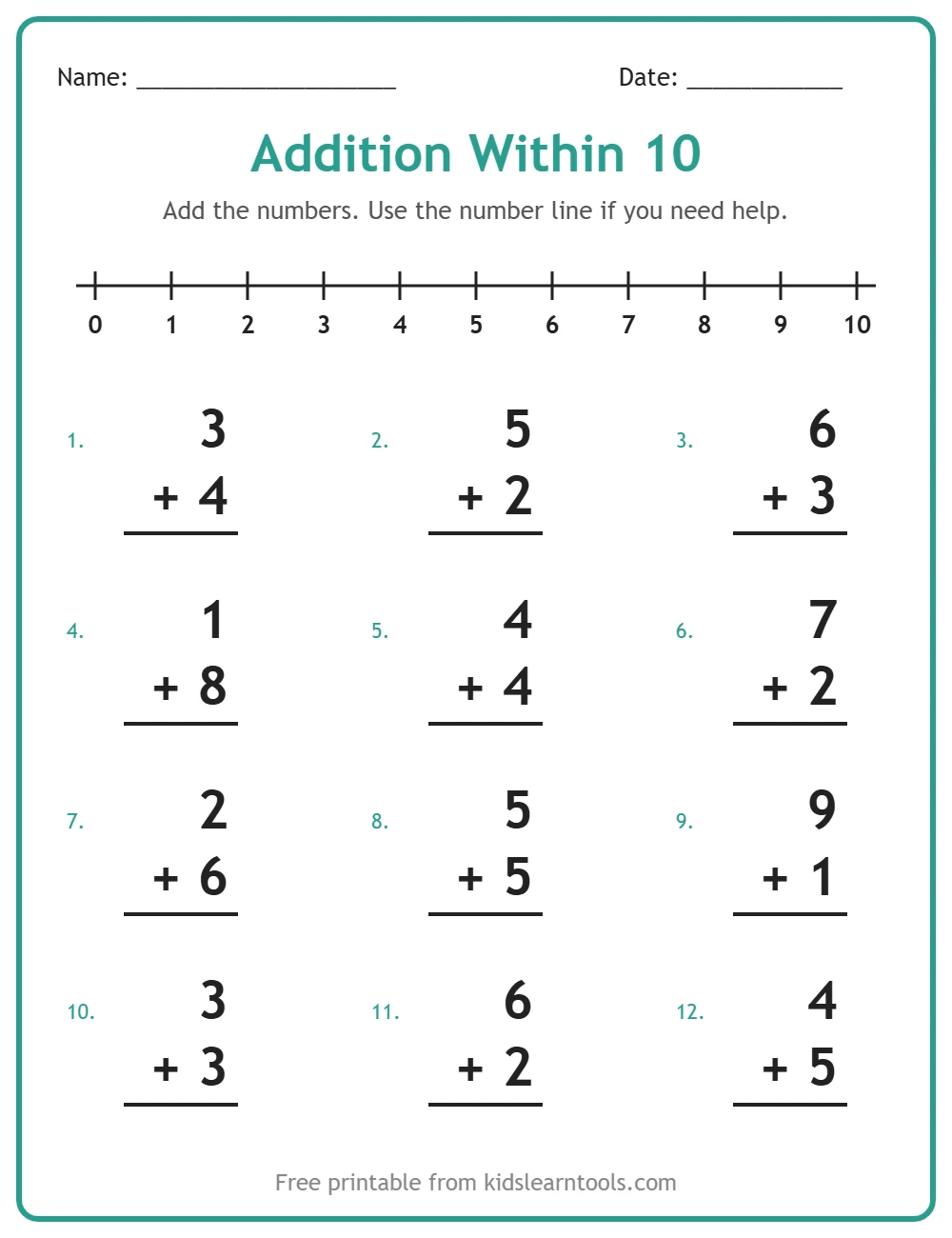
Kids add two single-digit numbers with sums up to 10. The goal is fluency: by the end of first grade, kids should know these facts without counting on fingers. Number bonds are the best tool for learning the pairs that make 10 (1+9, 2+8, 3+7, 4+6, 5+5).
Single Digit Addition Worksheets (Within 20)
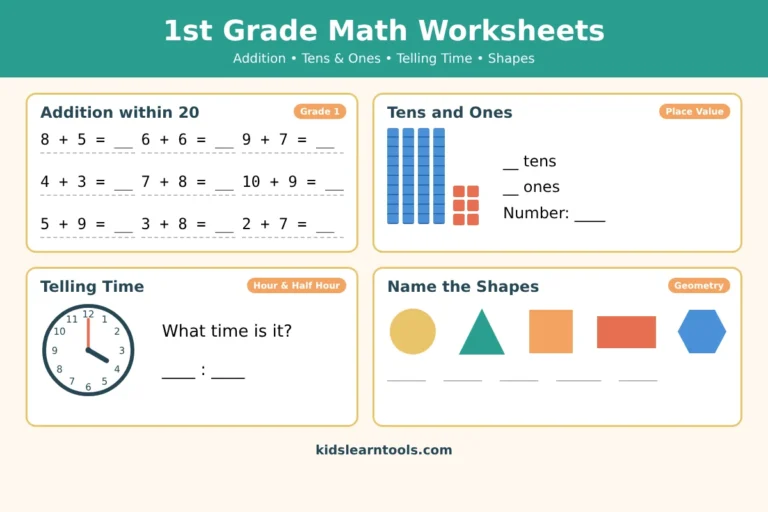
Sums like 9 + 6 or 7 + 8. Kids use strategies instead of counting every object. These sheets are a core part of our 1st grade math worksheets plan.
Two-Digit Addition Worksheets
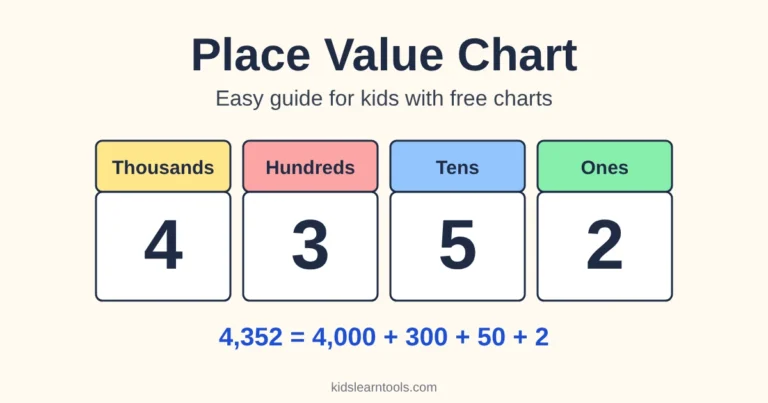
Kids add tens and ones separately. Without regrouping, 23 + 45 is 2 tens + 4 tens = 6 tens, and 3 ones + 5 ones = 8 ones, so 68. A place value chart helps kids line up the digits.
Addition with Regrouping Worksheets
When the ones add up to 10 or more (8 + 7 = 15), kids “regroup” 10 ones into 1 ten and carry it to the tens column. Kids should understand place value before starting these sheets.
Addition Word Problem Worksheets
Story problems teach kids when to add. Look for words like “in all,” “altogether,” “more” and “total.” Teach kids to read the problem, draw a quick picture, then write the number sentence.
6 Addition Strategies Every Kid Should Know
Good addition worksheets teach strategies, not just answers. Teach them in this order:
- Counting all: Count every object in both groups (for beginners).
- Counting on: Start from the bigger number and count up. For 3 + 8, start at 8 and say “9, 10, 11.”
- Doubles: Learn 1+1 to 10+10 by heart. Doubles are easy to remember.
- Near doubles: Use a double to solve a close fact. 6 + 7 = 6 + 6 + 1 = 13.
- Make 10: Break one number to make 10 first. 8 + 5 = 8 + 2 + 3 = 13.
- Number line jumps: Start at one number and jump forward. Great for visual learners and for adding tens.
How to Teach Addition with Regrouping (Step by Step)
Example: 38 + 47
- Add the ones: 8 + 7 = 15.
- 15 ones = 1 ten and 5 ones. Write 5 in the ones place.
- Carry the 1 ten to the top of the tens column.
- Add the tens: 1 + 3 + 4 = 8 tens.
- Answer: 85.
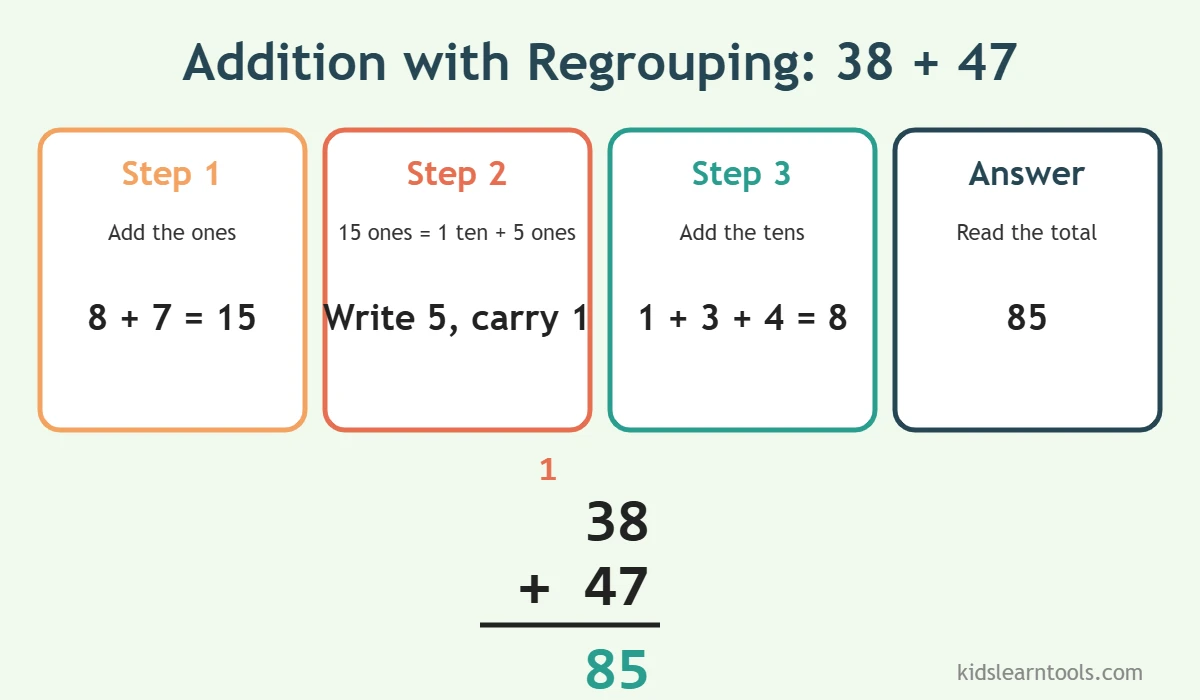
Show it first with base-ten blocks or bundled straws, so “carrying” means something real.
Addition Worksheets by Skill: What Each One Teaches
Most worksheet sites give you a page of sums and nothing else. Below, each skill has a short explanation, one teaching tip and an example problem set you can copy or build in our free math worksheet generator. Work through them in this order.
| Skill | What kids do | Example | Best for |
|---|---|---|---|
| Addition to 20 | Add two numbers with a sum up to 20 | 9 + 7 = 16 | Late K, Grade 1 |
| Number line addition | Start on a number and jump forward | 5 + 4 = 9 | K, Grade 1 |
| Doubles and doubles plus one | Use known doubles to solve close facts | 6 + 7 = 6 + 6 + 1 | Grade 1 |
| Missing addends | Find the unknown part | 4 + ☐ = 10 | Grade 1 |
| Adding 3 numbers | Add three single-digit numbers | 3 + 7 + 5 = 15 | Grade 1, Grade 2 |
| Friends of 10 | Find the pairs that make 10 | 8 + ☐ = 10 | K, Grade 1 |
Addition to 20 Worksheets
Addition to 20 is the main fact goal for first grade: by the end of the year, kids should add within 20 quickly and add within 10 from memory. Start with sums to 10, then add “teen” sums such as 9 + 6 and 8 + 7, which need the make-10 strategy.
Teaching tip: Mix in only 3 to 4 new facts per page. Repeating a small set builds recall faster than 30 random facts.
- 9 + 4 = ___
- 7 + 8 = ___
- 10 + 6 = ___
- 6 + 6 = ___
- 8 + 9 = ___
Number Line Addition Worksheets
Number line addition turns a sum into movement. Kids put a finger on the first number, then jump forward one step for each number they add. It is the bridge between counting objects and adding in their heads.
Teaching tip: Draw a big number line on the floor with tape and let kids jump it with their feet before they do it on paper. Use a 0–20 line for first grade and a hundreds chart later for jumps of 10.
Doubles and Doubles Plus One Worksheets
Doubles (2 + 2, 5 + 5, 8 + 8) are the easiest facts to remember because they come in pairs. Once kids know doubles, doubles plus one (also called near doubles) unlock a new group of facts: if 6 + 6 = 12, then 6 + 7 is one more, 13.
| Double | Doubles plus one | Answer |
|---|---|---|
| 3 + 3 = 6 | 3 + 4 | 7 |
| 5 + 5 = 10 | 5 + 6 | 11 |
| 7 + 7 = 14 | 7 + 8 | 15 |
| 8 + 8 = 16 | 8 + 9 | 17 |
Teaching tip: Link doubles to real things: 2 eyes, 4 wheels on a car (2 + 2), 10 fingers (5 + 5), 16 crayons in a box of two rows (8 + 8).
Missing Addends Worksheets
A missing addend problem gives the total and one part, and kids find the other part: 6 + ☐ = 10. It shows that addition and subtraction are connected, and it prepares kids for simple algebra later.
Teaching tip: Have kids “count up” from the number they know to the total. For 6 + ☐ = 10, they say “7, 8, 9, 10” and count four fingers. Our number bonds guide uses the same part-part-whole idea.
- 3 + ☐ = 8
- ☐ + 5 = 9
- 7 + ☐ = 12
- ☐ + 4 = 10
Adding 3 Numbers Worksheets
Adding 3 numbers teaches kids that they can choose the order. Look for a pair that makes 10 or a double first, then add the third number. For 4 + 7 + 6, add 4 + 6 = 10 first, then 10 + 7 = 17.
Teaching tip: Ask kids to circle the two numbers they will add first. That one step stops them from adding left to right without thinking.
Friends of 10 (Making 10) Worksheets
Friends of 10 are the number pairs that make 10: 1 + 9, 2 + 8, 3 + 7, 4 + 6 and 5 + 5. Knowing them by heart makes addition to 20 much easier, because 8 + 5 becomes 8 + 2 + 3 = 13. A ten frame is the best visual for this skill.
Teaching tip: Play “Make 10” with a deck of cards: kids turn over a card and say its friend of 10 as fast as they can.
Addition Worksheets for Grade 1
Grade 1 addition worksheets should cover adding within 20, word problems with “put together” and “add to” stories, adding 3 numbers, and adding tens to a two-digit number (such as 30 + 20 or 45 + 10). Kids should also understand the equal sign, so include true/false problems like 5 + 2 = 4 + 3.
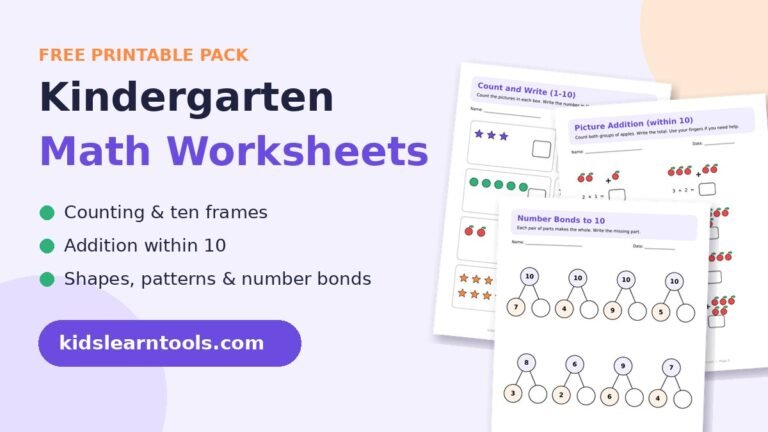
For a full list of first grade skills with printables, see our 1st grade math worksheets guide. If your child is younger, start with the kindergarten math worksheets hub.
Addition and Subtraction Worksheets for Grade 1
Once addition facts to 10 are steady, mix addition and subtraction on the same page so kids read the sign before they solve. Fact families help: 3 + 5 = 8, 5 + 3 = 8, 8 − 3 = 5, 8 − 5 = 3. Start with half addition and half subtraction, then mix them at random.
Common Addition Mistakes and How to Fix Them
| Mistake | Example | Fix |
|---|---|---|
| Counting the first number again when counting on | 5 + 3 = 7 | Say “5” in your head, then count 6, 7, 8 |
| Forgetting to carry | 38 + 47 = 75 | Circle the carried 1 in a different color |
| Lining up digits wrong | 34 + 5 written under the 3 | Use grid paper or a place value chart |
| Writing the full sum in the ones place | 8 + 7 → writes 15 in the ones column | Practice “15 ones = 1 ten 5 ones” with blocks |
| Always using fingers | Slow on 9 + 6 | Practice doubles and make 10 daily |
From My Classroom
Most of my eight teaching years were with kids who learned more slowly than their classmates, and addition was where I saw the biggest confidence gaps. One method that worked again and again was teaching doubles as a song and a hand game before showing any worksheet. Once kids knew 6 + 6 by heart, near doubles like 6 + 7 suddenly felt easy, and the worksheet became a place to show off instead of a test.
I also paired each child with a peer buddy for the first five problems on a new sheet. Kids explain things to each other in words adults often forget to use.
Many of my students were shy and hesitant to take part in class. I learned that a teacher’s friendly behaviour is the first step: when kids feel safe and welcome, their confidence grows and their shyness begins to fade. Instead of pushing them to answer questions, I drew them into hands-on activities, where they could join in without feeling put on the spot. Little by little, their shyness faded. They began to participate actively, and I saw a clear, positive change in their confidence and in their learning.
How Often Should Kids Practice Addition?
A short daily routine beats one long session a week. Here is a simple 15-minute plan:
- 3 minutes: Warm up with doubles or make-10 flash facts.
- 7 minutes: One addition worksheet at the right level.
- 3 minutes: Check answers together and fix one mistake.
- 2 minutes: A fun finish, like dice addition or our addition quiz for kids.
Fun Addition Activities Beyond Worksheets
- Domino addition: Add the dots on both sides of a domino.
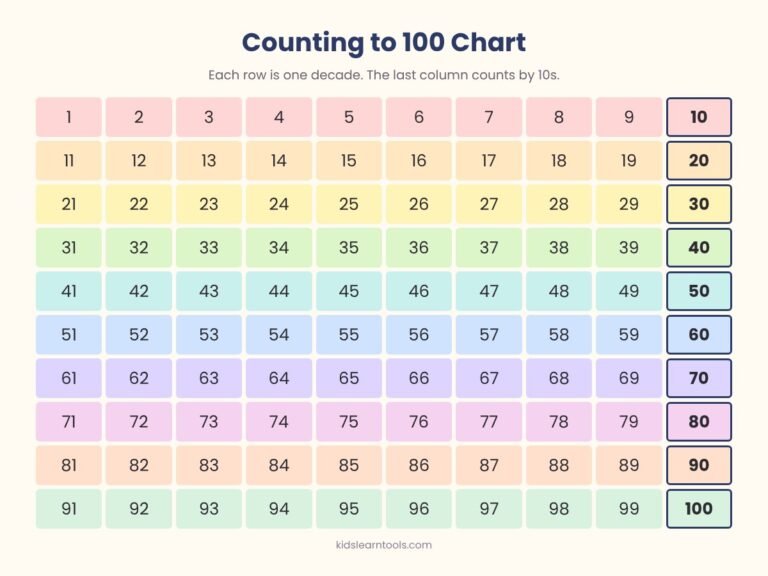
- Hundreds chart jumps: Add 10 by moving down one row on a hundreds chart.
- Grocery game: Add the prices of two small items.
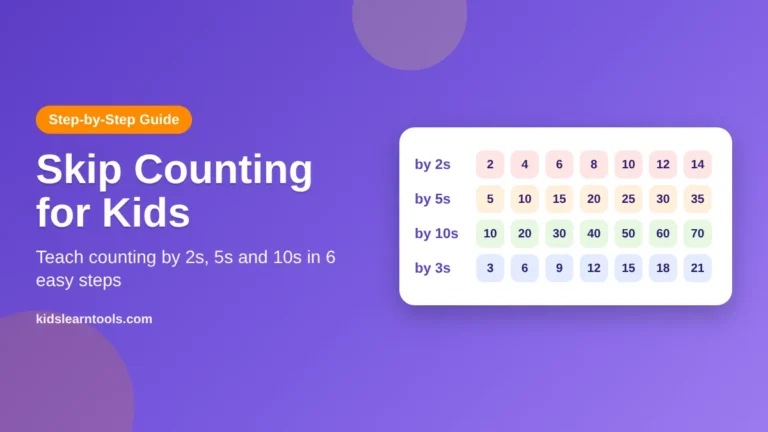
- Skip counting songs: Build speed with skip counting for kids.
- Color by sum: Solve each problem and color the picture with our color by number tool.
Frequently Asked Questions
At what age do kids learn addition?
Most kids start simple addition with objects at age 4–5 (preschool and kindergarten). They work on sums within 20 in first grade (age 6–7) and two-digit addition with regrouping in second grade (age 7–8).
What is the best way to teach addition to kids?
Start with real objects, then pictures, then numbers. Teach strategies in order: counting on, doubles, near doubles and make 10. Keep practice short and daily.
What is regrouping in addition?
Regrouping (also called carrying) happens when the digits in one place add up to 10 or more. You trade 10 ones for 1 ten and move it to the tens column.
How many addition facts should a 1st grader know?
First graders should know all addition facts within 10 by heart and be able to solve facts within 20 using strategies like doubles and make 10.
Are these addition worksheets free to print?
Yes. All addition worksheets and tools on Kids Learn Tools are free to print and use at home or in the classroom, with no sign-up.
What comes after addition worksheets?
Subtraction comes next, followed by mixed addition and subtraction worksheets. Later, repeated addition leads into multiplication.
Final Thoughts
The best addition worksheets match your child’s level, teach one strategy at a time and build from pictures to regrouping. Practice a little every day, celebrate progress, and move up only when your child feels confident. Start with our kindergarten math worksheets for the basics, and find more free practice in our learning tools.