Number Bonds: What They Are and How to Teach Them (to 5, 10 and 20)
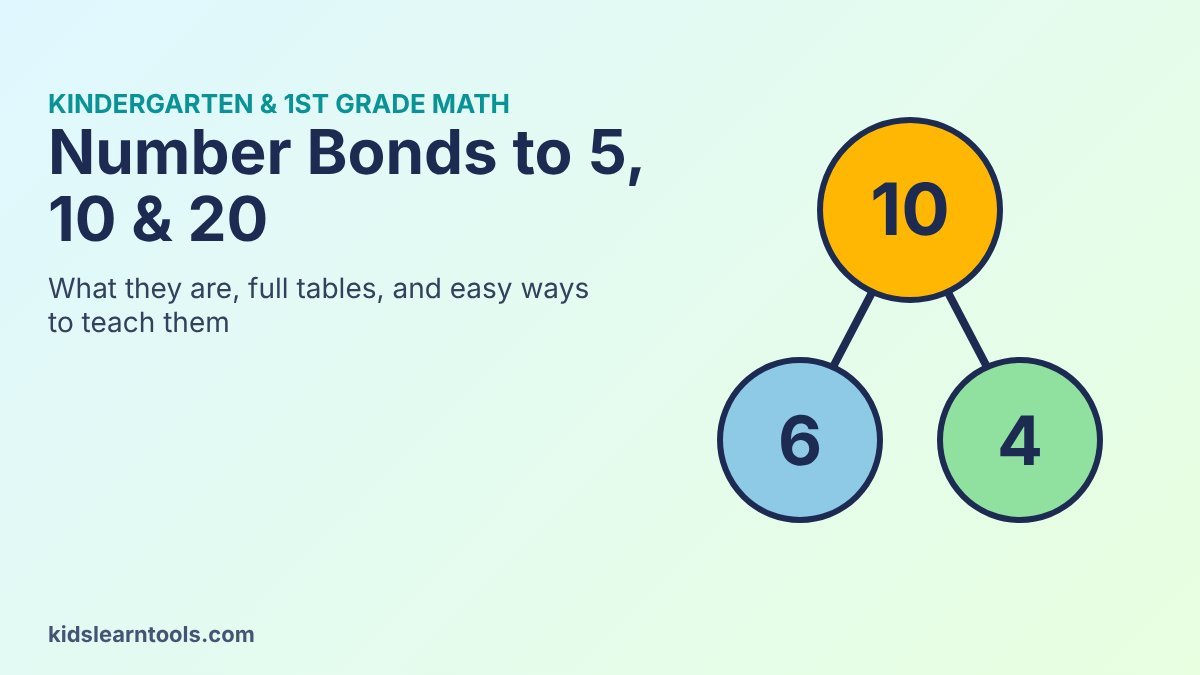
Number bonds are pairs of numbers that join together to make a bigger number. For example, 3 and 2 are a number bond of 5, because 3 + 2 = 5. Kids usually see them as a “part-part-whole” diagram: one circle for the whole and two circles for the parts. Learning number bonds helps kids add, subtract and do mental math quickly.
This guide explains number bonds in simple words, gives full tables for bonds to 5, 10 and 20, and shares easy activities you can use at home or in class.
What Is a Number Bond?
A number bond shows how a number can be split into two parts. It has three pieces:
- The whole – the total number (for example, 10)
- Part 1 – one smaller number (for example, 6)
- Part 2 – the other smaller number (for example, 4)
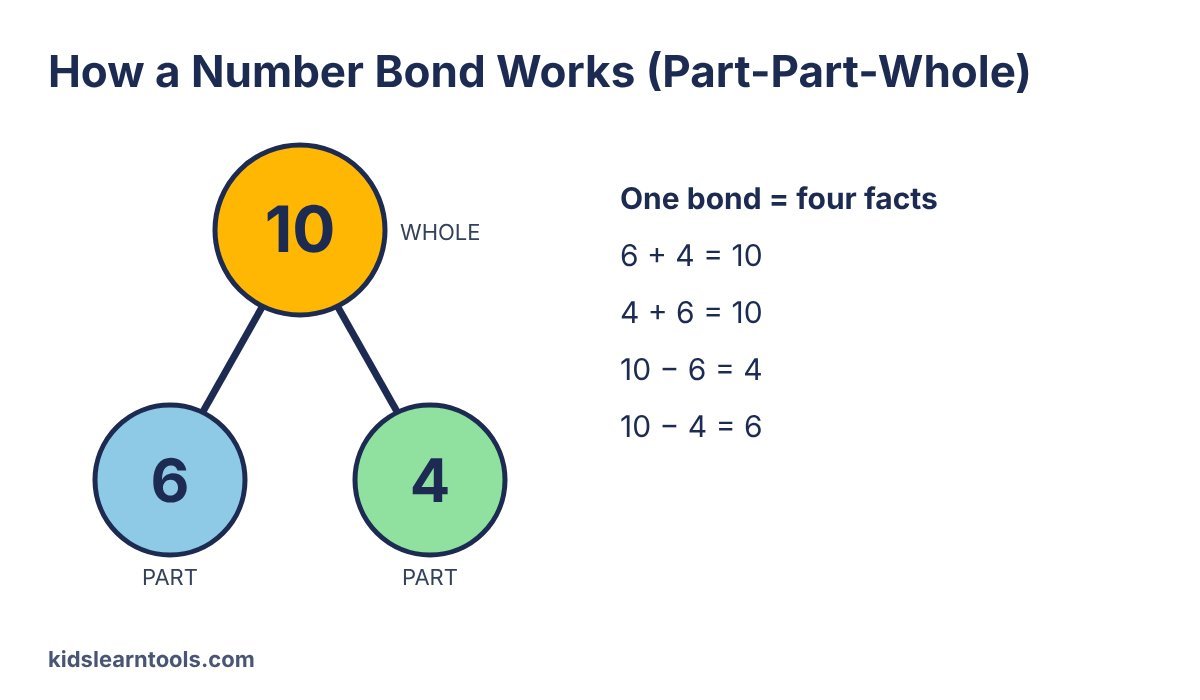
The same picture gives kids four facts at once:
- 6 + 4 = 10
- 4 + 6 = 10
- 10 − 6 = 4
- 10 − 4 = 6
That’s why number bonds are so powerful — kids learn addition and subtraction together, as a family of facts, instead of memorising them separately.
Why Are Number Bonds Important for Kids?
Number bonds are one of the biggest building blocks in early math. They help kids:
- Add and subtract faster without counting on fingers
- Understand that numbers can be broken apart (number sense)
- See the link between addition and subtraction
- Do mental math – e.g. 8 + 5 = 8 + 2 + 3 = 13 (“make 10” strategy)
- Prepare for place value, where numbers are split into tens and ones
Kids who know their bonds to 10 by heart find later topics — like adding two-digit numbers and place value — much easier. In fact, the U.S. Common Core kindergarten standards ask kids to break numbers up to 10 into pairs in more than one way — that is exactly what number bonds teach.
Which Number Bonds Should Kids Learn in Each Grade?
Number bonds come from the Singapore Math approach, and today they are used in classrooms around the world. Here is what kids usually learn at each stage, based on the U.S. Common Core math standards:
| Grade | Number bonds focus | What kids should be able to do |
|---|---|---|
| Preschool / Pre-K | Bonds to 5 with real objects | Split a small group of objects (up to 5) into two groups and count each part |
| Kindergarten | Bonds within 10 | Break numbers up to 10 into pairs in more than one way, and find the number that makes 10 with any number from 1 to 9 |
| 1st grade | Bonds to 20 | Add and subtract within 20 using strategies like “make 10”, and see how addition and subtraction are linked |
| 2nd grade | Bonds to 100 | Know all sums of two one-digit numbers from memory and use tens and ones to add and subtract within 100 |
If a child is moving into a new grade, quickly check the bonds from the grade before. Gaps in bonds to 10 are the most common reason kids struggle with bigger numbers later.
What Are the Number Bonds to 5?
Start here. Bonds to 5 are small enough for kids to check with their fingers on one hand.
| Whole | Part 1 | Part 2 | Addition fact |
|---|---|---|---|
| 5 | 0 | 5 | 0 + 5 = 5 |
| 5 | 1 | 4 | 1 + 4 = 5 |
| 5 | 2 | 3 | 2 + 3 = 5 |
| 5 | 3 | 2 | 3 + 2 = 5 |
| 5 | 4 | 1 | 4 + 1 = 5 |
| 5 | 5 | 0 | 5 + 0 = 5 |
What Are the Number Bonds to 10?
Bonds to 10 are the most important set. Kids should practice these until they can answer instantly.
| Whole | Part 1 | Part 2 | Addition fact | Subtraction fact |
|---|---|---|---|---|
| 10 | 0 | 10 | 0 + 10 = 10 | 10 − 0 = 10 |
| 10 | 1 | 9 | 1 + 9 = 10 | 10 − 1 = 9 |
| 10 | 2 | 8 | 2 + 8 = 10 | 10 − 2 = 8 |
| 10 | 3 | 7 | 3 + 7 = 10 | 10 − 3 = 7 |
| 10 | 4 | 6 | 4 + 6 = 10 | 10 − 4 = 6 |
| 10 | 5 | 5 | 5 + 5 = 10 | 10 − 5 = 5 |
| 10 | 6 | 4 | 6 + 4 = 10 | 10 − 6 = 4 |
| 10 | 7 | 3 | 7 + 3 = 10 | 10 − 7 = 3 |
| 10 | 8 | 2 | 8 + 2 = 10 | 10 − 8 = 2 |
| 10 | 9 | 1 | 9 + 1 = 10 | 10 − 9 = 1 |
| 10 | 10 | 0 | 10 + 0 = 10 | 10 − 10 = 0 |
Pattern to show kids: as Part 1 goes up by one, Part 2 goes down by one. Spotting this pattern helps kids remember the whole list.

What Are the Number Bonds to 20?
Once bonds to 10 are secure, kids can extend them to 20. The trick is that every bond to 20 is a bond to 10 with an extra 10 added.
| Bond to 10 | Matching bond to 20 |
|---|---|
| 1 + 9 | 11 + 9 = 20 (or 1 + 19) |
| 2 + 8 | 12 + 8 = 20 (or 2 + 18) |
| 3 + 7 | 13 + 7 = 20 (or 3 + 17) |
| 4 + 6 | 14 + 6 = 20 (or 4 + 16) |
| 5 + 5 | 15 + 5 = 20 (or 5 + 15) |
| 10 + 0 | 10 + 10 = 20 |
This shows kids that what they already know still works with bigger numbers.
What Are the Number Bonds to 100?
In 2nd grade, kids use what they know about bonds to 10 to find number bonds to 100. Start with the tens:
| Bond to 10 | Bond to 100 (tens) |
|---|---|
| 1 + 9 | 10 + 90 = 100 |
| 2 + 8 | 20 + 80 = 100 |
| 3 + 7 | 30 + 70 = 100 |
| 4 + 6 | 40 + 60 = 100 |
| 5 + 5 | 50 + 50 = 100 |
For numbers that are not whole tens, like 35 + ? = 100, teach kids to work in two steps:
- Make the ones up to the next ten: 35 + 5 = 40.
- Make the tens up to 100: 40 + 60 = 100.
- Add the two jumps together: 5 + 60 = 65. So 35 + 65 = 100.
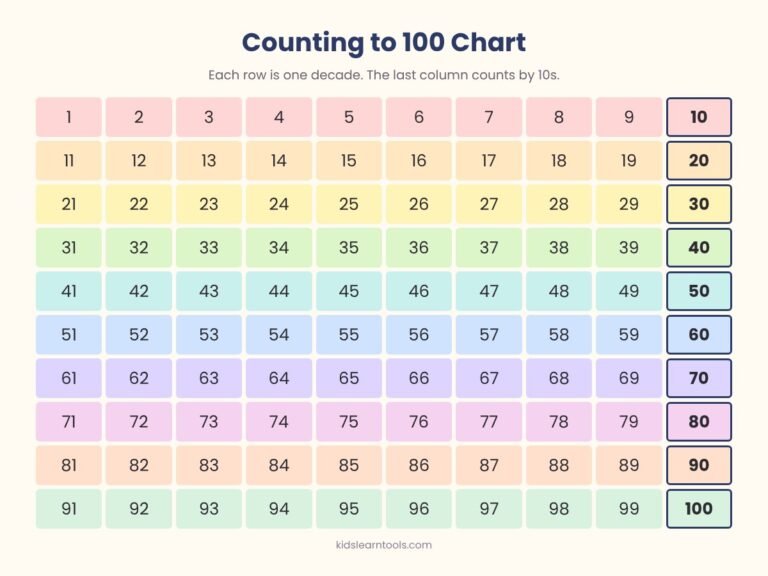
A hundreds chart makes this easy to see, because kids can count the jumps on the chart.
How Do You Teach Number Bonds Step by Step?
Follow the concrete → pictorial → abstract order. Don’t rush to written sums.
- Concrete (hands-on): Give kids 5 real objects — blocks, buttons or pebbles. Ask them to split the pile into two groups in as many ways as they can.
- Pictorial (drawings): Draw the part-part-whole circles and let kids draw dots inside each part.
- Abstract (numbers only): Fill in number bond diagrams with one part missing, e.g. 10 = 7 + ?
- Fluency: Use quick games and short daily practice until answers come without counting.
How Do You Use Number Bonds for Subtraction?
Subtraction with number bonds is simply finding the missing part. Kids know the whole and one part, so they ask, “What goes with this part to make the whole?”
- 10 − 7 = ? Think: “7 and what make 10?” The missing part is 3.
- 8 − 5 = ? Think: “5 and what make 8?” The missing part is 3.
- 15 − 9 = ? Think: “9 and 1 make 10, and 10 and 5 make 15.” So 1 + 5 = 6.
This “think addition” way of subtracting is much faster than counting back on fingers, and it is the main reason number bonds are taught so early.
Number Bond Examples and Word Problems
Word problems show kids that number bonds are useful in real life. Draw a number bond for each one:
| Word problem | Whole | Parts | Answer |
|---|---|---|---|
| Sara has 6 red apples and 4 green apples. How many apples does she have? | ? | 6 and 4 | 10 apples |
| There are 9 birds. 5 are in the tree and the rest are on the grass. How many are on the grass? | 9 | 5 and ? | 4 birds |
| Ali has 12 crayons. 8 are in the box. How many are on the table? | 12 | 8 and ? | 4 crayons |
| A class has 20 kids. 13 are girls. How many are boys? | 20 | 13 and ? | 7 boys |
Older kids also meet number bonds with multiplication (12 split into 3 groups of 4) and fractions (1 whole split into ½ and ½). The idea stays the same: one whole, split into parts.
Easy Number Bond Activities for Kids
- Shake and spill: Put 10 two-colored counters in a cup, shake and spill. Count reds and yellows — that’s a bond!
- Ten-frame fill: Show 7 dots on a ten frame. Ask, “How many more to make 10?”
- Hide and seek: Show 10 blocks, hide some under a cup. Kids work out how many are hidden.
- Number bond rainbow: Write 0–10 in an arc and draw colored arcs joining pairs that make 10 (0–10, 1–9, 2–8 …).
- Finger flash: Hold up some fingers; kids show the rest to make 10.
- Bond snap card game: Snap when two cards add up to 10.
- Printable worksheets: Make free number bond and addition sheets at the right level with our Math Worksheet Generator.
Free Printable Number Bonds Worksheet
Print this blank number bonds worksheet for quick practice. Kids fill in the missing part or the missing whole, and the last bond is left empty so they can make up their own. It also works well as a number bonds template or a small anchor chart on the classroom wall.
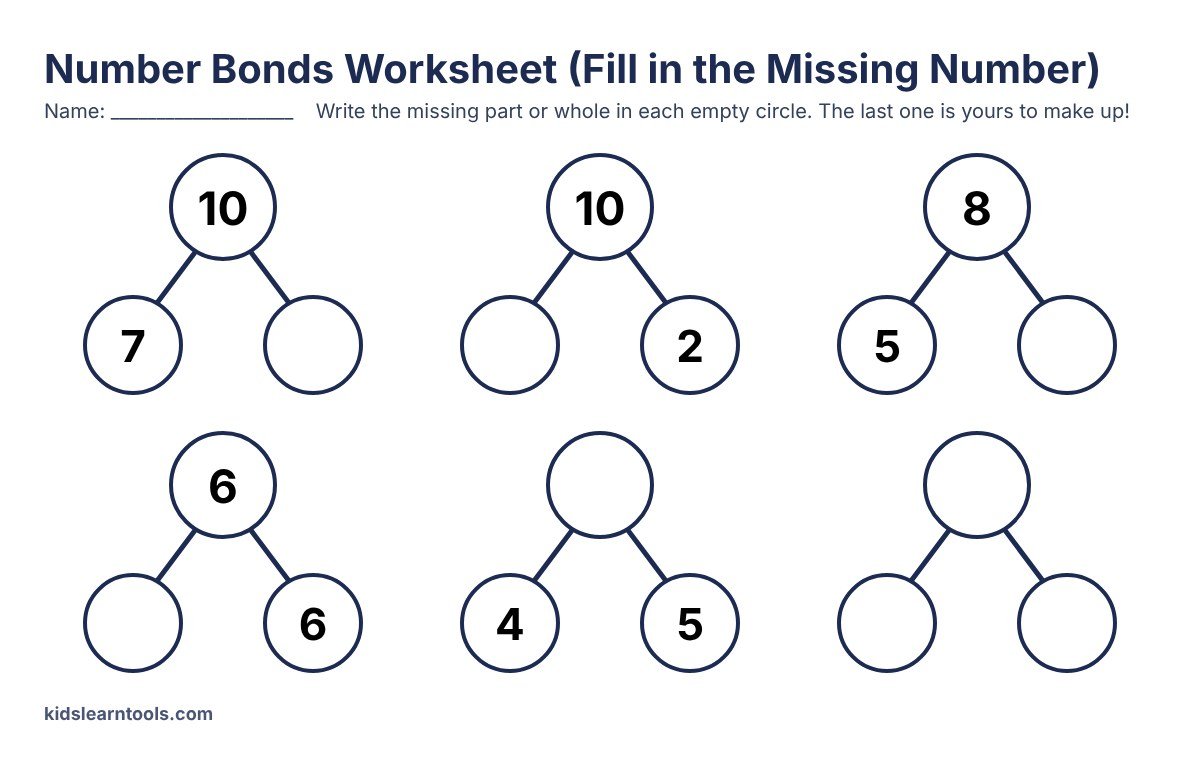
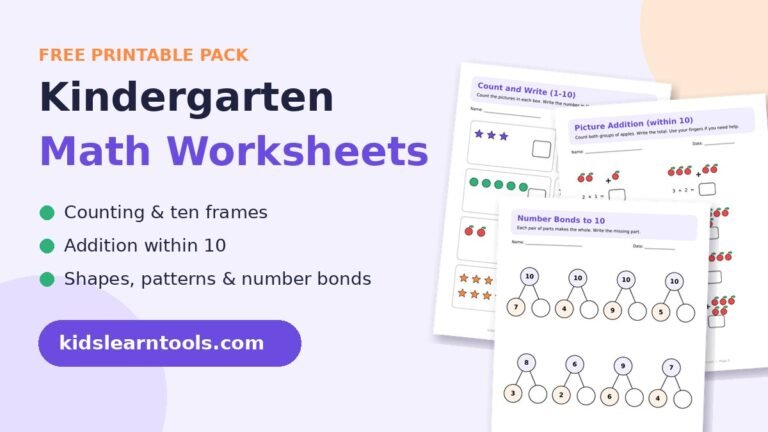
For more addition and subtraction practice within 10 or 20, make new sheets in seconds with our free Math Worksheet Generator. Choose the grade level, print, and you have fresh number fact practice every day. You will also find a number bonds page in our free kindergarten math worksheets pack.
What Are Common Mistakes Kids Make With Number Bonds?
| Mistake | Why it happens | Quick fix |
|---|---|---|
| Counting on fingers every time | Bonds not memorised yet | Daily 2-minute games with a ten frame |
| Forgetting 0 + 10 and 10 + 0 | Kids think zero “doesn’t count” | Show an empty hand and a full hand |
| Mixing up the whole and a part | Diagram is unfamiliar | Always say “whole” and “parts” out loud |
| Only learning addition facts | Subtraction not linked | Write all four facts for every bond |
🍎 From My Classroom
When I taught number bonds to my slower-paced learners, written sums made them anxious. So I put away the worksheets and gave each pair of kids ten buttons and two small bowls. Their only job was to find “all the ways to share 10 buttons.” Within one lesson, they had discovered almost every bond to 10 themselves — and because they found the pattern on their own, they remembered it. Only after that did we move to drawing circles and, finally, to numbers. Let kids touch the math before they write it.
Key Takeaways
- A number bond shows how a whole number splits into two parts (e.g. 10 = 6 + 4).
- One number bond gives two addition and two subtraction facts.
- Teach bonds to 5 first, then 10, then 20.
- Use real objects first, then pictures, then numbers.
- Short daily games build fast, confident recall.
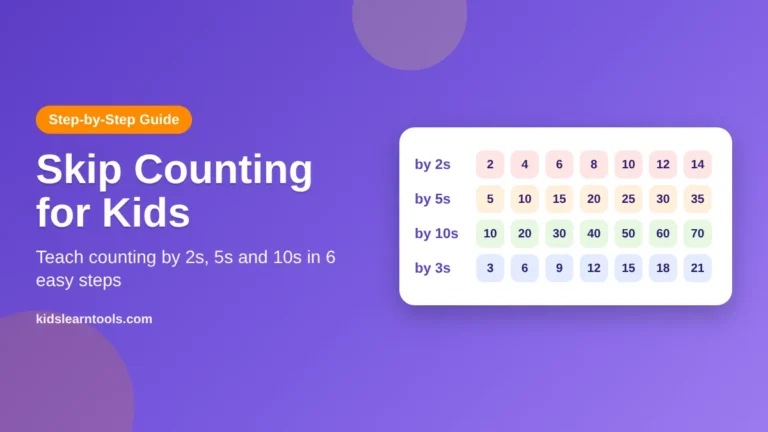
Next steps: once bonds to 10 are strong, move on to skip counting for kids, try these hundreds chart activities, and learn how tens and ones work with our place value guide. Create practice sheets anytime with the free Math Worksheet Generator.
Frequently Asked Questions
What is a number bond in simple words?
A number bond is two numbers that join to make a bigger number. For example, 4 and 1 are a number bond of 5 because 4 + 1 = 5.
What grade are number bonds taught?
Number bonds are usually introduced in kindergarten (bonds to 5 and 10) and built on in 1st grade (bonds to 20). Some preschoolers start with bonds to 5 using real objects.
How many number bonds are there to 10?
There are 11 number bonds to 10 if you count from 0 + 10 to 10 + 0. Without repeating reversed pairs, there are 6 unique pairs: 0+10, 1+9, 2+8, 3+7, 4+6 and 5+5.
What is the difference between a number bond and a fact family?
A number bond is the picture showing a whole and its two parts. A fact family is the set of four number sentences that come from it, like 6 + 4 = 10, 4 + 6 = 10, 10 − 6 = 4 and 10 − 4 = 6.
How do number bonds help with mental math?
They let kids “make 10” to add quickly. For 8 + 5, kids split 5 into 2 and 3, make 8 + 2 = 10, then add 3 to get 13.