What Is Place Value? Easy Meaning, Examples & Activities for Kids
Place value is the value a digit has because of where it sits in a number. In 274, the 2 is worth 200, the 7 is worth 70 and the 4 is worth just 4. The digits are small, but their places make them big. Once a child understands this one idea, reading big numbers, adding, subtracting and rounding all become much easier.
In this guide, I’ll explain place value in simple words, show you 10 easy examples, and share the step-by-step teaching methods I used with my own students in eight years of classroom teaching. You’ll also find diagrams, a graph, a number line, fun activities and practice questions with answers.
What Is Place Value?
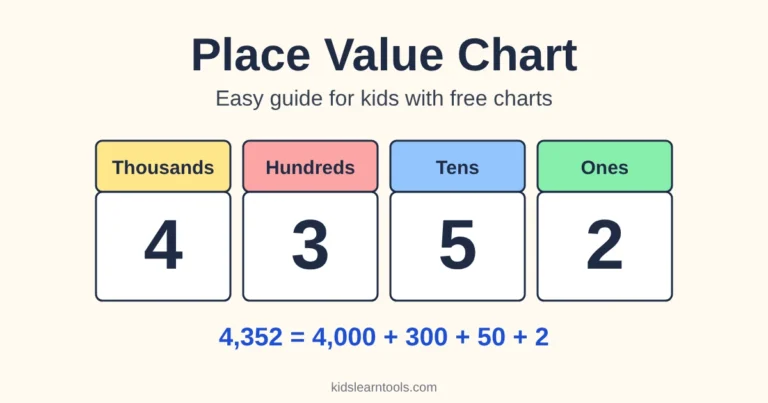
Our number system uses only ten digits: 0, 1, 2, 3, 4, 5, 6, 7, 8 and 9. To write bigger numbers, we put digits in different places. Each place has a name and a value: ones, tens, hundreds, thousands and so on. The place of a digit tells us how much that digit is really worth.
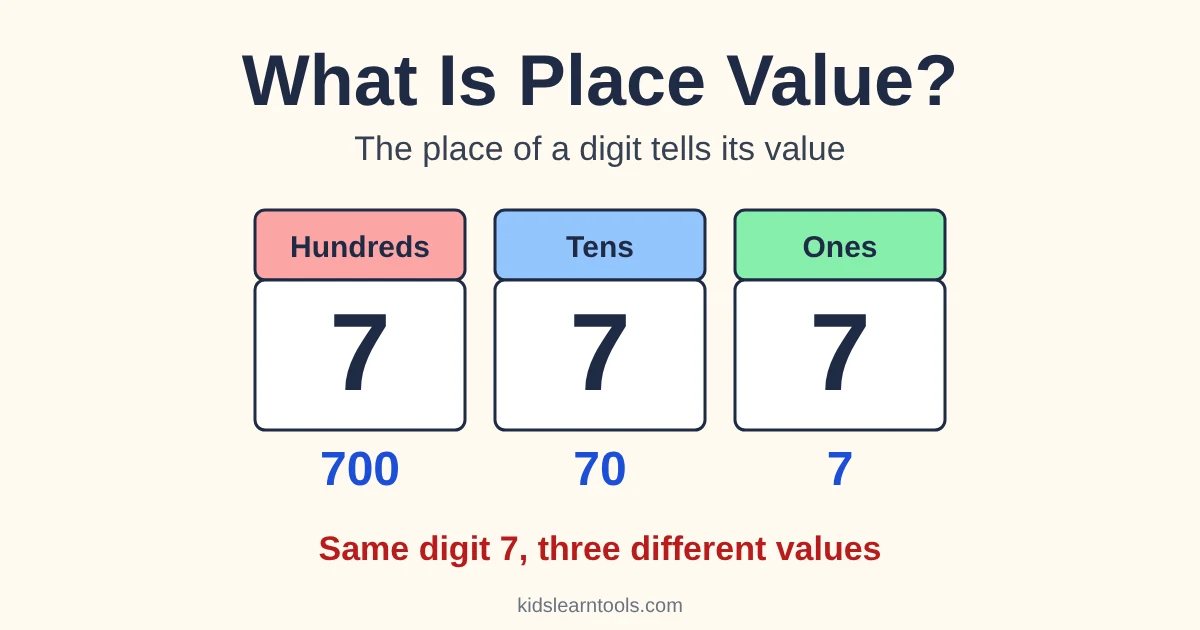
Look at the picture above. The digit 7 is the same in all three boxes, but it means 7 in the ones place, 70 in the tens place and 700 in the hundreds place. That is the whole idea of place value in one picture.
Meaning for Kids
Here is a kid-friendly way to say it: “Every digit has a home. The home tells you what the digit is worth.” A 3 living in the tens house is worth 30. A 3 living in the hundreds house is worth 300. Young children love this “house” idea, and it sticks.
Why Does It Matter?
- Reading and writing numbers: Kids need it to read 5,082 correctly and to write “five thousand eighty-two” without mixing up the digits.
- Comparing numbers: It tells us that 410 is bigger than 99, even though 9 is bigger than 4.
- Adding and subtracting: Carrying and borrowing (regrouping) only make sense when you understand tens and ones.
- Rounding and estimating: You look at a specific place to decide whether to round up or down.
- Decimals and money: Tenths and hundredths follow the same rule, so $3.45 makes sense.
Place Value vs Face Value
Many kids (and some parents!) mix up these two terms. They are easy to separate:
| Term | What It Means | Example in 4,639 |
|---|---|---|
| Face value | The digit itself, no matter where it is | Face value of 6 = 6 |
| Place value | What the digit is worth in its place | Place value of 6 = 600 |
The face value never changes. The place value changes every time the digit moves to a new place. For zero, both are always 0, but zero still does an important job as a placeholder.
How to Find the Place Value of a Digit
Finding the value of any digit takes four quick steps. The diagram below shows them with the number 3,628.

- Find the digit you are asked about (6 in 3,628).
- Name its place by counting from the right: ones, tens, hundreds. The 6 is in the hundreds place.
- Multiply the digit by the value of its place: 6 × 100.
- Write the answer: the place value of 6 is 600.
If your child finds it hard to name the places, write the number in a place value chart first. The labeled columns do the hard work for them.
Each Place Is 10 Times Bigger
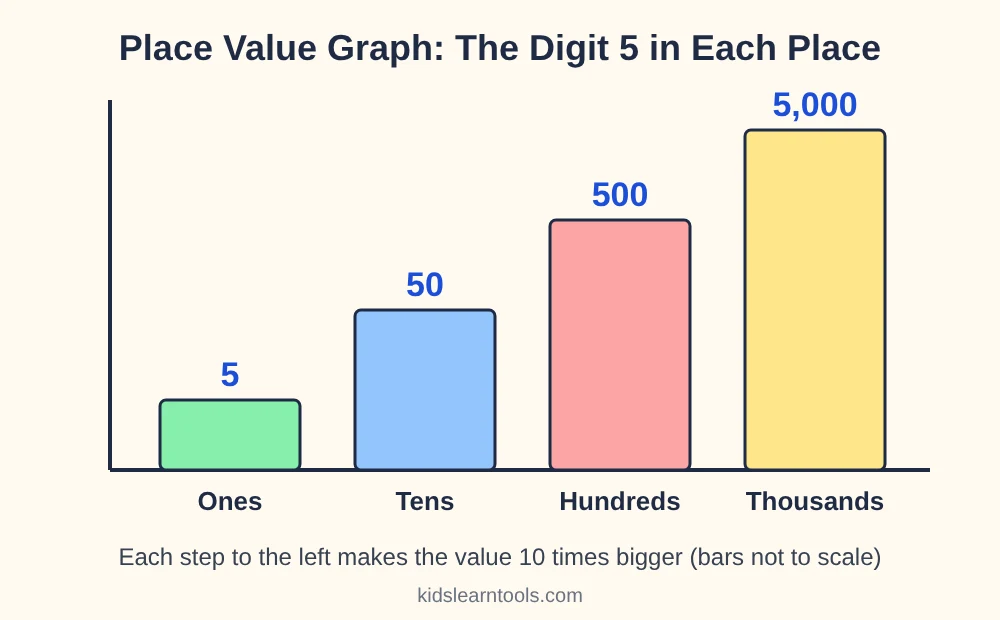
Our number system is called base ten because every place is worth 10 times the place to its right. Watch what happens to the digit 5 as it moves left:
| Place | Value of One Unit | Digit 5 Is Worth |
|---|---|---|
| Ones | 1 | 5 |
| Tens | 10 | 50 |
| Hundreds | 100 | 500 |
| Thousands | 1,000 | 5,000 |
| Ten thousands | 10,000 | 50,000 |
| Hundred thousands | 100,000 | 500,000 |
| Millions | 1,000,000 | 5,000,000 |
Why ten? Most historians believe people started counting in groups of ten because we have ten fingers. Long ago, many number systems had no zero and no places at all. Roman numerals, for example, write 8 as VIII, which gets very long for big numbers and makes adding and multiplying hard.
The system we use today, with ten digits and a zero, came from India and spread through the Arab world to Europe. Because each position does the counting for us, we can write any number, from 3 to 3 billion, with just ten small symbols. Sharing this story with kids often sparks curiosity, and it helps them see that places are a clever invention, not just a rule to memorize.
Moving one place to the right does the opposite: the value becomes 10 times smaller. This same pattern continues past the decimal point into tenths, hundredths and thousandths.
10 Easy Place Value Examples
Practice makes this skill automatic. Here are 10 examples, from easy two-digit numbers to decimals. Cover the last column and let your child try first.
| Number | Digit | Place | Value |
|---|---|---|---|
| 46 | 4 | Tens | 40 |
| 83 | 3 | Ones | 3 |
| 275 | 2 | Hundreds | 200 |
| 509 | 0 | Tens | 0 |
| 1,384 | 1 | Thousands | 1,000 |
| 6,712 | 7 | Hundreds | 700 |
| 29,450 | 9 | Thousands | 9,000 |
| 815,026 | 8 | Hundred thousands | 800,000 |
| 4.7 | 7 | Tenths | 0.7 |
| 12.36 | 6 | Hundredths | 0.06 |
What About Zero?
In 509, the 0 is in the tens place, so its value is 0. But try removing it: 509 becomes 59, a completely different number. Zero holds the place open so the 5 stays in the hundreds. This is one of the most common mistakes kids make, so point it out often.
Expanded Form: Breaking Numbers Apart
When we write a number as the sum of its digit values, we call it expanded form. It is the best way to check if a child really understands each place.
- Standard form: 4,072
- Expanded form: 4,000 + 0 + 70 + 2 (or simply 4,000 + 70 + 2)
- Expanded notation: (4 × 1,000) + (7 × 10) + (2 × 1)
- Word form: four thousand seventy-two
Ask your child to go both ways: break a number into parts, and then build a number back from its parts. Building is often harder, especially when there is a zero.
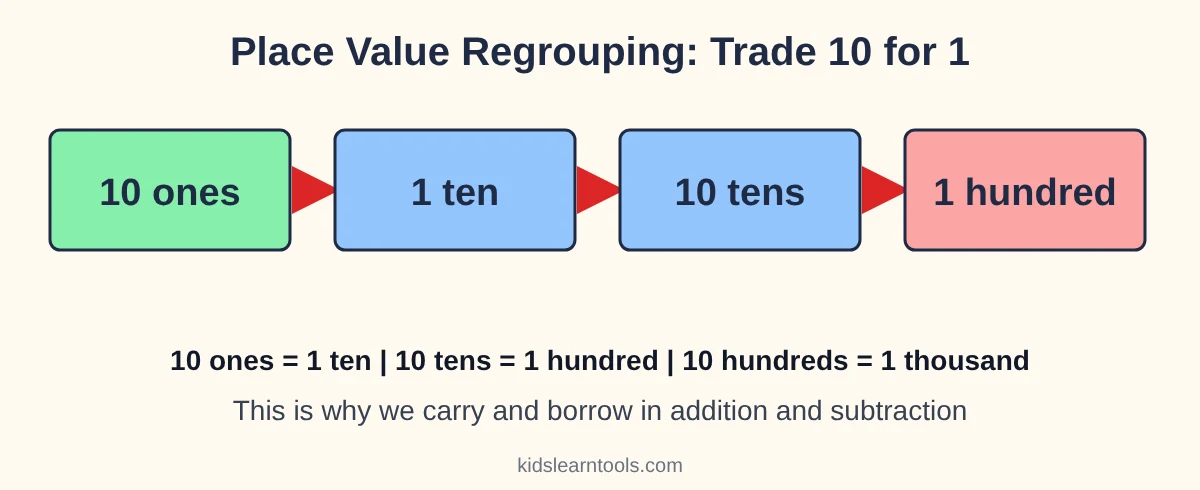
Regrouping: Trading 10 for 1
Regrouping means trading 10 of one place for 1 of the next place. It is the reason carrying and borrowing work. The diagram shows the pattern.
Adding with Regrouping
When the ones add up to 10 or more, we trade 10 ones for 1 ten and carry it to the tens column.
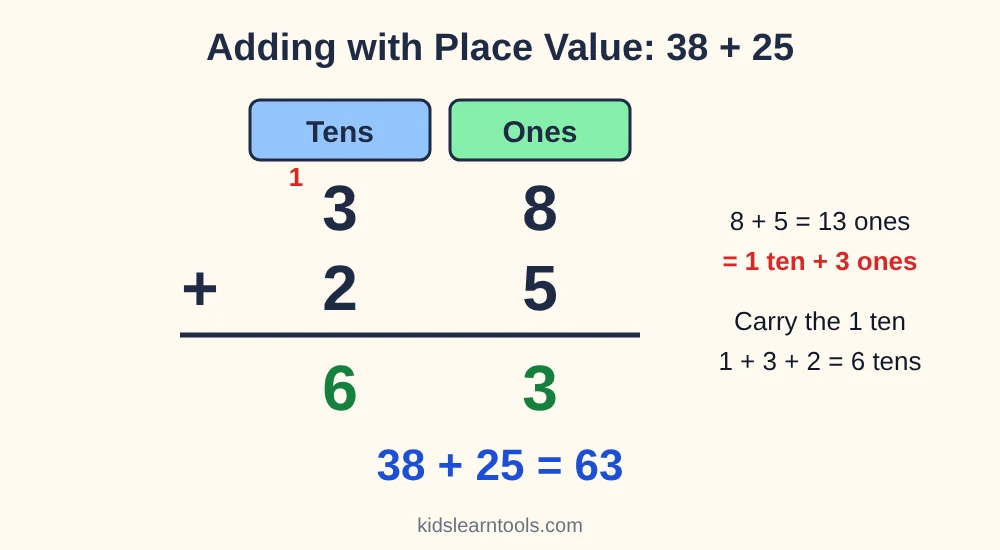
- Add the ones: 8 + 5 = 13 ones.
- Regroup: 13 ones = 1 ten and 3 ones. Write 3, carry 1 ten.
- Add the tens: 1 + 3 + 2 = 6 tens.
- Answer: 38 + 25 = 63.
Subtracting with Regrouping
For 52 − 17, there aren’t enough ones to take away 7 from 2. So we trade 1 ten for 10 ones: 52 becomes 4 tens and 12 ones. Now 12 − 7 = 5 ones and 4 − 1 = 3 tens. The answer is 35. Using real objects such as bundled straws makes this trade easy to see.
Rounding Numbers Using Place Value
Rounding is a place value skill. To round, you look at the digit one place to the right of the place you are rounding to.
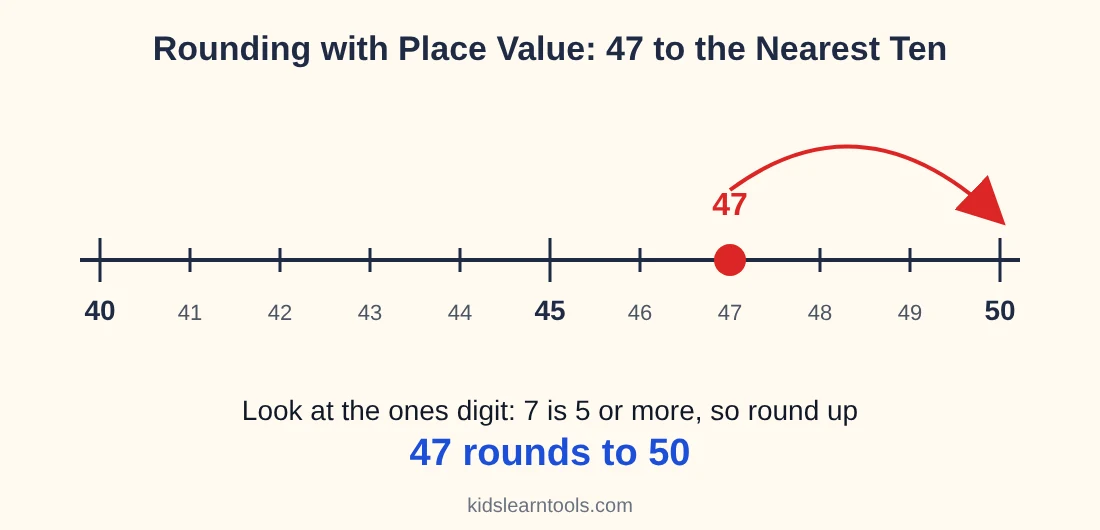
- If that digit is 5 or more, round up. 47 rounds to 50.
- If that digit is 4 or less, round down. 43 rounds to 40.
- Rounding to the nearest hundred, look at the tens digit: 362 rounds to 400 because 6 is 5 or more.
Comparing and Ordering Numbers
Which is bigger, 398 or 412? Kids who only look at the digits might pick 398 because 9 and 8 are big digits. But the hundreds digit decides first. Here is the simple rule I teach:
- Count the digits first. A number with more digits (without leading zeros) is always bigger, so 1,005 is bigger than 999.
- If they have the same number of digits, compare from the left. The first place where the digits differ decides the answer.
- Compare 398 and 412: 4 hundreds is more than 3 hundreds, so 412 is bigger. We don’t even need to look at the tens or ones.
- Use the symbols: 412 > 398 and 398 < 412. A fun trick is that the open “mouth” always eats the bigger number.
To order a list of numbers from smallest to largest, line them up so the ones are under the ones and the tens are under the tens, then compare one column at a time from left to right.
Tips for Parents at Home
- Spot numbers everywhere: House numbers, prices at the store and page numbers are great quick questions. Ask, “What is the 6 worth in this price?”
- Talk in tens and ones: Instead of saying “twenty-four”, sometimes say “two tens and four ones” so your child hears the structure.
- Let them be the teacher: Children remember more when they explain an idea to someone else, even a favorite toy.
- Celebrate mistakes: A wrong answer is a clue. Ask your child how they got it, and you’ll usually find the exact place where the idea broke down.
- Keep it playful: Games, songs and short challenges build confidence much faster than long worksheets.
Decimal Place Value
Places to the right of the decimal point show parts of one whole. They follow the same times-ten rule, just going smaller.
| Place | Fraction | Example in 7.258 |
|---|---|---|
| Tenths | 1/10 | 2 tenths = 0.2 |
| Hundredths | 1/100 | 5 hundredths = 0.05 |
| Thousandths | 1/1,000 | 8 thousandths = 0.008 |
Money is the easiest way to teach this. In $7.25, the 7 is dollars, the 2 is dimes (tenths of a dollar) and the 5 is pennies (hundredths). For a full visual guide to tenths, hundredths and thousandths, see our decimal section in the place value chart guide.
How to Teach Place Value to Kids
Kids learn this concept best in three stages: first with real objects, then with pictures, and only then with numbers on paper. Teachers call this the concrete, pictorial, abstract approach. Here is how I teach it, step by step.
Start with Real Objects
- Bundle straws or craft sticks in groups of 10 with a rubber band. A bundle is one ten; a single stick is one.
- Use base ten blocks: unit cubes for ones, rods for tens and flats for hundreds.
- Try money: pennies, dimes and dollar bills work as ones, tens and hundreds.
Move to Pictures and Drawings
- Draw quick sketches: a dot for one, a line for ten and a square for one hundred.
- Use a printable place value chart so every digit has a labeled column.
- Color-code each place (green for ones, blue for tens, red for hundreds) and keep the colors the same every time.
Then Use Numbers and Words
- Practice reading numbers aloud and writing them in word form.
- Ask “What is the value of this digit?” every day, not just “What is this digit?”
- Mix in expanded form, comparing and rounding once the basics are solid.
Keep sessions short. Five to ten minutes a day works far better than one long session each week. If your child is still building counting skills, a quick round of our counting song for kids is a nice warm-up.
From My Classroom: The “Bundle of Ten” Moment
In my classes, place value finally clicked when children made the tens themselves. We counted ice-cream sticks one by one, and every time we reached ten, a child wrapped them with a rubber band and moved the bundle to the “tens” mat. When a learner who had struggled for weeks counted 3 bundles and 4 loose sticks and said “thirty-four” without counting every stick, the whole class cheered. Children who need more time do best when they bundle tens with their own hands before they see a chart or a worksheet.
- Use real objects first (sticks, straws or blocks), pictures second, digits last.
- Say the trade out loud every time: “ten ones make one ten”.
- Keep lessons short, about 10 minutes, and repeat the same routine for several days.
Fun Activities and Games
- Build the biggest number: Roll a die three times and arrange the digits to make the biggest (then smallest) number possible.
- Place value war: Each player draws three playing cards and builds a number. The bigger number wins.
- Mystery number riddles: “I have 3 hundreds, 0 tens and 8 ones. Who am I?” (308)
- Shopping game: Price toys with sticky notes and pay with dimes and pennies.
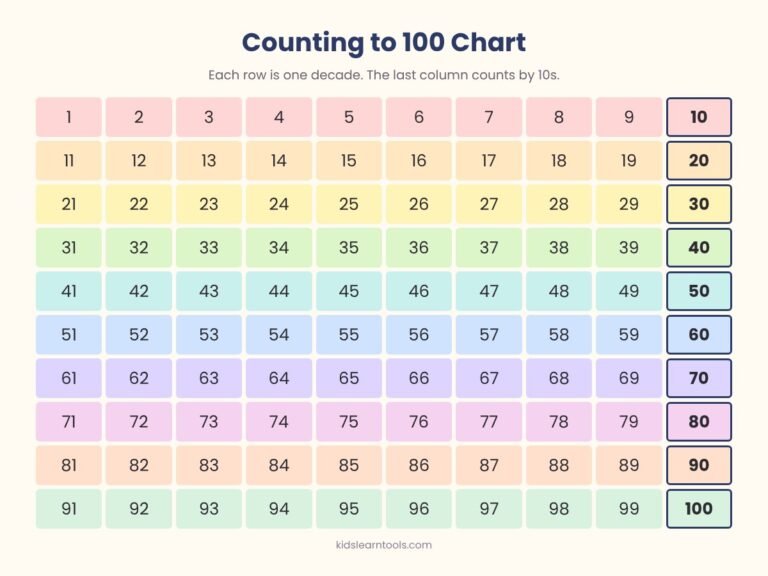
- Hundreds chart hunt: On a hundreds chart, ask kids to find “4 tens and 6 ones” and notice how each row is a new ten.
- Worksheet practice: Make quick practice pages with our free math worksheet generator.
More free practice:
- Print the free place value chart PDF (hundreds, tens and ones) with a practice worksheet and answer key.
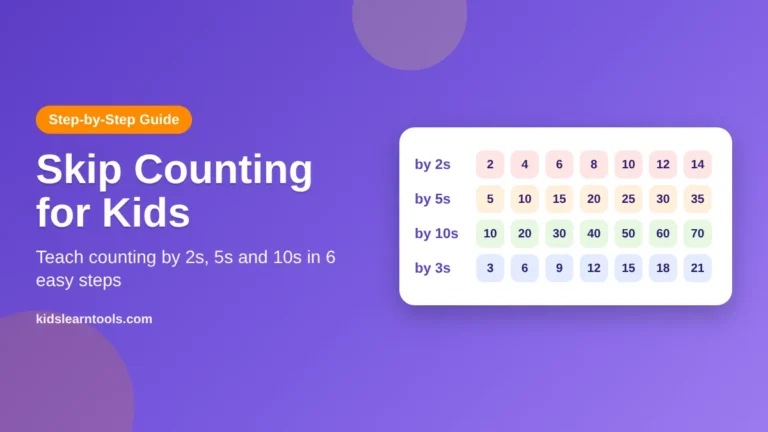
- Count by 10s and 100s with our skip counting guide.
- Explore patterns of tens with these hundreds chart activities.
- Create unlimited practice sheets with the Math Worksheet Generator.
What Kids Learn in Each Grade
Here is what US students usually learn each year, based on the Common Core math standards. Every child moves at their own pace, so use it as a guide, not a rule.
| Grade | What Kids Learn |
|---|---|
| Kindergarten | Numbers 11–19 as ten ones and some more ones |
| 1st grade | Tens and ones up to 120; comparing two-digit numbers |
| 2nd grade | Hundreds, tens and ones up to 1,000; expanded form |
| 3rd grade | Rounding to the nearest 10 or 100; adding and subtracting within 1,000 |
| 4th grade | Numbers up to 1,000,000; each place is 10 times the place to its right |
| 5th grade | Decimals to thousandths; powers of 10 |
Common Mistakes and Quick Fixes
- Saying the digit instead of its value: “The 4 in 342 is worth 4.” Fix: ask “4 what? 4 ones or 4 tens?”
- Dropping the zero: Writing 306 as 36. Fix: use a chart so the empty tens place needs a 0.
- Reversing digits: Writing 71 for seventeen. Fix: say “one ten and seven ones” and build it with objects.
- Comparing by length only with decimals: Thinking 0.25 is bigger than 0.3. Fix: compare tenths first.
Practice Questions with Answers
Try these with your child. The answers are below.
- What is the value of 9 in 2,915?
- What is the face value of 4 in 6,047?
- Write 3,000 + 400 + 6 in standard form.
- Round 268 to the nearest ten.
- What is the value of 3 in 5.36?
Answers:
- 900
- 4
- 3,406 (the tens place is 0)
- 270
- 0.3 (3 tenths)
Place value and number bonds go hand in hand. When kids know that 7 + 3 = 10, place value helps them see that 70 + 30 = 100 as well.
Frequently Asked Questions
What is place value in simple words?
Place value is how much a digit is worth because of its position in a number. In 52, the 5 is worth 50 because it is in the tens place.
What is an example of place value?
In the number 4,386, the 4 is worth 4,000, the 3 is worth 300, the 8 is worth 80 and the 6 is worth 6.
What is the place value of 0?
The value of 0 is always 0, in any place. But it is still important, because it holds a place open. Without it, 105 would become 15.
What is the difference between place value and face value?
Face value is the digit itself. Place value is what the digit is worth in its position. In 723, the face value of 2 is 2 and its place value is 20.
How do you teach place value to kindergarten kids?
Start with real objects. Bundle 10 straws to make one ten and keep loose straws as ones. Then show teen numbers as one ten and some ones before moving to written numbers.
What are the place values in order?
From right to left: ones, tens, hundreds, thousands, ten thousands, hundred thousands and millions. After the decimal point: tenths, hundredths and thousandths.
Final Thoughts
Place value is the foundation of almost everything kids do with numbers. Teach it with real objects first, then pictures, then written numbers, and keep asking “What is this digit worth?” every day. Pair this guide with our free place value chart printables, practice a few examples daily, and your child will be reading, comparing and rounding big numbers with confidence in no time.