Hundreds Chart for Kids: How to Use It + 15 Fun 100 Chart Activities
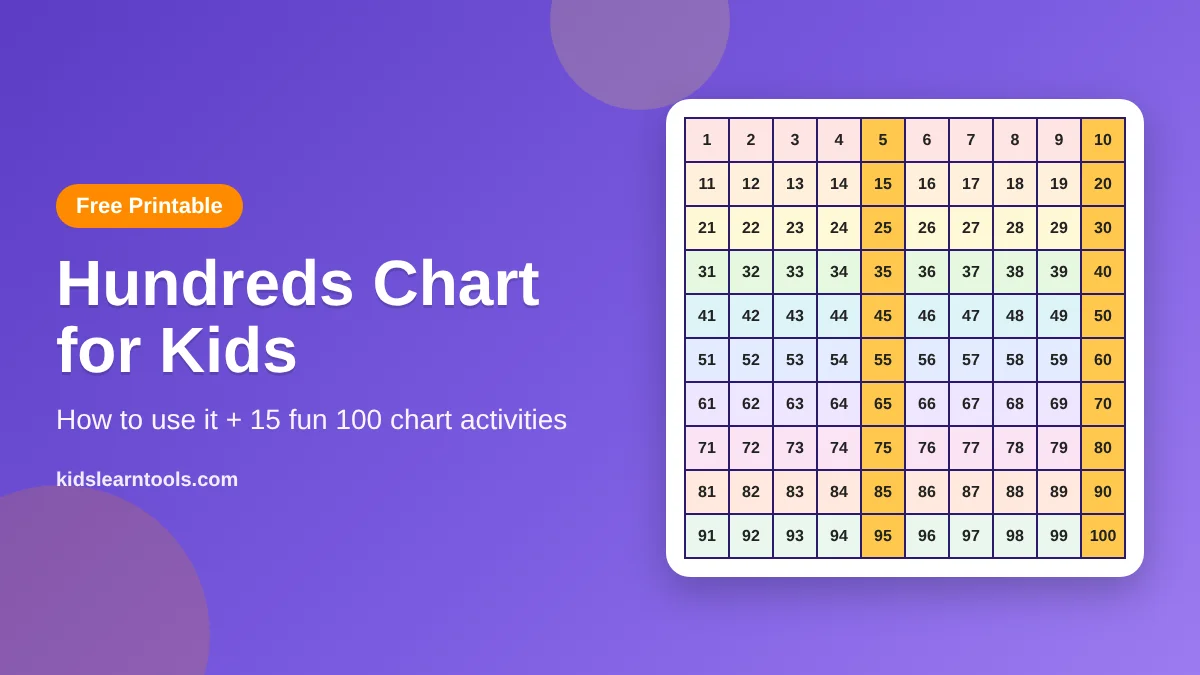
A hundreds chart (also called a 100 chart or number chart) is a 10 × 10 grid that shows the numbers 1 to 100 in order. Kids use it from pre-K to grade 2 to learn counting, place value, skip counting and mental addition, because every move on the chart follows a pattern: one box right adds 1, and one box down adds 10. This guide explains how to use a hundreds chart, then gives 15 easy activities you can do with a free printable chart.
You can make a filled, blank or missing-number chart in seconds with our free Hundreds Chart Maker.
What Is a Hundreds Chart?
A hundreds chart is a square grid of 100 boxes arranged in 10 rows and 10 columns. The first row holds 1 to 10, the second row 11 to 20, and so on until 100.
It shows four patterns that make numbers easier to understand:
- Across a row, each number is one more than the number before it.
- Down a column, each number is ten more than the number above it.
- Every column ends in the same ones digit (3, 13, 23, 33…).
- Most rows share the same tens digit (41, 42, 43… 49).
These patterns turn a long list of numbers into a map. Kids stop memorizing and start seeing how tens and ones work, which is the heart of number sense.
Hundreds Chart vs 120 Chart vs 0–99 Chart
Teachers use three versions of the same idea. Pick the one that matches your child’s grade.
| Chart | Numbers | Best for | Why use it |
|---|---|---|---|
| Hundreds chart (100 chart) | 1–100 | Pre-K to grade 1 | The classic chart; easy first introduction to numbers to 100 |
| 0–99 chart | 0–99 | Kindergarten to grade 2 | Every row has the same tens digit (20–29), so place value is clearer |
| 120 chart | 1–120 | Grade 1 to grade 2 | Shows that counting keeps going past 100 (101, 102…), matching the grade 1 goal of counting to 120 |
How to Use a Hundreds Chart (With Examples)
The hundreds chart is a tool for thinking, not only for counting. Teach kids these four moves:
- Move right to add 1. Move left to subtract 1.
- Move down to add 10. Move up to subtract 10.
- Combine moves to add or subtract bigger numbers.
- Count the jumps to find the difference between two numbers.
Example 1: Addition
23 + 20 = ? Start on 23. Adding 20 means two tens, so move down two rows: 33, then 43. Answer: 43.
Example 2: Subtraction
57 − 30 = ? Start on 57. Subtracting 30 means three tens, so move up three rows: 47, 37, 27. Answer: 27.
Example 3: How far apart?
How far is 36 from 72? Start on 36 and move down three rows to 66 (that is 30). Then move right six boxes to 72 (that is 6). Answer: 36.
Example 4: Rounding to the nearest ten
Round 47. Find 47 on the chart. It sits between 40 and 50, and it is only 3 boxes from 50 but 7 boxes from 40. Answer: 50.
When Do Kids Use a Hundreds Chart in School?
In US schools, hundreds chart skills line up with these Common Core math standards:
| Grade | Standard | What kids learn | Chart activity that helps |
|---|---|---|---|
| Kindergarten | K.CC.1 | Count to 100 by ones and by tens | Color the 10s column, Race to 100 |
| Kindergarten | K.CC.2 | Count forward from any number | Missing number hunt |
| Grade 1 | 1.NBT.1 | Count to 120 | 120 chart puzzles |
| Grade 1 | 1.NBT.5 | Find 10 more or 10 less mentally | Plus 10 / minus 10 jumps |
| Grade 2 | 2.NBT.2 | Skip count by 5s, 10s and 100s | Skip counting colors |
15 Fun Hundreds Chart Activities for Kids
All you need is a printed chart, a pencil, crayons and a few counters such as buttons or coins.
Counting and Number Recognition (Pre-K–K)
1. Missing Number Hunt
Print a chart with 10 to 20 numbers removed. Kids look at the numbers around each blank and fill in the missing one. Start with blanks in one row, then spread them across the chart.
2. Mystery Picture
Read out a list of numbers and ask kids to color those boxes. When they finish, a simple picture appears, such as a heart or a house. Kids practice finding numbers fast and love the surprise.
3. Race to 100
Two players start on 1 and take turns rolling a dice, moving forward that many spaces. The first to reach 100 wins. Younger kids can race to 30 or 50 instead.
4. Hundreds Chart Puzzle
Cut a filled chart into 6 to 10 pieces and mix them up. Kids rebuild the chart by matching numbers. Wavy cuts make it harder.
5. Fill the Blank Hundreds Chart
Give a fully blank chart and ask kids to write 1 to 100. Younger kids can fill one or two rows a day. This doubles as number-writing practice.
Place Value and Mental Math (K–Grade 1)
6. Plus 10, Minus 10 Jumps
Put a counter on any number, such as 34. Ask “What is 10 more?” and the child moves down to 44. “10 less?” and they move up to 24. Mix in one more and one less.
7. Number Flaps
Cover the four boxes around a number (above, below, left and right) with sticky notes. Kids say what is hidden under each flap, then lift it to check.
8. Mystery Number Riddles
Give clues like: “I am in the 60s. My ones digit is 4. Who am I?” (64). Then let kids write riddles for you.
9. Too Big, Too Small, Just Right
Think of a secret number. Kids guess, and you answer “too big” or “too small”. They cover the numbers that can no longer be the answer until only one is left.
10. How Far Apart?
Pick two numbers, such as 18 and 45. Kids count tens down and ones across to find the distance (27). This builds subtraction as “the distance between” numbers.
Patterns, Skip Counting and Beyond (Grade 1–Grade 2)
11. Color the Skip Counting Pattern
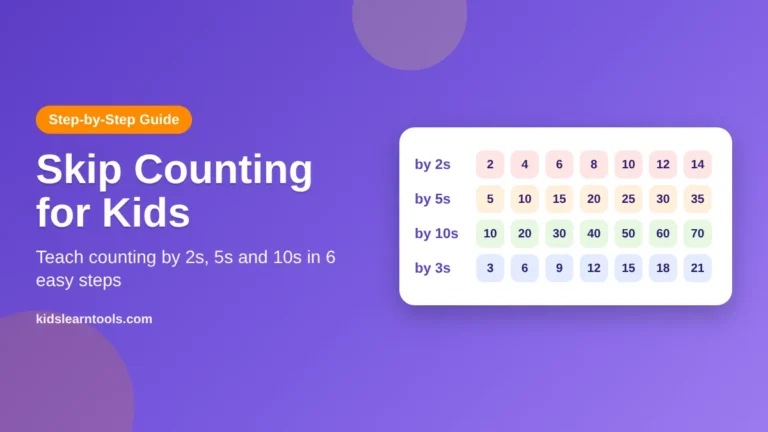
Color every number you say when counting by 2s, 5s or 10s. Counting by 10s makes one column, 5s makes two columns, and 2s makes stripes. Read our full guide on skip counting for kids for more.
12. Odd and Even Stripes
Color even numbers in one color and odd numbers in another. The chart turns into neat vertical stripes, showing that odd and even numbers take turns.
13. Color the Multiples
Color multiples of 3 (3, 6, 9, 12…) or 4. Kids discover that multiples of 3 make diagonal lines. This is an early step toward times tables.
14. Count Coins on the Chart
Put a dime on each number while counting by 10s (10, 20, 30…) or a nickel while counting by 5s. Kids connect skip counting to real money.
15. Round to the Nearest Ten
Pick any number and ask which tens column it is closer to. Numbers ending in 5 or more round up; numbers ending in 4 or less round down.
Which Activity Fits Your Child’s Age?
| Age / Grade | Start with | Chart to print |
|---|---|---|
| 4–5 years (Pre-K) | Mystery picture, Race to 30 | Filled 1–50 chart |
| 5–6 years (Kindergarten) | Missing number hunt, Odd and even stripes, Puzzle | Filled chart with a few blanks |
| 6–7 years (Grade 1) | Plus 10 / minus 10, Number flaps, 120 chart | Partly blank or 120 chart |
| 7–8 years (Grade 2) | How far apart, Multiples, Rounding | Blank chart |
Math Talk Questions to Ask
Good questions make kids explain their thinking. Try these while using the chart:
- What do you notice about the numbers in this column?
- What number is 10 more than 58? How do you know?
- Why do all the numbers in this row start with 7?
- If you color every 5th number, what pattern do you think you’ll see?
- What is the quickest way to get from 14 to 54?
From My Classroom
During my eight years of teaching, the hundreds chart was one of the first tools I reached for with children who found math difficult. Many of them could count aloud to 100 but could not tell me what came after 39 when asked out of order. Coloring the counting-by-10s column and doing short “10 more, 10 less” jumps each morning helped them see that numbers follow a reliable pattern. In my experience, five minutes a day with the chart built more confidence than one long lesson a week.
Tips for Parents and Teachers
- Keep it short. Five to ten minutes a day works better than one long session.
- Use real objects. Buttons, coins or small erasers make good counters.
- Laminate one chart or slide it into a plastic sleeve so kids can use a dry-erase marker again and again.
- Ask before you tell. Let kids find the pattern first, then explain it.
- Move from filled to blank. Remove more numbers as your child improves.
Practice Questions (With Answers)
- What number is 10 more than 46? (56)
- What number is 1 less than 80? (79)
- Start at 35 and move down 3 rows. Where are you? (65)
- How far apart are 22 and 52? (30)
- Round 63 to the nearest ten. (60)
How to Introduce a Hundreds Chart for the First Time
Many kids feel lost when they first see 100 numbers on one page. A slow first week makes the hundreds chart feel friendly instead of busy. Use this simple five-day plan, about ten minutes a day.
| Day | Goal | What to do |
|---|---|---|
| Day 1 | Explore the chart | Let your child point to numbers they know, such as their age or house number. Ask, “What do you notice?” |
| Day 2 | Read across a row | Read one row together, then let your child read the next row alone. Point to each box while counting. |
| Day 3 | Read down a column | Read the 10s column (10, 20, 30…), then a column like 4, 14, 24, 34. Talk about the ones digit that stays the same. |
| Day 4 | One more, one less | Cover a number with a coin and ask which numbers are on its left and right. |
| Day 5 | Ten more, ten less | Put a counter on any number and move one row down or up. Say the new number together. |
By the end of the week, most kids can find any number quickly and are ready for the 15 activities above. You can print a fresh chart each day with the Hundreds Chart Maker.
Hundreds Chart Strategies for Addition and Subtraction
Once kids know how to move around the chart, the hundreds chart becomes a mental math tool. These four strategies are the ones teachers use most often in grade 1 and grade 2.
1. Jump by Tens, Then Ones
To solve 26 + 32, start on 26. Jump down three rows for 30 (36, 46, 56), then move right two boxes for 2. Answer: 58. Breaking a number into tens and ones is the same place value thinking kids will later use on paper.
2. Count On From the Bigger Number
For 8 + 45, start on the bigger number, 45, not on 8. Then move right eight boxes to 53. Starting with the bigger number means fewer jumps and fewer mistakes.
3. Make the Next Ten
For 38 + 7, move right 2 boxes to reach 40 at the end of the row. Then count the remaining 5 on the next row to 45. Kids learn that reaching a “friendly” tens number first makes adding easier.
4. Subtract by Jumping Back
For 64 − 28, start on 64. Move up two rows for 20 (54, 44), then move left eight boxes for 8. Answer: 36. Kids can check the answer by adding 36 + 28 on the chart and landing back on 64.
Common Hundreds Chart Mistakes (and Easy Fixes)
- Getting lost at the end of a row. Kids often stop at 30 and don’t know that 31 starts the next row. Fix: trace the path from the end of one row to the start of the next with a finger, like reading a book.
- Mixing up up and down. Some kids move up when adding ten. Fix: remember that numbers get bigger as you go down the chart.
- Counting the starting box. When counting on from 45, kids say “45, 46…” and land one box short. Fix: teach them to count the jumps, not the boxes.
- Reading 61 as 16. Number reversals are common at this age. Fix: say the tens digit first (“six tens and one”) and point to the column and row.
A 5-Minute Daily Hundreds Chart Routine
Short daily practice builds number sense faster than long lessons. Keep a chart on the fridge or desk and try this quick routine:
- Number of the day (1 minute): Pick a number and find it on the chart.
- Neighbors (1 minute): Name the numbers one more, one less, ten more and ten less.
- Skip count (1 minute): Count by 10s from the number of the day, such as 7, 17, 27, 37.
- Quick question (1 minute): Ask one addition or subtraction question using the chart.
- Color it (1 minute): Color today’s number so kids see their progress across the month.
A hundreds chart is also a simple way to practise number bonds to 100: start on any tens number, such as 30, and count the jumps of ten it takes to reach 100.
Frequently Asked Questions
What is a hundreds chart?
A hundreds chart is a 10 × 10 grid of the numbers 1 to 100. It helps kids see counting, place value and number patterns at a glance.
How do you use a hundreds chart for adding?
Move right one box to add 1 and down one row to add 10. For 34 + 21, move down two rows to 54, then right one box to 55.
What age should kids start using a hundreds chart?
Most kids are ready at age 4 to 5 with numbers 1 to 30 or 1 to 50. The full chart fits kindergarten and grade 1, and the 120 chart fits grades 1 and 2.
What is the difference between a hundreds chart and a number line?
A number line shows numbers in one straight row. A hundreds chart folds the same numbers into rows of 10, so tens and ones patterns are easier to see.
Where can I get a free printable hundreds chart?
Use our free Hundreds Chart Maker. Choose a filled, blank, missing-number or 120 chart, then print it or save it as a PDF.
Start Practicing Today
A hundreds chart is free, simple and teaches many skills at once. Print one, keep it where your child can see it every day, and try one new activity each week. For more practice, make addition and subtraction sheets with our Math Worksheet Generator, or turn number facts into art with the Color by Number Generator. Pair it with our free kindergarten math worksheets for counting and number writing practice.