Kindergarten Sight Words: Complete List of 92 Easy Words
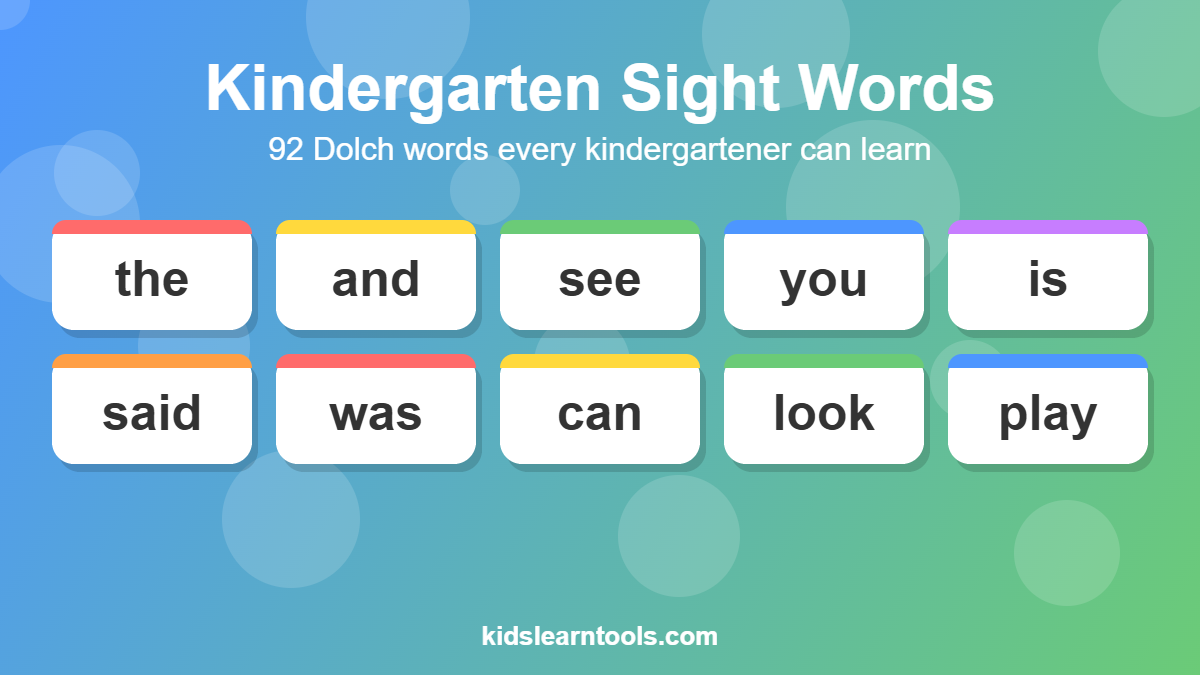
Kindergarten sight words are short, common words that children learn to read in a snap, without sounding them out. Words like the, and, see, is and you show up in almost every sentence a young child reads. When kids know these words by sight, reading feels smoother, faster and a lot more fun.
In this guide, you will find the complete kindergarten sight words list (all 92 Dolch pre-primer and primer words), the 25 best words to start with, easy practice sentences, fun games and a simple weekly plan. Everything here is free to use at home, in the classroom or in your homeschool.
What Are Kindergarten Sight Words?
Sight words are words a child recognizes instantly, the moment they see them. Kindergarten sight words are the first group of these words that most children learn between ages 5 and 6. They are usually small words (one to five letters) that appear again and again in picture books and early readers.
Many sight words are also high-frequency words. Researchers found that just a few hundred words make up more than half of all the words in children’s books. If a kindergartener can read the, a, to, and and is without stopping, they can already read a big part of every page.
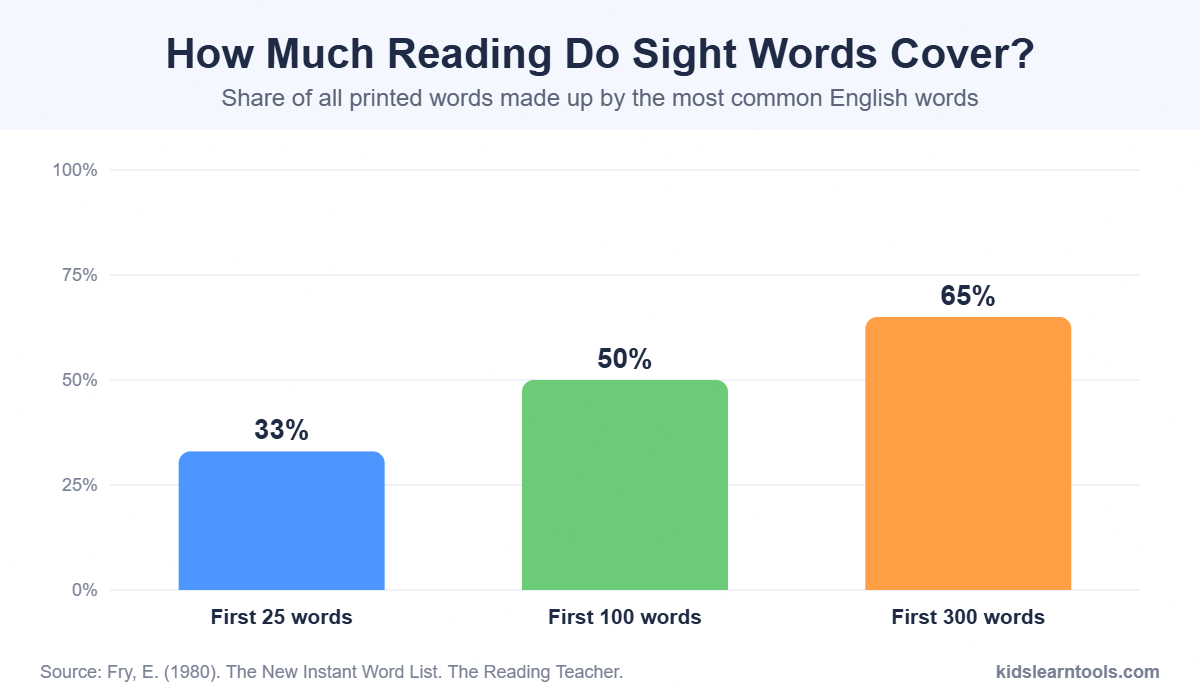
The chart above shows why these words matter so much. In his research on the most common English words, Dr. Edward Fry found that the first 25 words make up about one-third of all printed material, the first 100 make up about half, and the first 300 make up about 65 percent (Fry, 1980). In simple terms, a child who knows just 100 sight words can already read about every second word on a page.
Sight Words vs. High-Frequency Words
People often use these two terms as if they mean the same thing, but there is a small difference:
- High-frequency words are simply the words used most often in print, such as can, it and up. Many of them follow normal phonics rules.
- Sight words are words we want kids to read instantly. Some are “tricky” or “heart words” that do not follow regular phonics rules, such as said, was, one and the.
- In real classrooms, most kindergarten sight words lists mix both types, so children learn the most useful words first.
Why Do Kids Need to Learn Sight Words?
Learning sight words for kindergarten gives children a strong head start in reading. Here is why teachers focus on them so early:
- Reading fluency: Kids spend less energy on small words, so they can focus on sounding out new ones.
- Comprehension: When reading is smooth, kids understand the story better.
- Confidence: Reading a whole sentence on their own makes young learners proud and excited to read more.
- Writing skills: Children who know sight words can spell and write simple sentences much sooner.
How Many Kindergarten Sight Words Should a Child Know?
There is no single number for every school, but most kindergarten programs aim for children to read about 25 to 100 sight words by the end of the year. Many teachers use the Dolch lists, which give kindergarten 92 words in total (40 pre-primer words and 52 primer words).
A simple, realistic goal for most families looks like this:
- First half of kindergarten: 20 to 40 words (most of the pre-primer list).
- End of kindergarten: 50 to 100 words, including many primer words.
- Advanced readers: Some kids move on to 1st grade sight words before the year ends, and that is fine too.
Every child learns at a different speed. Two or three new words a week, with lots of review, works better than ten new words that are quickly forgotten.
What do school standards say? In the United States, the Common Core reading standard RF.K.3c asks kindergarteners to “read common high-frequency words by sight,” with examples such as the, of, to, you, she, my, is, are, do and does. Your child’s school may use its own list, so it is always a good idea to ask the teacher which words are on the class list.
Complete Kindergarten Sight Words List (Dolch)
The Dolch sight words were put together by Dr. Edward William Dolch in the 1930s and 1940s from words found in children’s books of his time. They are still one of the most popular lists in American schools today. You can read more about the history of the list on Wikipedia’s Dolch word list page.
For kindergarten, the Dolch words are split into two levels. Most children start with pre-primer words in preschool or early kindergarten, then move to primer words.
Pre-Primer Sight Words (40 Words)
These are the easiest words and a great starting point for 4 and 5 year olds:
| Words | Words | Words | Words |
|---|---|---|---|
| a | and | away | big |
| blue | can | come | down |
| find | for | funny | go |
| help | here | I | in |
| is | it | jump | little |
| look | make | me | my |
| not | one | play | red |
| run | said | see | the |
| three | to | two | up |
| we | where | yellow | you |
Primer Sight Words (52 Words)
Primer words are the main dolch sight words kindergarten teachers use during the school year:
| Words | Words | Words | Words |
|---|---|---|---|
| all | am | are | at |
| ate | be | black | brown |
| but | came | did | do |
| eat | four | get | good |
| have | he | into | like |
| must | new | no | now |
| on | our | out | please |
| pretty | ran | ride | saw |
| say | she | so | soon |
| that | there | they | this |
| too | under | want | was |
| well | went | what | white |
| who | will | with | yes |
Tip: Print this page and cut the tables into strips. Each strip makes a quick mini flash card set for your child.
Kindergarten Sight Words in ABC Order
Some parents like a simple alphabetical kindergarten sight words list for quick checking. Here are all 92 Dolch words grouped by first letter:
| Letter | Sight Words |
|---|---|
| A | a, all, am, and, are, at, ate, away |
| B | be, big, black, blue, brown, but |
| C | came, can, come |
| D | did, do, down |
| E | eat |
| F | find, for, four, funny |
| G | get, go, good |
| H | have, he, help, here |
| I | I, in, into, is, it |
| J | jump |
| L | like, little, look |
| M | make, me, must, my |
| N | new, no, not, now |
| O | on, one, our, out |
| P | play, please, pretty |
| R | ran, red, ride, run |
| S | said, saw, say, see, she, so, soon |
| T | that, the, there, they, this, three, to, too, two |
| U | under, up |
| W | want, was, we, well, went, what, where, white, who, will, with |
| Y | yellow, yes, you |
Dolch Sight Words by Level (Chart)
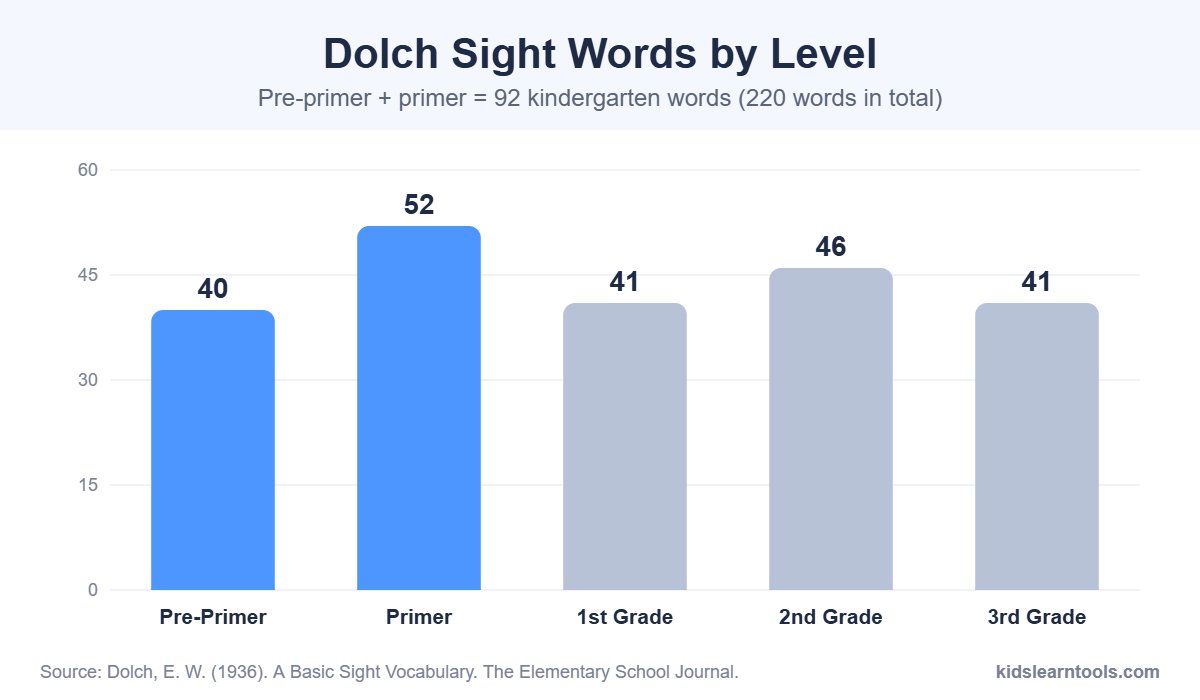
This bar chart shows how the 220 Dolch service words are spread across grade levels. The two kindergarten levels, pre-primer and primer, hold 92 words. That is about 42 percent of the whole list, so a child who finishes kindergarten with these words already knows almost half of the Dolch words (Dolch, 1936).
Top 25 Sight Words for Kindergarten to Teach First
If 92 words feels like a lot, start small. These 25 words are the most common in early reading books, so they give kids the fastest results:
| Word | Word | Word | Word | Word |
|---|---|---|---|---|
| the | a | I | to | and |
| is | it | in | see | can |
| we | you | my | go | up |
| like | look | me | he | she |
| said | was | are | for | play |
Teach these kindergarten sight words in small groups of three to five words. Once your child reads a group quickly for a few days in a row, add the next group.
Tricky “Heart Words” to Watch For
Some kindergarten sight words do not sound the way they are spelled. Teachers often call them heart words because kids have to learn part of the word “by heart.” Spend a little more time on these:
- said (sounds like “sed”)
- was (sounds like “wuz”)
- one and two (spelling does not match the sound)
- the, of, are, they, who and come
A simple trick: say the word, point to the letters that follow the rules, and draw a small heart over the “tricky” part that kids must remember.
Example: How Kids Map the Word “Said”
Reading researcher Linnea Ehri found that children remember sight words best through orthographic mapping, which means linking each sound in a word to the letters that spell it (Ehri, 2014). Instead of memorizing a word like a picture, kids connect sounds to letters, and that connection stores the word in long-term memory.
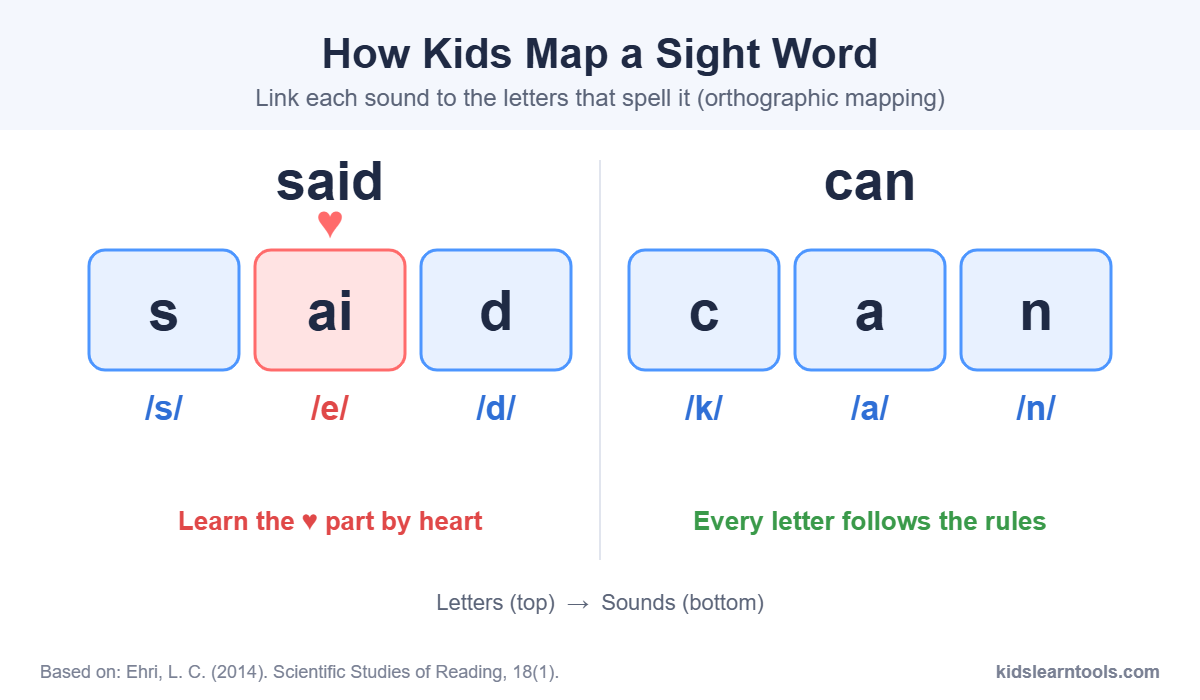
In said, the S and the D sound just as expected. Only the middle part, ai making a short /e/ sound, is tricky, so that is the only part kids learn “by heart.” In can, every letter follows the rules, so kids can sound it out first and soon read it on sight.
Dolch vs. Fry Sight Words: Which List Is Better for Kindergarten?
You may also see the Fry sight words list, created by Dr. Edward Fry in the 1950s and updated in 1980. Both lists are helpful. The main differences are:
| Feature | Dolch List | Fry List |
|---|---|---|
| Total words | 220 words + 95 nouns | 1,000 words |
| Kindergarten words | 92 (pre-primer + primer) | First 100 words |
| Sorted by | Grade level | How often words appear |
| Includes nouns | Separate noun list | Yes, mixed in |
| Best for | Pre-K to Grade 2 | K to Grade 3 and beyond |
For most families, the Dolch list is easier for kindergarten because it is shorter and already sorted by level. Many teachers also add words from Fry’s first 100 words, which is why you will see lists of “100 sight words kindergarten” kids should know.
Kindergarten Sight Words Sentences for Practice
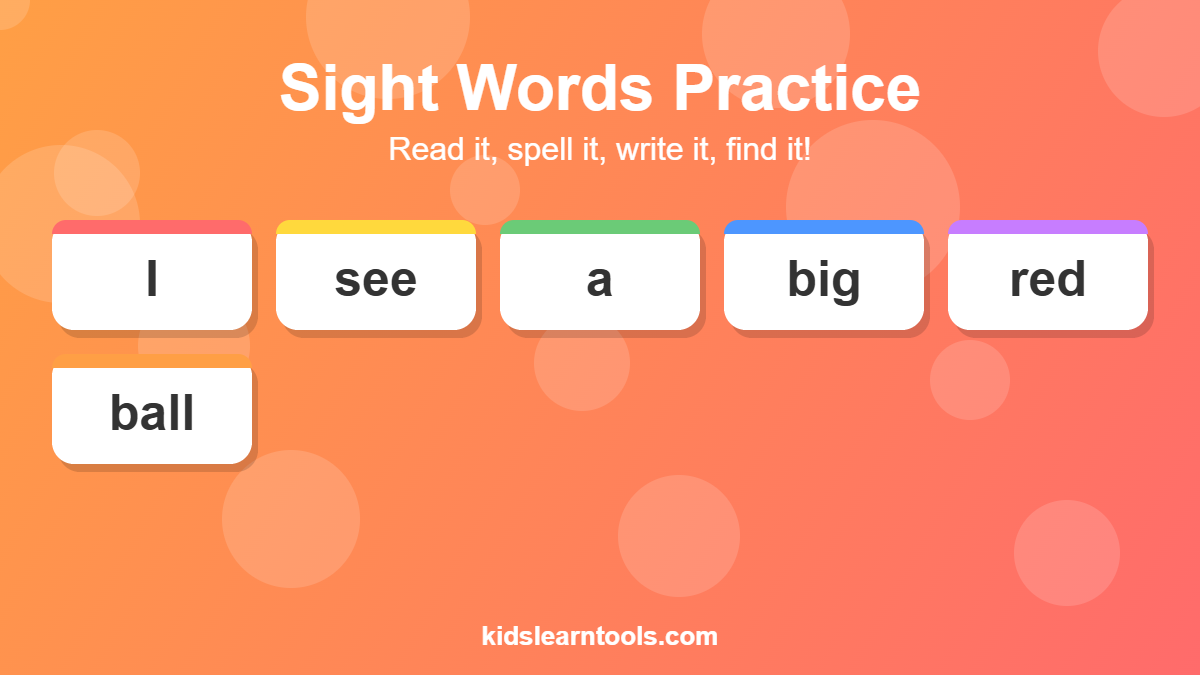
Reading sight words inside real sentences helps kids remember them much better than reading single words on cards. Here are easy sentences using only (or almost only) kindergarten sight words:
| Sight Words Used | Practice Sentence |
|---|---|
| I, see, a, big, red | I see a big red ball. |
| can, you, come, and, play | Can you come and play? |
| the, cat, is, in | The cat is in the box. |
| we, like, to, run | We like to run and jump. |
| look, at, my, new | Look at my new hat! |
| she, said, yes | She said yes to me. |
| he, was, under, the | He was under the bed. |
| where, is, the, yellow | Where is the yellow car? |
| they, ate, all, good | They ate all the good cake. |
| please, help, me, find | Please help me find my dog. |
Read each sentence together first. Then let your child read it alone and point to each word as they go. Finger-pointing builds the link between the spoken word and the printed word.
How to Teach Sight Words to Kindergarten Kids
Kids learn kindergarten sight words best with short, playful and frequent practice. Five to ten minutes a day works better than one long lesson a week. Follow these simple steps:
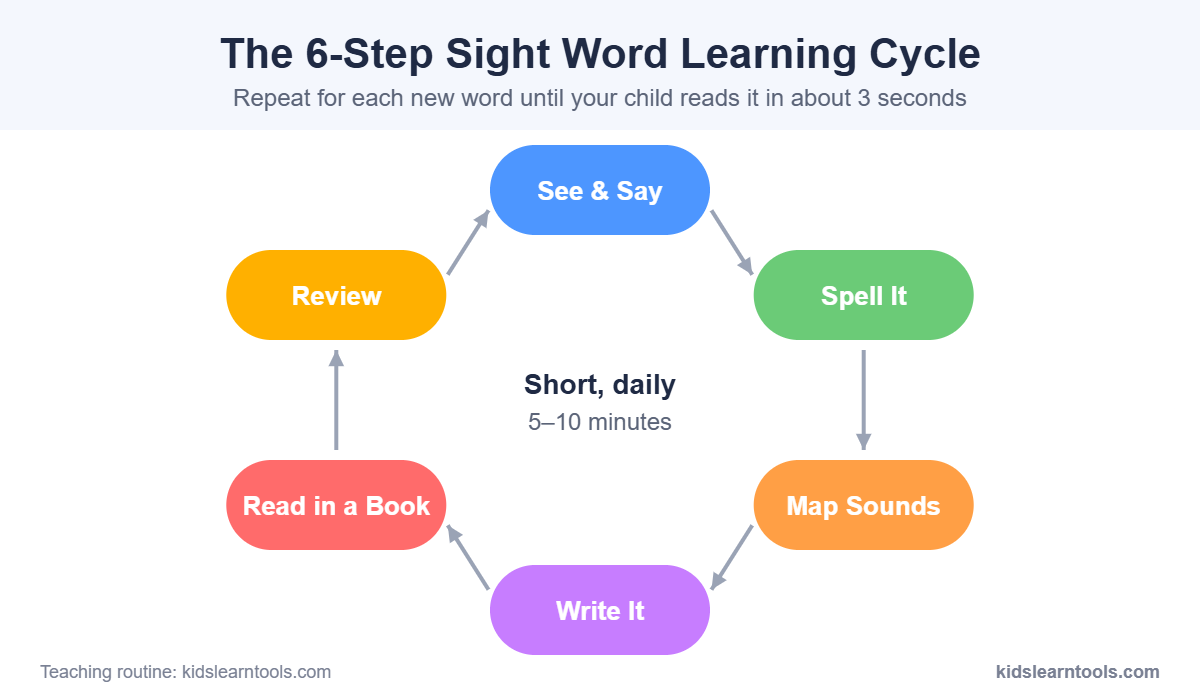
Step 1: See It and Say It
Show the word on a card. Say it clearly and use it in a short sentence. Ask your child to repeat the word while looking at it.
Step 2: Spell It Out Loud
Point to each letter and say the letter names together: “s-e-e, see.” This helps connect letter names to the full word. If your child is still learning letters, try our letter recognition activities first.
Step 3: Map the Sounds
Many sight words can be sounded out. For example, can, up and it follow normal phonics rules, just like CVC words. Tap one finger for each sound, then blend the sounds together. Only the tricky part of a heart word needs to be memorized.
Step 4: Write It
Writing a word helps lock it into memory. Let kids trace the word, write it in sand or shaving cream, or build it with magnetic letters. Our free letter tracing worksheet maker lets you type any sight word and print a tracing page in seconds.
Step 5: Read It in a Book
Finish by finding the word in a real book or sentence. Kids love to “hunt” for their new word on a page and shout it out when they spot it.
Step 6: Review, Review, Review
Keep old kindergarten sight words in a “review pile” and mix them with new ones. A word is truly learned when your child can read it in about three seconds or less, several days in a row.
Worked Example: Teaching the Word “Look” in 5 Minutes
Here is how the six steps look in a real five-minute lesson at the kitchen table:
- Minute 1 (See and Say): Show the card look. Say, “This word is look. Look at the dog.” Your child repeats the word.
- Minute 2 (Spell It): Point to each letter and spell it together: “l-o-o-k, look.”
- Minute 3 (Map Sounds): Tap the sounds /l/ /oo/ /k/. Show that the two O letters make one sound.
- Minute 4 (Write It): Your child traces look once, then writes it once from memory.
- Minute 5 (Read and Review): Read the sentence “Look at me!” and add the card to the review pile with older words.
Repeat this short routine for three or four days. Most children can read the new word quickly by the end of the week.
Fun Kindergarten Sight Words Games
Games turn practice into play. Here are easy games for kindergarten sight words you can set up in minutes with paper and a marker:
- Sight Word Hopscotch: Write words in chalk squares. Kids read each word as they hop on it.
- Swat the Word: Tape word cards on a wall. Call out a word and let your child swat it with a fly swatter.
- Memory Match: Make two cards for each word. Turn them face down and find the pairs, reading each card you flip.
- Sight Word Bingo: Fill a bingo grid with words. Call them out and let kids cover the words they hear.
- Go Fish: Play the classic card game, but ask “Do you have said?” instead of numbers.
- Treasure Hunt: Hide word cards around the room. Kids read each card they find to “collect” it.
- Rainbow Writing: Write a word, then trace over it in three or four different colors.
- Build a Sentence: Give kids word cards and let them build silly sentences like “The big dog can jump.”
Once your child knows 20 or more words, try short story writing too. Our writing prompt generator for kids gives fun story ideas that use simple words.
A Simple 4-Week Kindergarten Sight Words Plan
Use this kindergarten sight words plan as a starting point. Move slower or faster depending on how your child is doing.
| Week | New Words | Daily Activity |
|---|---|---|
| Week 1 | the, a, I, see, can | Flash cards + read 2 practice sentences |
| Week 2 | to, and, is, it, in | Memory match + rainbow writing |
| Week 3 | we, you, my, go, up | Sight word hopscotch + book hunt |
| Week 4 | like, look, me, said, play | Bingo + build a sentence |
At the end of each week, do a quick check. Put any words your child missed back into next week’s practice.
Common Mistakes Parents Make (and Easy Fixes)
- Too many words at once: Kindergarten sight words stick best in small sets. Teach three to five new words a week, not 20.
- Only using flash cards: Mix in games, writing and real books so practice stays fun.
- Skipping phonics: Sight words work best alongside phonics. Keep practicing letter sounds, short a words and other word families.
- No review: Old words fade fast. Review them every few days.
- Long sessions: Stop while your child is still having fun. Short and happy beats long and tired.
Sight Words and Phonics: Do Kids Need Both?
Yes. Today, most reading experts agree that kids learn best when sight words and phonics work together. Phonics teaches kids how letters and sounds connect, so they can read new words. Sight words help them read the most common words quickly.
For example, the word this is a kindergarten sight word, but it also contains the TH digraph. If you want to go deeper into sounds like this, see our guide to TH words for kids. Teaching both ways at once gives kids the full toolbox they need to become confident readers.
Frequently Asked Questions
What are kindergarten sight words?
Kindergarten sight words are short, common words such as the, and, see, is, you and said that children learn to read instantly, without sounding them out. They help kids read faster and understand more.
How many sight words should a kindergartener know?
Most kindergarten programs expect children to read about 25 to 100 sight words by the end of the year. The Dolch kindergarten lists contain 92 words in total.
What are the first 10 sight words to teach?
Good first words are the, a, I, to, and, is, it, in, see and can. They appear in almost every early reading book.
Is Dolch or Fry better for kindergarten?
Both work well. The Dolch list is often easier for kindergarten because it is short and sorted by level. Many teachers add words from Fry’s first 100 words as well.
How do I teach sight words to a struggling child?
Teach only two or three words at a time, use games and hands-on writing, sound out the regular parts of each word, and review old words often. Keep sessions to 5 to 10 minutes.
What age should a child start learning sight words?
Many children start learning a few sight words around age 4 in preschool, and most learn the bulk of them between ages 5 and 6 in kindergarten. Start when your child knows most letter names and sounds.
Final Thoughts
Kindergarten sight words are one of the easiest and most rewarding parts of early reading. Start with a few common words, practice for a few minutes every day, and use games, sentences and real books to keep things fun. Before long, your child will be reading whole sentences with a big proud smile.
Bookmark this kindergarten sight words list and come back each week to add new words. For more free reading help, explore our phonics guides and printable tools for kids.
References
The facts, charts and teaching ideas in this guide are based on the following sources:
- Dolch, E. W. (1936). A basic sight vocabulary. The Elementary School Journal, 36(6), 456–460. View the Dolch word list (University of Utah Reading Clinic)
- Fry, E. (1980). The new instant word list. The Reading Teacher, 34(3), 284–289. View the Fry Instant Words (Utah Education Network)
- Ehri, L. C. (2014). Orthographic mapping in the acquisition of sight word reading, spelling memory, and vocabulary learning. Scientific Studies of Reading, 18(1), 5–21. Read the research summary (Reading Rockets)
- National Governors Association Center for Best Practices & Council of Chief State School Officers. (2010). Common Core State Standards for English Language Arts, Reading: Foundational Skills, Standard RF.K.3c. View the kindergarten standards