Money Worksheets for Kids: Free Coin Charts, Counting Coins & Making Change
Money worksheets teach kids to recognize coins, know their values, count mixed coins, and make change, using printable practice that moves from easy to hard. Start with identifying coins (penny 1¢, nickel 5¢, dime 10¢, quarter 25¢), then count same coins, then mixed coins, then dollars and cents, and finally making change and money word problems.
Money is one of the few math topics kids use in real life right away. It also pulls together skills they already have: skip counting by 5s, 10s and 25s, addition and subtraction. This guide shows which money worksheets to use at each level, how to teach counting coins step by step, a free printable “Count the Coins” sheet, and how to fix the mistakes kids make most.
What Are Money Worksheets?
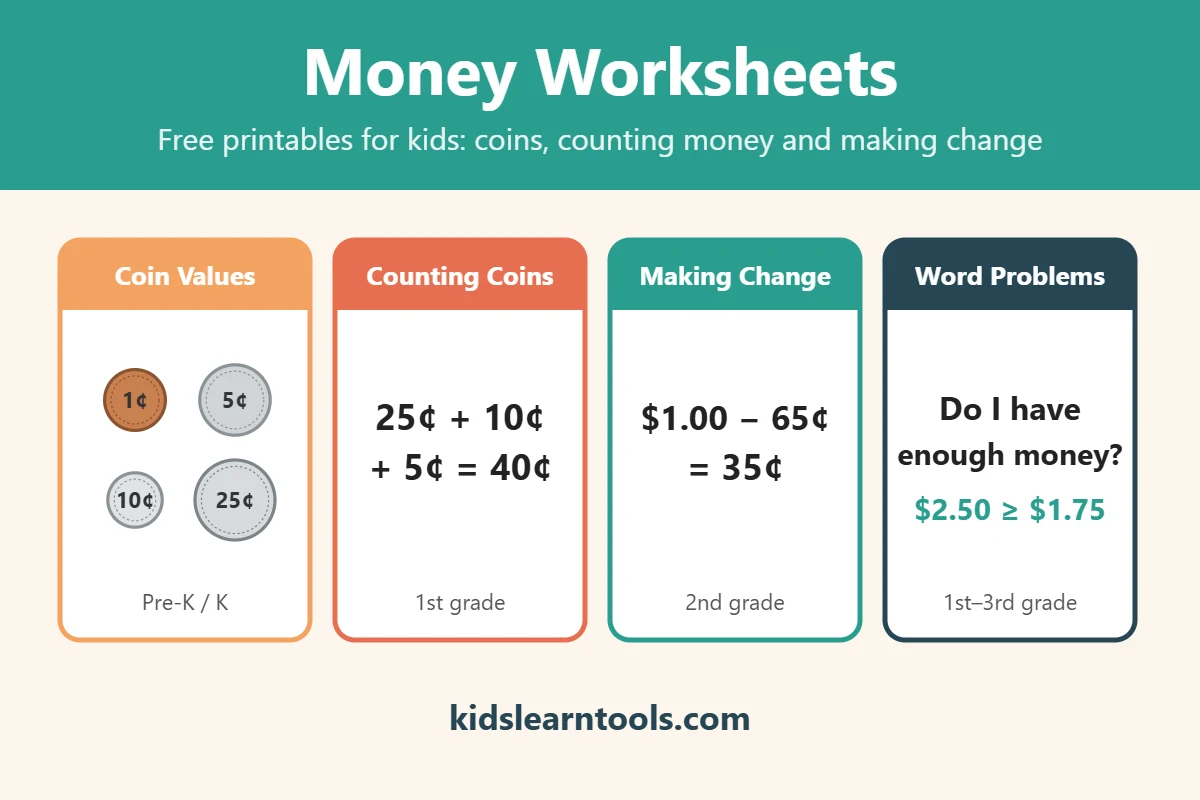
Money worksheets are printable math pages where kids work with coins and bills: naming them, matching them to their values, adding them up and solving shopping problems. The best ones use clear coin pictures, start with one coin type at a time, and always connect the page to a real-life situation like buying a snack or saving for a toy.
US Coin Values Chart for Kids
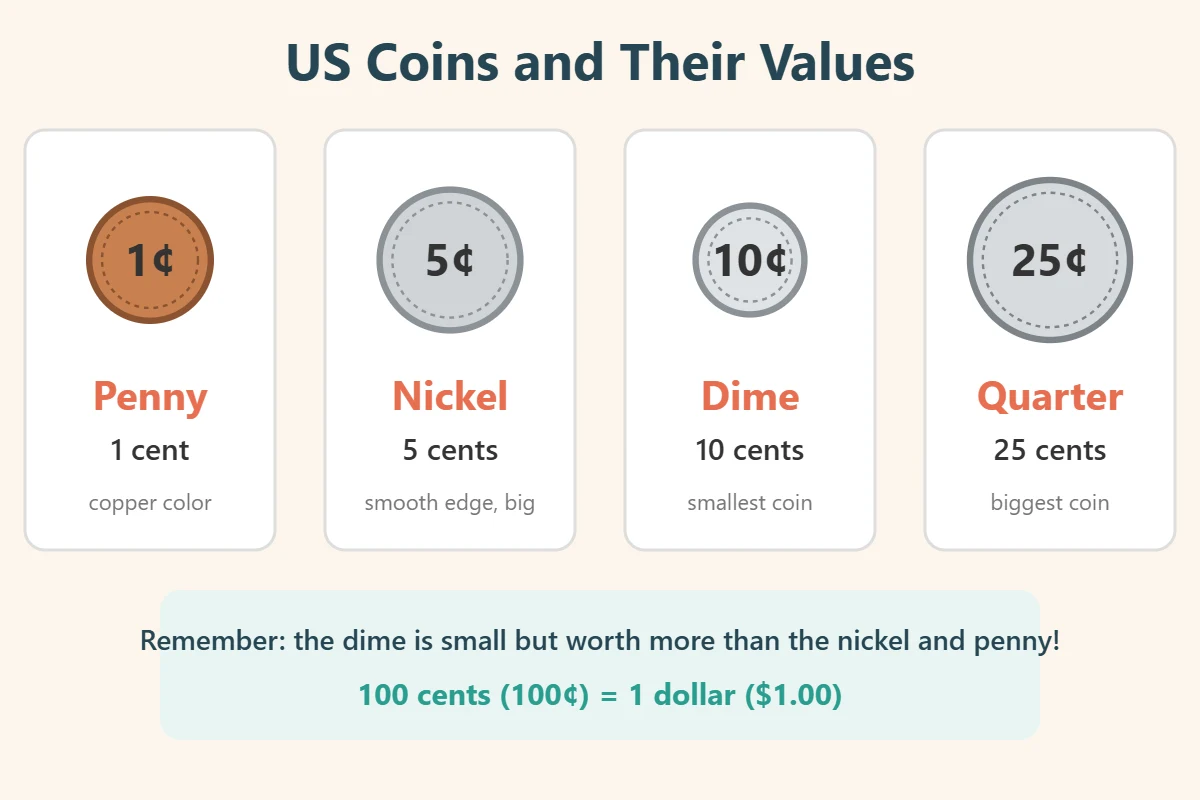
Before any counting worksheet, kids need to know four coins and their values by heart. Print or show this chart and practice it for a few days with real coins.
| Coin | Value | How to spot it | Count by |
|---|---|---|---|
| Penny | 1¢ (1 cent) | Copper color, smooth edge | 1s |
| Nickel | 5¢ (5 cents) | Silver, thick, smooth edge | 5s |
| Dime | 10¢ (10 cents) | Silver, smallest and thinnest coin | 10s |
| Quarter | 25¢ (25 cents) | Silver, biggest common coin | 25s |
| Dollar bill | $1.00 (100 cents) | Paper bill, worth 100 pennies | 1s (dollars) |
The trickiest idea for kids is that size does not equal value. The dime is the smallest coin but is worth more than a penny and a nickel. Say it as a rhyme: “Small but mighty, the dime is ten.”
Money Worksheets by Level
Pick the level your child can do with about 80% accuracy, and move up only when the page feels easy. If you are unsure, start one level lower; a quick success builds confidence for the next step.
| Level | Typical grade | Example task | Skill |
|---|---|---|---|
| Identifying coins | Pre-K / Kindergarten | Circle all the dimes | Coin names and values |
| Counting same coins | Kindergarten / 1st grade | 4 nickels = ? | Skip counting by 5s and 10s |
| Counting mixed coins | 1st grade | 1 quarter + 2 dimes + 1 penny = 46¢ | Start with the biggest coin, count on |
| Comparing amounts | 1st–2nd grade | Which is more: 3 dimes or 1 quarter? | Greater than / less than |
| Dollars and cents | 2nd grade | $1.25 = 1 dollar and 1 quarter | Decimal notation, $ and ¢ |
| Making change | 2nd–3rd grade | Pay $1.00 for a 65¢ toy. Change? | Counting up, subtraction |
| Money word problems | 1st–3rd grade | Do I have enough money? | Choosing the operation |
Identifying Money Worksheets
At this stage kids sort, match and color coins. Typical tasks are “color the pennies brown and the dimes gray” or “draw a line from each coin to its value”. Use real coins in a bag alongside the worksheet so kids can feel the size and edge of each one.
Counting Money Worksheets
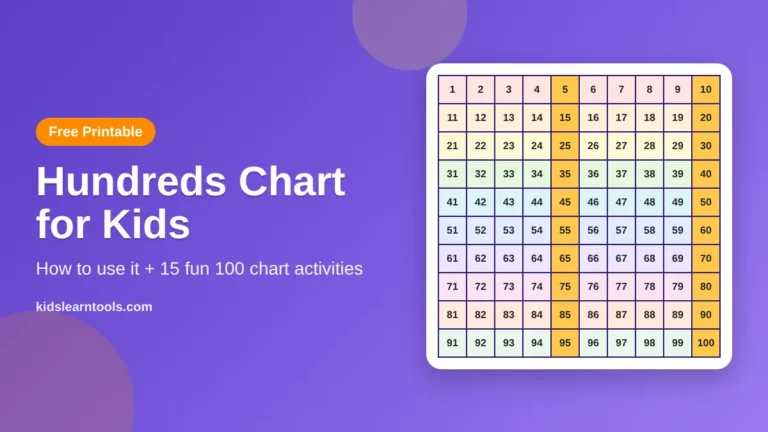
Counting money worksheets start with groups of the same coin, such as 6 dimes, so kids can skip count by 10s. Then they mix coins. The key rule is start with the biggest coin and count on: for 1 quarter, 1 dime and 2 pennies, say “25, 35, 36, 37”. A hundreds chart helps kids see each jump.
Counting Coins Worksheets with Mixed Coins
Mixed coin pages are the heart of first grade money practice. Coins on the page are often shown in random order, so teach kids to first sort them by size and value, then count. Our free printable below uses this approach.
Making Change Worksheets
Making change means finding how much money comes back after paying. The easiest way for kids is counting up, the way a shopkeeper does: for a 65¢ toy paid with $1.00, count up “70, 80, 90, 100”, which is 35¢. This links directly to the “count up” strategy in our subtraction guide.
Money Word Problem Worksheets
Word problems make money meaningful: “Ali has 2 quarters. A pencil costs 40¢. Does he have enough? How much is left?” They teach kids to decide whether to add, subtract or compare. In the US, solving word problems with dollar bills, quarters, dimes, nickels and pennies is part of the Common Core second grade measurement and data standards.
Free Printable Money Worksheet: Count the Coins
This free counting coins worksheet has 8 problems that move from easy (2 quarters) to harder (3 quarters and 2 dimes). Save the image and print it on A4 or US Letter paper. Kids write the total in cents in each box.
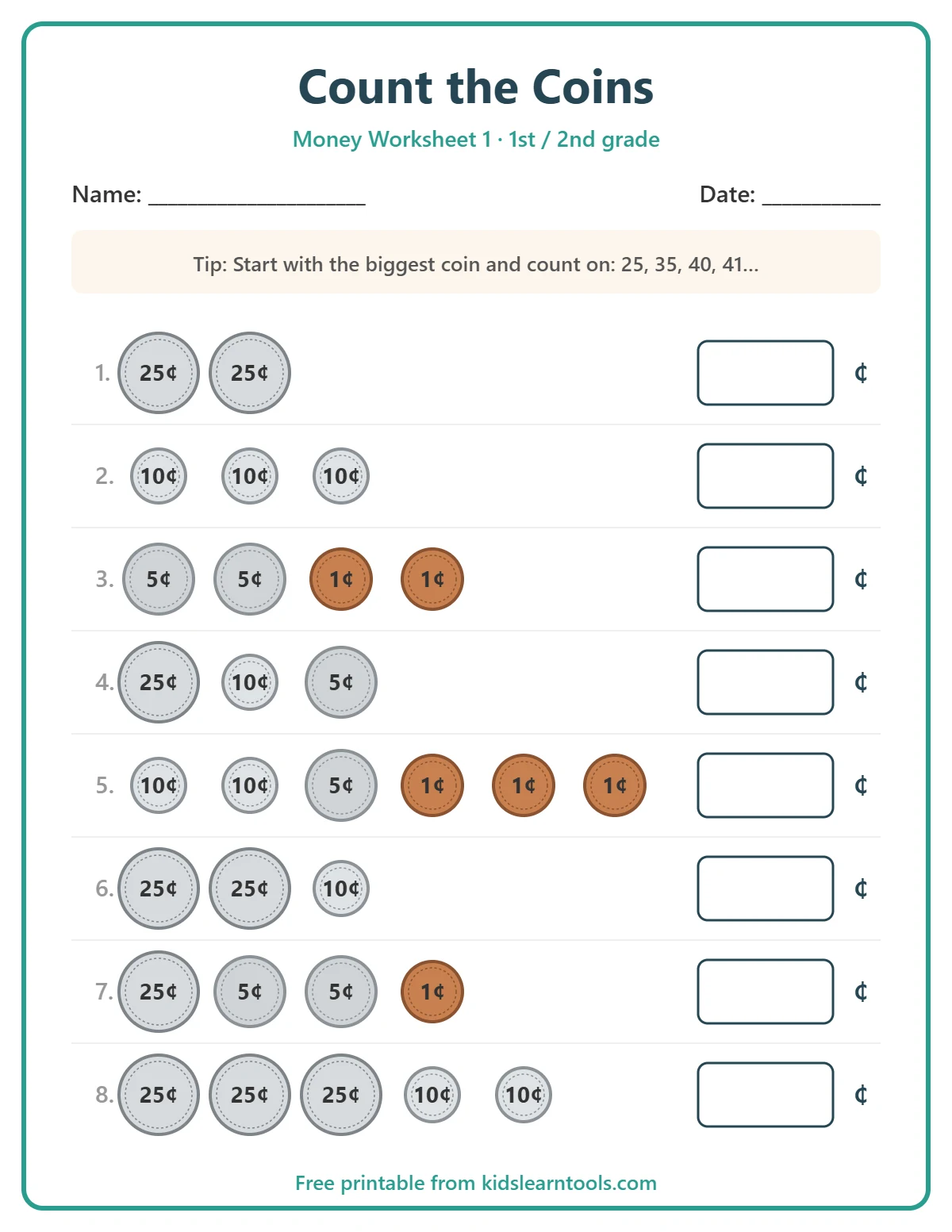
Make it hands-on: before writing each answer, let kids build the same set with real or toy coins and count it out loud. Then ask a challenge question for each row, such as “What one coin could you add to make 50¢?”
How to Teach Counting Money (Step by Step)
- Learn the coins. Spend a few days on names and values only. Play “coin detective”: hide coins in a bag and let kids identify them by touch.
- Skip count one coin type. Count dimes by 10s, nickels by 5s and quarters by 25s (25, 50, 75, 100). Practice the quarter pattern until it is automatic.
- Sort before counting. Line coins up from biggest value to smallest: quarters, dimes, nickels, pennies.
- Count on. Start with the total of the biggest coins, then keep counting on as the coin type changes: 25, 50, 60, 65, 66.
- Write it two ways. Show the same amount as cents and as dollars: 125¢ = $1.25. Explain that the dot separates dollars from cents.
- Use it in a pretend shop. Label toys with prices and let kids pay with coins and give change. This is where the skill really sticks.
| Coins | Count on | Total |
|---|---|---|
| 1 quarter, 2 dimes | 25 → 35 → 45 | 45¢ |
| 2 quarters, 1 nickel, 3 pennies | 25 → 50 → 55 → 56 → 57 → 58 | 58¢ |
| 3 dimes, 2 nickels | 10 → 20 → 30 → 35 → 40 | 40¢ |
| 4 quarters | 25 → 50 → 75 → 100 | $1.00 |
Money Worksheets for Kindergarten, 1st and 2nd Grade
Kindergarten: focus on naming coins, sorting them, and counting pennies up to 20. Money fits well alongside counting practice from our counting to 100 guide and the skills in our kindergarten math worksheets.
1st grade: count collections of the same coin, then mixed coins up to $1.00, and compare two amounts. Keep it to coins only. See how money fits the full year in our 1st grade math worksheets guide.
2nd grade: add dollar bills, write amounts with $ and ¢, solve two-step word problems and begin making change. Extra addition and subtraction practice with numbers to 100 makes money problems much faster, because every money problem is really an addition or subtraction problem.
Using Money Worksheets Outside the US
Most printable money worksheets online use US coins. If your child uses a different currency, keep the same teaching order: name the coins, learn their values, skip count, then count mixed amounts and make change. For example, Pakistani kids can count 1, 2, 5 and 10 rupee coins, and UK kids can count 1p, 2p, 5p, 10p, 20p and 50p coins. The steps, mistakes and games in this guide work the same way with any currency.
Common Money Mistakes and How to Fix Them
| Mistake | Example | Quick fix |
|---|---|---|
| Thinking bigger coins are worth more | Says a nickel is worth more than a dime | Use the “small but mighty dime” rhyme and compare 1 dime to 2 nickels |
| Counting every coin as 1 | 3 dimes = 3¢ | Skip count out loud while touching each coin |
| Starting with the smallest coin | Counts 1, 2, 7, 17, 42 and loses track | Always sort from biggest to smallest first |
| Mixing up ¢ and $ | Writes 50¢ as $50 | Show $0.50 and 50¢ side by side; the dot means “dollars before, cents after” |
| Losing count when the coin type changes | 25, 50, 51, 61 | Pause and say the new coin value before counting on |
| Making change by guessing | $1.00 − 65¢ = 45¢ | Count up from the price to the amount paid |
From My Classroom
In my eight years of teaching, my focus was always on kids who needed a little more time than their classmates. With topics like money, these kids could often name the coins but froze when they had to count a mixed handful, and many of them were too shy to say they were stuck.
What helped most was working in small peer groups and turning practice into an activity. Kids who were quiet in front of the whole class were much more willing to count coins with one or two friends, take turns and check each other’s answers. When they did well, I made sure they knew it, and that praise did more for their confidence than another worksheet would have.
I always tell parents that a friendly, patient adult changes how a child feels about math. Keep money practice playful and real, and celebrate every correct total. Confident kids keep trying, and kids who keep trying learn.
Fun Money Activities Beyond Worksheets
- Pretend shop: price toys or snacks from 5¢ to $1.00 and take turns being the shopkeeper and the customer.
- Coin rubbing: place coins under paper and rub with a crayon, then label each coin and its value.
- Race to $1.00: roll a die and collect that many pennies, trading 5 pennies for a nickel and 2 nickels for a dime, until someone reaches $1.00.
- Piggy bank count: once a week, empty a piggy bank, sort the coins and count the total together.
- Grocery helper: at the store, let kids find an item under $1.00 or compare two prices.
How Often Should Kids Practice Money?
Money practice works best in short, regular sessions. Two or three 10–15 minute sessions a week are enough for most kids, with one of them being a hands-on activity like the pretend shop. In 1st and 2nd grade, add one money word problem to your daily math warm-up, and mix in a weekly math quiz for kids to keep addition and subtraction facts sharp.
Frequently Asked Questions
At what age should kids learn about money?
Kids can start naming coins at age 4–5 in preschool and kindergarten. Counting mixed coins usually starts in first grade (age 6–7), and dollars, cents and making change are taught in second grade (age 7–8).
What is the easiest way to teach kids to count money?
Teach coin values first, then skip count one coin type at a time. For mixed coins, sort from biggest to smallest value and count on. Always practice with real or toy coins before using worksheets.
What should kids learn before money worksheets?
Kids should count to 100, skip count by 5s and 10s, and add within 20. Skip counting by 25s (25, 50, 75, 100) makes counting quarters much easier.
How do you teach making change to kids?
Use the counting up method. Start at the price and count up to the amount paid using coins. For a 65¢ item paid with $1.00, count 70, 80, 90, 100, so the change is 35¢.
Are these money worksheets free?
Yes. The coin values chart and the Count the Coins worksheet on this page are free to print for home and classroom use.
Can I use these money worksheets with other currencies?
Yes. The worksheet uses US coins, but the teaching steps work with any currency. Swap in your local coins, learn their values, then follow the same counting and making change steps.
Final Thoughts
Money worksheets work best when they follow a clear order: know the coins, skip count one coin type, count mixed coins, then make change and solve word problems. Keep sessions short, use real coins whenever you can, and connect every page to a real situation. Print the free coin chart and Count the Coins worksheet above, revisit skip counting if counting feels slow, and let your child run the pretend shop this week.