Subtraction Worksheets for Kids: Free Printables, Strategies & Regrouping Steps
Subtraction worksheets help kids practice taking away, finding the difference and regrouping, one small step at a time. Start with picture subtraction within 5, move to subtraction within 10 and 20, then two-digit subtraction without and with regrouping (borrowing). Kids learn fastest when each sheet practices one strategy, such as counting back, think-addition or a number line, for 10–15 minutes a day.
Subtraction feels harder than addition for most kids, because it asks them to think backwards. The good news is that it builds directly on what they already know. If your child is comfortable with addition worksheets and number bonds, they are ready for subtraction. This guide shows which subtraction worksheets to use at each level, the strategies behind them, a free printable practice sheet and how to fix the most common mistakes.
What Are Subtraction Worksheets?
Subtraction worksheets are printable practice pages where kids solve take-away problems, such as 9 − 4 = 5. Good worksheets do more than list problems. They move from pictures to numbers, from small numbers to big ones, and from one strategy to the next, so a child always knows how to solve the page in front of them.
Every subtraction problem has three parts. The minuend is the number you start with, the subtrahend is the number you take away, and the difference is the answer. In 9 − 4 = 5, 9 is the minuend, 4 is the subtrahend and 5 is the difference. Kids do not need these words in kindergarten, but teaching the word “difference” early helps with word problems later.
Subtraction Worksheets by Level
Use this table to pick the right starting point. If a child gets more than 3 problems wrong on a page, step back one level for a few days. That is not failure; it is how confidence is built.
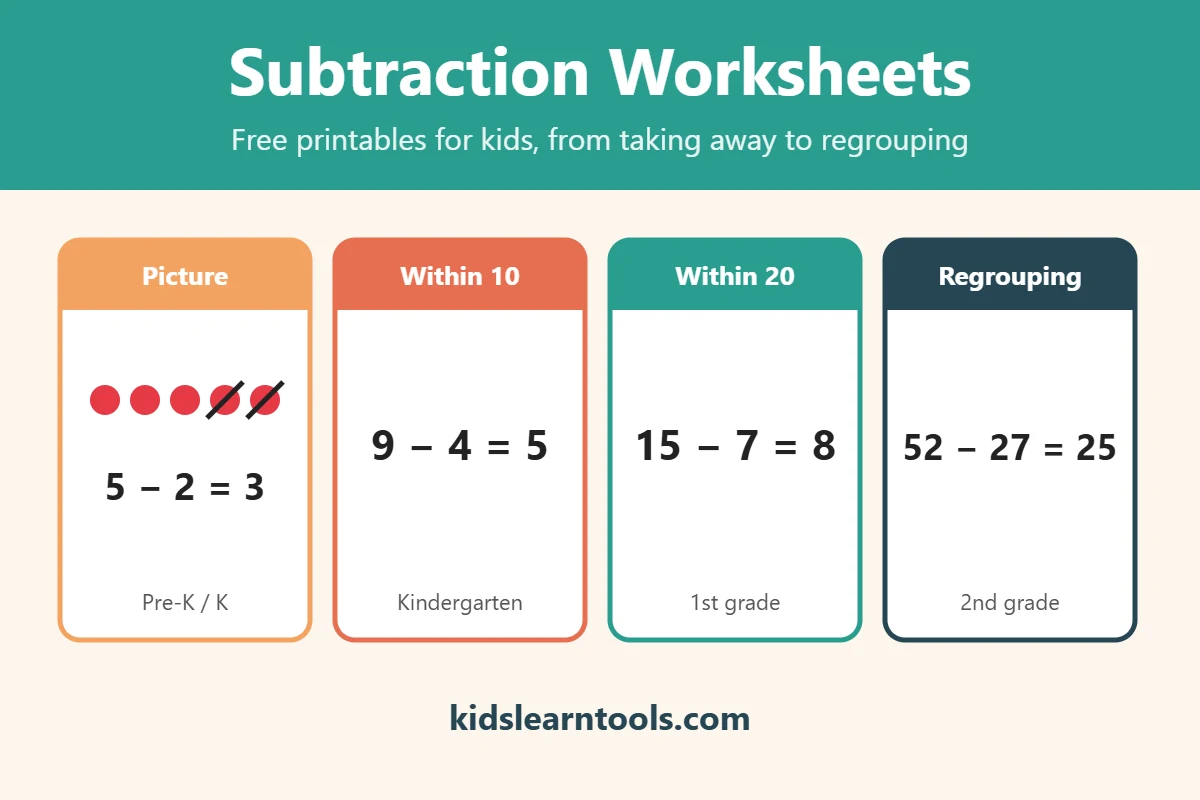
| Level | Typical grade | Example | What kids learn |
|---|---|---|---|
| Picture subtraction (within 5) | Pre-K / Kindergarten | 5 dots, cross out 2 → 3 | Take away means “fewer are left” |
| Subtraction within 10 | Kindergarten | 9 − 4 = 5 | Counting back, fact families |
| Subtraction within 20 | 1st grade | 15 − 7 = 8 | Think-addition, back through 10 |
| Two-digit, no regrouping | 1st–2nd grade | 58 − 23 = 35 | Subtract ones, then tens |
| Two-digit with regrouping | 2nd grade | 52 − 27 = 25 | Trading 1 ten for 10 ones |
| Three-digit and across zeros | 3rd grade | 400 − 156 = 244 | Regrouping across places |
| Word problems | K–3 | Sam had 8 apples and ate 3… | Choosing the right operation |
Picture Subtraction Worksheets (Within 5)
Picture worksheets show a set of objects with some crossed out, and kids count what is left. This is the best first step because the child can see the “taking away” happen. Use real objects first, like 5 crayons with 2 moved aside, then move to the paper version.
Subtraction Within 10 Worksheets
Kindergarten subtraction worksheets use numbers from 0 to 10. Kids count back on their fingers or a number line, and they start to notice patterns, such as “any number minus 0 stays the same” and “any number minus itself is 0”. Our free printable sheet below is at this level.
Subtraction Within 20 Worksheets
First grade subtraction worksheets use numbers up to 20, like 14 − 6. Counting back 6 times is slow and easy to get wrong, so this is where kids need smarter strategies: think-addition (6 + ? = 14) and going back through 10 (14 − 4 = 10, then 10 − 2 = 8).
Two-Digit Subtraction Without Regrouping
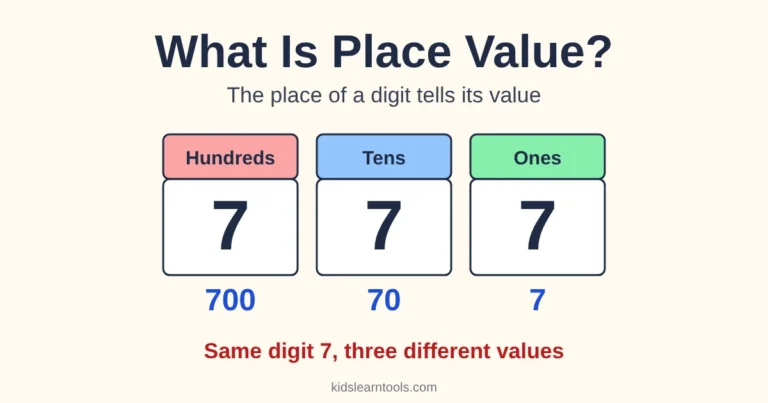
Problems like 58 − 23 teach kids to line up the tens and ones and subtract each place separately: 8 − 3 = 5 ones and 5 − 2 = 3 tens, so the answer is 35. A quick review of place value makes this level much easier.
Subtraction with Regrouping (Borrowing) Worksheets
Regrouping is needed when the ones digit on top is smaller than the ones digit below, as in 52 − 27. Kids cannot take 7 from 2, so they trade 1 ten for 10 ones. In the Common Core second grade standards, this is part of using place value to subtract within 100 and 1,000. It is also the most misunderstood subtraction skill, so we explain it step by step further down.
Subtraction Word Problem Worksheets
Word problems teach kids when to subtract, not just how. Look for key ideas like “left”, “fewer”, “how many more” and “difference”. Start with one-step stories that use small numbers and familiar things, like toys, snacks or friends.
Free Printable Subtraction Worksheet (Within 10)
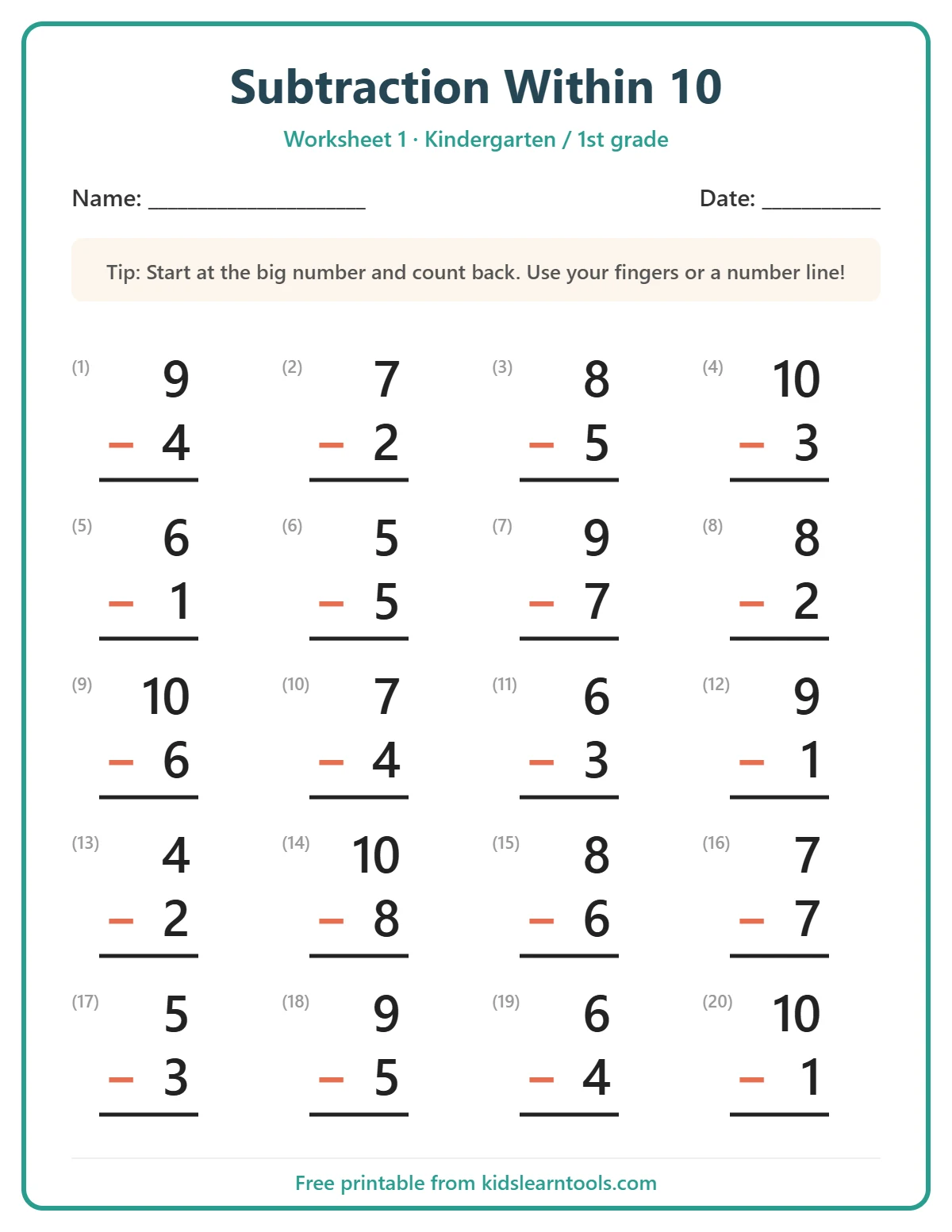
Here is a ready-to-print practice page with 20 vertical subtraction problems within 10. Right-click or long-press the image to save it, then print it on A4 or US Letter paper. It works well as a 10-minute warm-up for kindergarten and as a quick review for first grade.
Need more pages? Our free Math Worksheet Generator makes unlimited subtraction worksheets. Choose Subtraction (−), pick a number range (0–5, 0–10, 0–20, 0–100 or up to 999), set how many problems you want, and print with or without the answer key. Because every sheet is new, kids practice the skill instead of memorizing one page.
6 Subtraction Strategies Every Kid Should Know
Worksheets work best when each one practices a single strategy. Teach these in order, one or two weeks each.
- Take away with objects. Start with 7 blocks, take 3 away, count what is left. This is the meaning of subtraction.
- Count back. Start at the bigger number and count back: for 9 − 3, say “8, 7, 6”. Best for taking away 1, 2 or 3.
- Use a number line. Jump back from the first number. A number line turns counting back into a picture kids can check.
- Think addition. For 13 − 5, ask “5 plus what makes 13?” Kids who know their number bonds find this the fastest strategy.
- Go back through 10. For 15 − 7, take 5 to reach 10, then take 2 more to get 8. This is the bridge to mental math.
- Count up to find the difference. For 42 − 38, count up from 38: 39, 40, 41, 42 is 4. Great when the numbers are close together.
How to Teach Subtraction with Regrouping (Step by Step)
Regrouping, also called borrowing or trading, means breaking 1 ten into 10 ones so there are enough ones to subtract. Teach it with base-ten blocks or bundles of 10 straws before any worksheet.
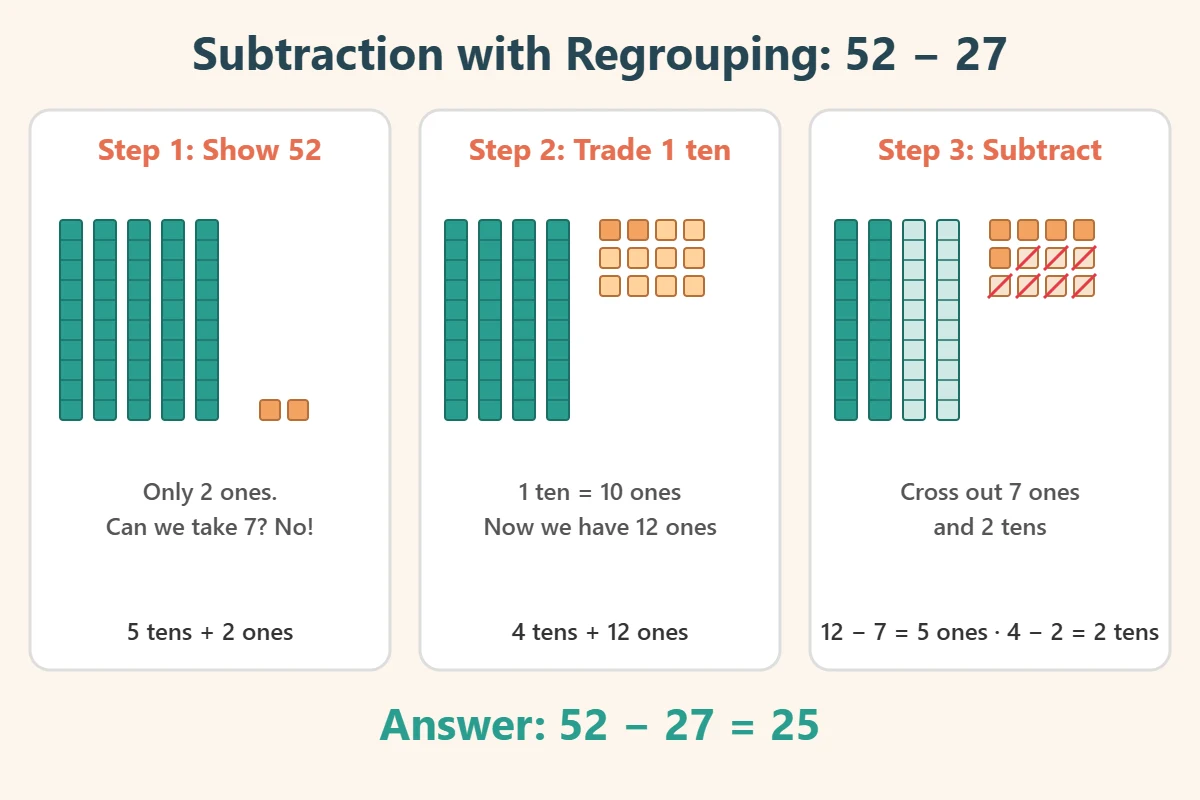
- Build the top number. Show 52 as 5 tens and 2 ones.
- Check the ones. Ask: “Can we take 7 ones from 2 ones?” No, so we need more ones.
- Trade 1 ten. Break one ten into 10 ones. Now there are 4 tens and 12 ones. On paper, cross out the 5, write 4, and write a small 1 next to the 2 to make 12.
- Subtract the ones. 12 − 7 = 5.
- Subtract the tens. 4 − 2 = 2.
- Read the answer and check it. 52 − 27 = 25. Check with addition: 25 + 27 = 52.
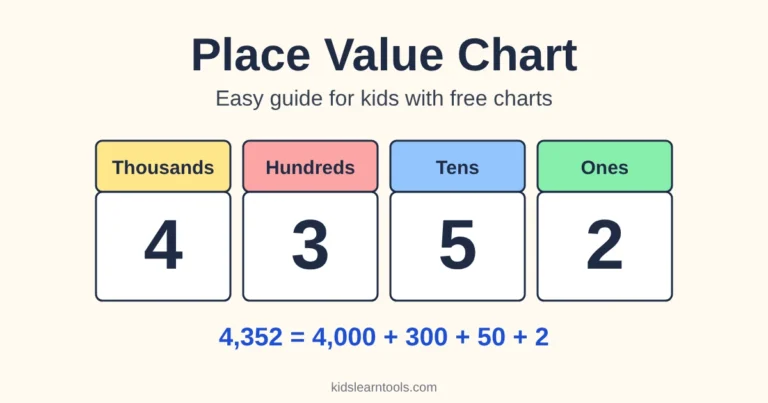
Once kids are confident, give mixed pages where some problems need regrouping and some do not. This teaches them to check first instead of regrouping every time. The place value chart is a helpful mat to keep on the desk during this stage.
Subtraction Across Zeros
Problems like 400 − 156 need two trades in a row: 4 hundreds become 3 hundreds and 10 tens, then 1 ten becomes 10 ones. Kids should only meet this after regular regrouping is easy. Saying “400 is 39 tens and 10 ones” is a shortcut many third graders like.
Subtraction Worksheets for Kindergarten and 1st Grade
In kindergarten, subtraction should feel like a story: “There were 5 birds, 2 flew away.” Kids act it out, draw it, then write it. The Common Core kindergarten standards expect kids to fluently subtract within 5 by the end of the year. See our kindergarten math worksheets for the full skill list.
In first grade, kids subtract within 20 and start two-digit subtraction with tens, like 70 − 30. Fact families are the key idea: 8 + 5 = 13, 5 + 8 = 13, 13 − 5 = 8 and 13 − 8 = 5 all belong together. Our 1st grade math worksheets guide shows how subtraction fits with the rest of the year.
| Fact family | Addition facts | Subtraction facts |
|---|---|---|
| 3, 4, 7 | 3 + 4 = 7, 4 + 3 = 7 | 7 − 3 = 4, 7 − 4 = 3 |
| 5, 8, 13 | 5 + 8 = 13, 8 + 5 = 13 | 13 − 5 = 8, 13 − 8 = 5 |
| 6, 9, 15 | 6 + 9 = 15, 9 + 6 = 15 | 15 − 6 = 9, 15 − 9 = 6 |
Common Subtraction Mistakes and How to Fix Them
| Mistake | Example | Why it happens | Quick fix |
|---|---|---|---|
| Subtracting the smaller digit from the bigger one | 52 − 27 = 35 | Child thinks “7 − 2” because 2 − 7 feels impossible | Use blocks: show that we must take 7 from the top number |
| Counting the starting number | 9 − 3: “9, 8, 7” = 7 | Child says the start number as the first count | Teach “jump first, then say the number” on a number line |
| Forgetting the traded ten | 52 − 27 = 35 (no cross-out) | Regrouped the ones but kept 5 tens | Always cross out and rewrite the tens digit |
| Lining up digits wrongly | 45 − 3 written as 45 − 30 | Place value not secure | Use grid paper or a place value chart |
| Adding instead of subtracting | 8 − 3 = 11 | Not reading the sign | Circle the sign in color before starting each row |
| Thinking 0 − 4 = 4 | 40 − 24 = 24 | Treating zero as “nothing to do” | Show 40 as 4 tens and trade 1 ten for 10 ones |
From My Classroom
Most of my eight years of teaching were spent with kids who learned more slowly than their classmates, and subtraction was often where they went quiet. Many of them were shy and would rather leave a problem blank than risk a wrong answer in front of others.
What changed this was not a new worksheet. It was involving every child in classroom activities and small peer groups, so that no one had to sit quietly on the side. Once the shy kids took part, they began to participate actively, and I saw a clear positive change in their confidence and in their work.
I learned that a friendly teacher and a supportive peer group do more for subtraction than any amount of drilling. When a child feels safe to make a mistake, they start to try, and once they try, the worksheet becomes something they can finish with pride.
How Often Should Kids Practice Subtraction?
Short and daily beats long and weekly. Here is a simple routine that fits into any school day or homeschool schedule:
- Kindergarten: 5–10 minutes a day, half with objects and half on paper.
- 1st grade: 10–15 minutes a day: 1 strategy page plus 1 mixed fact page.
- 2nd grade: 15 minutes a day, with regrouping practice 3 days a week and word problems 2 days a week.
- Every level: stop while the child still feels successful, and finish with a problem you know they can solve.
Mix in addition every few days so kids keep checking the sign. A math quiz for kids once a week is a fun way to see progress without pressure.
Fun Subtraction Activities Beyond Worksheets
- Bowling subtraction: set up 10 plastic bottles, roll a ball and write 10 − knocked down = left standing.
- Snack subtraction: count 8 raisins, eat 3, write the number sentence.
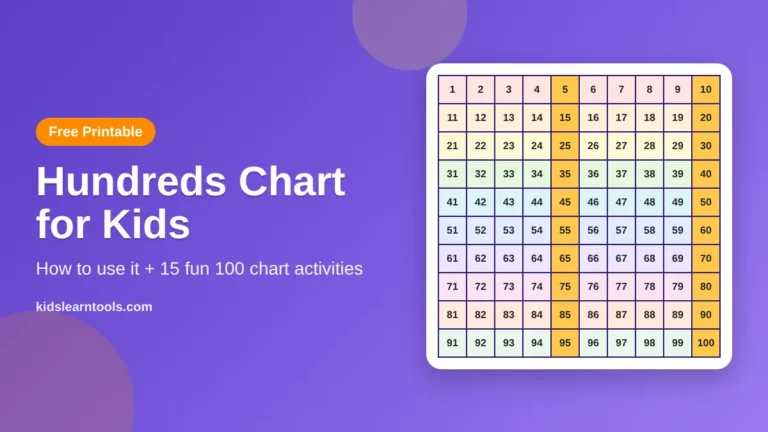
- Hundreds chart jumps: on a hundreds chart, move up one row to subtract 10 and left one box to subtract 1.
- Subtraction war: each player flips two cards and subtracts; the biggest difference wins.
- Shop game: give kids 20 pretend coins and let them “buy” toys, a natural bridge to money worksheets.
Frequently Asked Questions
At what age do kids learn subtraction?
Most kids start simple subtraction with objects at age 4–5 (preschool and kindergarten). They subtract within 20 in first grade (age 6–7) and learn two-digit subtraction with regrouping in second grade (age 7–8).
What is the easiest way to teach subtraction to kids?
Start with real objects and the idea of “taking away”, then use pictures, then numbers. Teach counting back for small numbers and think-addition for bigger ones. Keep daily practice short, around 10–15 minutes.
What is regrouping in subtraction?
Regrouping (also called borrowing) means trading 1 ten for 10 ones when there are not enough ones to subtract. In 52 − 27, 5 tens and 2 ones become 4 tens and 12 ones, so 12 − 7 = 5 and 4 − 2 = 2, giving 25.
What should kids know before subtraction worksheets?
Kids should count to 20 forwards and backwards, recognize numbers to 10 and understand “more” and “fewer”. Knowing addition facts and number bonds to 10 makes subtraction much faster.
Are these subtraction worksheets free to print?
Yes. The worksheet on this page is free for home and classroom use, and the Math Worksheet Generator on Kids Learn Tools lets you make unlimited free subtraction worksheets with answer keys.
How do I check a subtraction answer?
Add the answer to the number you took away. If you get the starting number, the answer is right. For example, 52 − 27 = 25 is correct because 25 + 27 = 52.
Final Thoughts
Subtraction clicks when kids see it, say it and then write it. Start with objects and pictures, teach one strategy at a time, and use short daily worksheets to build speed and confidence. When your child is ready for real-life practice, try counting coins and making change, which use subtraction every day. Print the free worksheet above, open the Math Worksheet Generator for more, and celebrate every small win.